Summary
- This article presents a detailed and comparative analysis of macro-economic factors, the real nature of inflation and unemployment, and the contrasting work cultures, education approaches, and employment perspectives of Hindu society and the Muslim community.
- While a nation’s macroeconomic conditions are shaped by global, geopolitical, and policy factors, the work ethics, obsession with degrees, and practical skills within different societies determine their future.
- This article highlights the stark reality that while Muslim community youth learn practical skills at a young age, respect labor, become self-reliant, and support their families, Hindu youth—bound by an obsession with lengthy degrees and white-collar jobs—remain unemployed for years and burden their parents.
- This article issues a clear call to Hindu society to shed false prestige and reform its work culture so that its youth can become economically strong and play a powerful role in nation-building.
Employment, Skills, and Social Mindset: A Path to Awakening
1. Real Economic Factors Behind Inflation and Unemployment
Discussing inflation and unemployment superficially or linking them to the family size of any particular community is entirely misleading. According to economists and statistical data, these burning issues depend on complex macroeconomic factors:
- Global and Internal Causes of Inflation: Inflation is primarily controlled by international crude oil prices, supply chain disruptions, the impact of climate change on agricultural production, and global currency fluctuations.
- Structure of Unemployment and Jobs: Unemployment in any country depends on industrial development, private and public investment opportunities, policy reforms, and the balance between market-available skills and formal education.
- Individual Life vs. Macro Economy: The size of a family or the lifestyle of a specific community does not directly dictate a nation’s macroeconomy; rather, an economy is driven by production, labor force, skills, and industrial policies.
2. Work Culture of the Muslim Community: Skills and Early Self-Reliance
Within the Muslim community, a very practical and disciplined work culture regarding employment, livelihood, and family support is evident:
- Early Financial Independence: Instead of wasting formative years acquiring formal higher education and lengthy degrees, youth in this community engage in practical vocational skills, craftsmanship, trade, or small-to-large works at a very young age.
- Immediate Financial Support for Families: Earning from a young age allows them not only to become self-reliant but also to immediately support their parents and families during financial distress.
- Respect for Labor and Business Unity: In this community, there is no hesitation regarding manual labor in traditional occupations, mechanic work, handicrafts, trade, or unorganized sector jobs. They demonstrate complete solidarity through family and social networks in promptly securing employment for their youth.
3. The Anomaly of Hindu Society: Degrees, Unemployment, and Family Burden
In contrast, modern Hindu society has become gripped by hollow and traditional beliefs regarding education and employment that have turned into heavy economic and mental crises for youth and families in today’s competitive era:
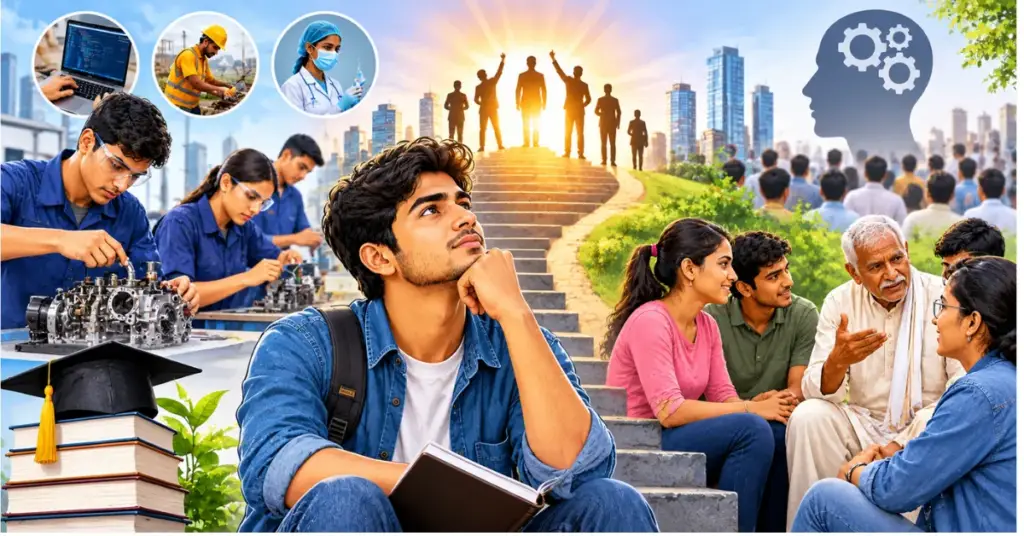
- Blind Race for White-Collar Jobs and Degrees: For a long time in Hindu society, college degrees and secure government or corporate (white-collar) jobs alone have been considered the sole benchmarks of prestige and success in society.
- Prolonged Unemployment and Parent Dependency: Due to this mental stagnation, youth spend 5 to 10 years of their youth chasing bookish degrees and competitive exam preparations. Failing to secure desired jobs, they remain unemployed for years and burden their elderly parents’ earnings.
- Aversion to Manual Labor: Physical labor, small businesses, technical craftsmanship, or ground-level work are often socially stigmatized, causing youth to shy away from working despite possessing skills—which is the biggest internal root cause of unemployment.
4. Message of Introspection and Awakening for Hindu Society
If Hindu society is to become economically strong, self-reliant, and ideologically robust, it must undergo a fundamental transformation in its priorities, mindset, and work culture:
- Abandoning Traditional Mindset and False Prestige: Society must shed the illusion that life is successful only with a big degree. Bookish knowledge is useless unless backed by solid practical skills or business acumen.
- Learning from the Example of Other Communities: Just as Muslim youth stand on their own feet and support their families by learning skills and respecting labor at an early age, Hindu youth and families must prioritize skill development, entrepreneurship, and independent trade.
- The Path of Nation-Building and Self-Reliance: When society’s youth break free from paper degrees and embrace practical proficiency, trade, and the dignity of labor, families will strengthen, and the nation’s economic fabric will grow robustly.
Conclusion
- Facing real challenges like inflation and unemployment requires society to introspect deeply on its internal structure and priorities rather than solely depending on governments.
- Discarding false prestige and lengthy degrees in favor of practical skills, early self-reliance, and the dignity of labor is the crying need of the hour.
- Hindu society must reform its work culture to transform youth from job seekers into job creators and skilled professionals. Only then can we realize the dream of a strong, self-respecting, and self-reliant India.
Think, evaluate, change your priorities, and keep the nation above all else.
🇮🇳Jai Bharat, Vandematram 🇮🇳
Read our previous blogs 👉 Click here
Join us on Arattai 👉 Click here
👉Join Our Channels👈