Summary
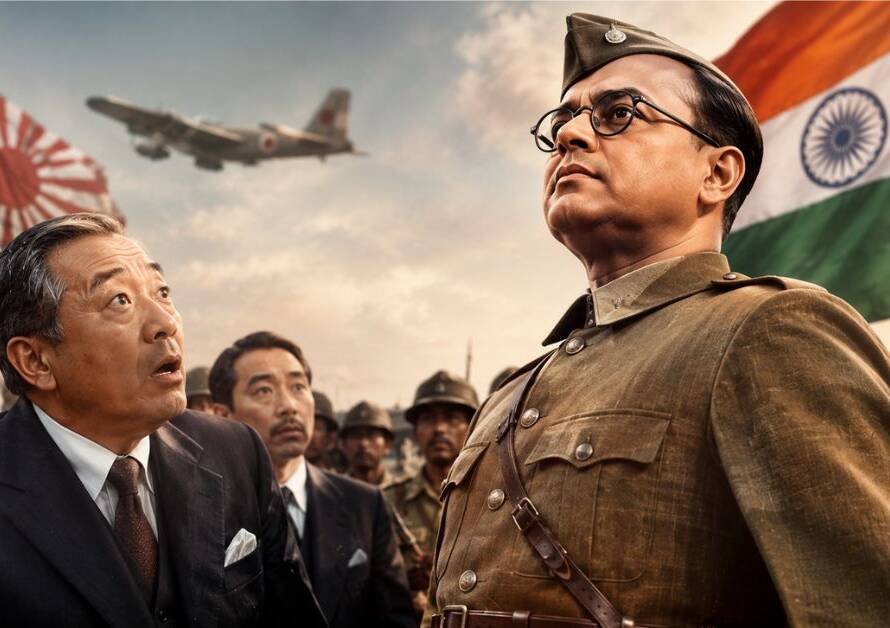
- This detailed historical narrative highlights the extraordinary courage and invincible prowess of Netaji Subhash Chandra Bose, which brought Japanese Prime Minister Hideki Tojo to his knees during World War II.
- It also sheds light on the tragic irony of Indian historiography, where the decisive military impact of the Azad Hind Fauj (INA) and nationwide armed unrest were sidelined in favor of a one-sided political narrative attributing independence solely to non-violent movements.
Subhash Chandra Bose’s Unstoppable Courage and Impact on Japanese Leadership
1. The First Encounter: When the Atmosphere in the Room Transformed
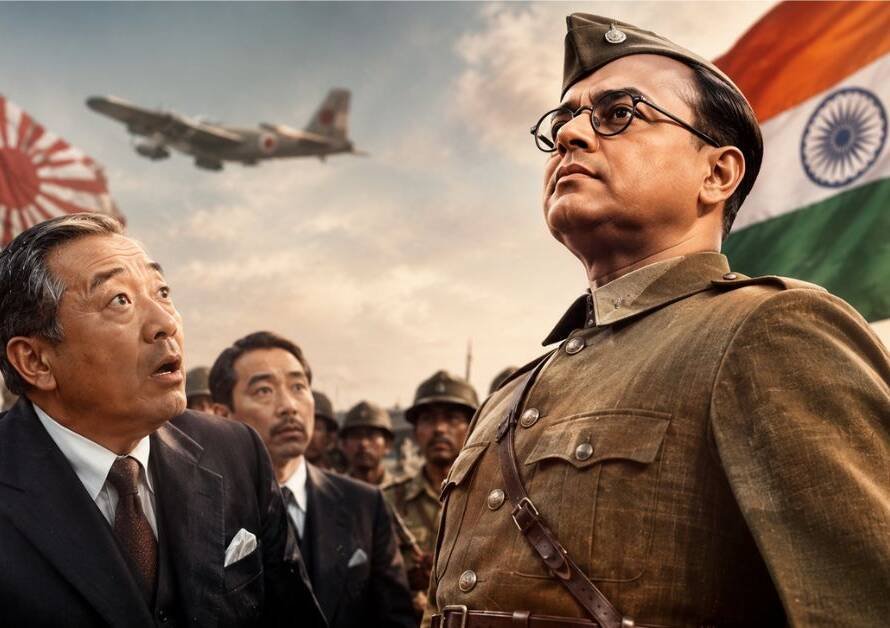
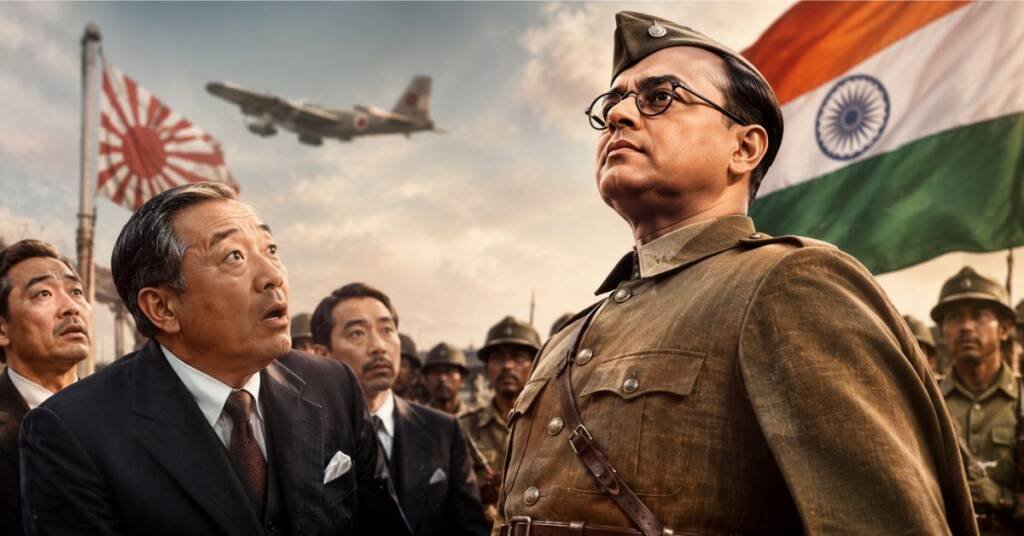
- Japan’s Preconceived Notion: When Netaji Subhash Chandra Bose arrived in Tokyo in May 1943 after a perilous submarine voyage, Japanese Prime Minister Hideki Tojo held a conventional view. He anticipated a typical colonial leader seeking assistance—someone who would plead for sympathy by detailing British atrocities.
- A Magnetic Personality: The moment Netaji stepped into the Prime Minister’s chamber, the atmosphere shifted completely. His eyes burned with an unyielding resolve to shatter the chains of colonial rule, his attire reflected military discipline, and his voice carried the roar of a sovereign nation.
- The Lion’s Roar: For the first time in his life, Tojo witnessed the self-respect and lionhearted prowess of a sovereign state within a leader from a colonized nation. The room felt occupied not by a petitioner, but by a conqueror.
2. Neither Pleading nor Begging for Aid: A Direct Invitation to History
- A Lion’s Roar Over Diplomatic Niceties: Tojo expected Bose to appeal for heavy Japanese military backing to liberate India. Instead, disregarding formal diplomatic protocol, Netaji placed his hand firmly on Tojo’s table and stated with fierce clarity:
“Whether Japan supports us or not… India will achieve independence at all costs. The only difference is whether you choose to become a part of this history or not.”
- Tojo’s Stunned Silence: This single declaration left the Japanese Prime Minister speechless. Standing before him was no ordinary politician begging for aid, but an uncompromising revolutionary set on reshaping history on his own terms.
3. Not Soldiers, But Forging Lions Out of a Nation
- Tojo’s Query: Deeply moved by this unprecedented display of strength, Prime Minister Tojo directly asked, “How much Japanese army force do you require to fight against the British?”
- Netaji’s Response: Netaji replied with a subtle smile, offering words that became immortalized in Indian freedom history:
“I do not need your army. I only need enough cooperation so that I can forge the men of my nation into lions and make the Azad Hind Fauj capable of seizing our freedom on its own.”
- Unmatched Self-Confidence: No Asian leader had ever demonstrated such immense self-belief and dignity before the Imperial Japanese Military Command. Tojo later admitted that such commanding brilliance and selfless leadership are found only among the greatest figures in human history.
4. When the Japanese Prime Minister Stood Up in Respect
- An Unprecedented Moment: As the meeting concluded, an extraordinary event occurred. Breaking all formal protocols and Japanese administrative hierarchy, Prime Minister Tojo stood up from his chair.
- Tojo’s Historic Admission: Shaking hands respectfully with Netaji, Tojo uttered words that stand as the ultimate testament to Bose’s character:
“In your presence, no one can remain neutral; one must either become your enemy or your soldier.”
- From Ally to Equal Partner: This marked the turning point when Japan recognized Subhash Chandra Bose not merely as a political leader, but as a strategic ally, an equal warrior, and the legitimate leader of an independent India.
5. The Fear of the Azad Hind Fauj: The Real Reason the British Left India
- Mass Outrage from the INA Trials: When the British attempted to court-martial Azad Hind Fauj officers (Sehgal, Dhillon, and Shahnawaz) at the Red Fort following World War II, a wave of rebellion swept across the nation.
- The Royal Indian Navy (RIN) Mutiny of 1946: Inspired by Netaji’s call and the spirit of the INA, Indian sailors (Ratings) in Bombay launched an armed revolt against the British in 1946. Discontent quickly spread to the Indian Army and the Royal Indian Air Force.
- The British Loss of Control: The British Raj realized that the 2.5 million Indian soldiers who formed the backbone of their rule were no longer loyal to the crown, having been transformed by Netaji’s fierce patriotism.
- Clement Attlee’s Admission: Former British Prime Minister Clement Attlee explicitly admitted during his 1956 visit to India that the primary reason for Britain’s withdrawal was not Gandhi’s non-violent movement, but the panic and revolt created within the armed forces by the INA, which broke the spine of British authority.
6. Distortion of History and the Void in Today’s Society
- The Irony of History Textbooks: Post-independence history textbooks focused almost exclusively on credit for freedom to non-violent movements under Gandhi and Nehru. The sacrifices of Netaji and the Azad Hind Fauj were relegated to the margins, even though the British decided to exit primarily because they could no longer contain the military threat posed by the INA’s legacy.
- Power Politics and Opportunism: Following the transfer of power, post-independence leadership prioritized political consolidation. They claimed sole credit for national independence while marginalizing the uncompromising character and patriotism exemplified by Netaji.
- Today’s Greatest Crisis—A Lack of Character: The greatest crisis facing contemporary society is the absence of leaders of Netaji’s caliber—individuals possessing uncompromising strength, selflessness, and a willingness to sacrifice everything for the nation.
- The True Price of Freedom: Modern discourse often revolves around rights and self-interest, whereas Netaji’s era produced patriots ready to lay down their lives. Until we acknowledge this historical reality, we cannot inspire the next generation with genuine nationalism and strength of character.
🇮🇳Jai Bharat, Vandematram 🇮🇳
Read our previous blogs 👉 Click here
Join us on Arattai 👉 Click here
👉Join Our Channels👈