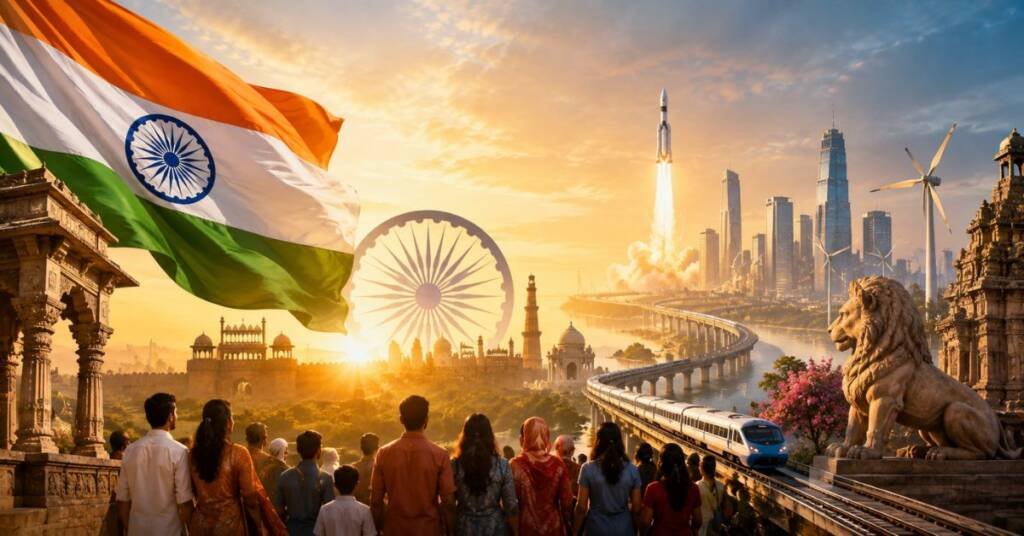
Summary
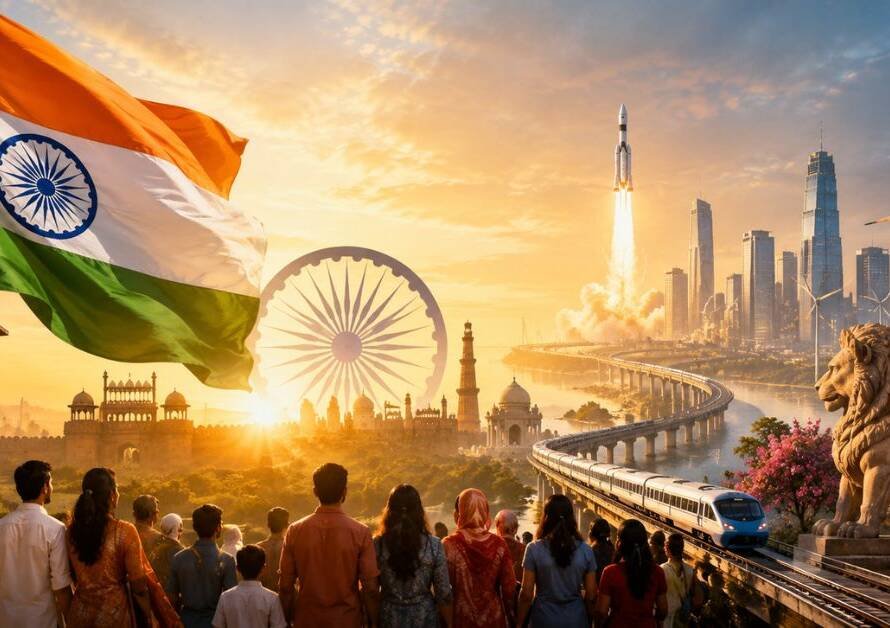
- This comprehensive historical and strategic manifesto highlights India’s resurgence, civilizational renaissance, and golden era following 2014.
- It outlines how, after ending centuries of exploitation by Mughal and British invaders and overcoming seven decades of post-independence policy paralysis, India is moving toward reclaiming its stature as a Vishwaguru (Global Leader).
- Framed through the lens of modern Chanakya-Neeti and Vidhur-Neeti, the document categorizes Prime Minister Narendra Modi’s leadership into four core pillars—Strong, Secure, Capable, and Prosperous India.
- It also details the collapse of opposition-driven narratives (e.g., EVM, EC bias, “Chowkidar Chor Hai”) and issues a call to 1.4 billion citizens to unite in restoring India as a global superpower.
- Whenever history assesses 21st-century India, the period following 2014 will be recorded not merely as a routine political transition, but as a civilizational renaissance and an era of revived national self-respect. It marked the awakening of 1.4 billion citizens who had been subjected to decades of inferiority complexes, appeasement politics, and corruption.
- A nation long portrayed on international platforms as a struggling state dependent on foreign powers has been established as a self-reliant and sovereign Vishwaguru by visionary, decisive, and dedicated leadership.
The Golden Chapter of New India: Leadership, Civilizational Renaissance, and the Changing Political Landscape
I. The 12 Historic Pillars of New India: 4 Key Dimensions
Under Prime Minister Narendra Modi’s leadership, India has achieved unprecedented progress across multiple domains. This transformation is categorized into four primary dimensions:
1. Strong & Sovereign India
- Political Revolution & End of Appeasement: Dismantled the century-old Congress system—which kept the country entangled in vote-bank politics, scams, and appeasement—through massive public mandates and nationalist policies.
- Cultural Renaissance & Ram Mandir: Re-established India’s cultural soul and national pride by facilitating the construction of the grand Prabhu Shri Ram Mandir, fulfilling 500 years of sacrifice, penance, and the faith of millions of Sanatanis.
- Surgical & Air Strikes (Krishna-Neeti): Adopted a proactive security policy (“entering the enemy’s home to strike”), delivering decisive blows to cross-border terrorists and forcing adversary nations to plead for aid globally.
2. Secure India
- Complete Integration of Kashmir: Eradicated the legacy of Articles 370 and 35A, fully integrating Kashmir as the crown jewel of India, ending decades of separatism, and ushering in peace, tourism, and development.
- Freedom from Terrorism: Secured major Indian cities from recurring bomb blasts, civilian casualties, and serial attacks, building an impenetrable internal security grid.
- Military Empowerment & Self-Reliance: Introduced Atmanirbhar Bharat in defense, equipping the armed forces with Rafale fighter jets, indigenous aircraft carriers (INS Vikrant), advanced missile systems, and strategic border infrastructure.
3. Capable & Resilient India
- Global Stature & Diplomacy: Replaced the “soft state” image with decisive diplomacy, ensuring India’s voice is respected and acted upon across international forums, including the UN, G20, and BRICS.
- Crisis Leadership & Vaccine Diplomacy: Protected 1.4 billion citizens during the COVID-19 pandemic, provided free food security, developed indigenous vaccines (Covaxin) in record time, and exported them to over 100 nations under Vasudhaiva Kutumbakam.
- Scientific Advancement: Elevated India to the forefront of space exploration by boosting scientific morale, leading to the historic landing of Chandrayaan-3 on the lunar south pole, the Aditya-L1 solar mission, and the Gaganyaan initiative.
4. Prosperous India
- Global Economic Powerhouse: Accelerated India’s GDP growth to transition the nation from the “Fragile Five” to one of the world’s top economies, establishing the country as a global hub for manufacturing and digital innovation.
- Financial Reform & Digital Revolution: Implemented structural reforms such as Demonetization, GST, and UPI to curb counterfeit currency, black money, and terror funding, building a transparent digital economy.
- Economic Security Amid Global Crises: Maintained stable domestic fuel and commodity prices through strategic foreign policy despite ongoing global wars, supply chain disruptions, and energy crises.
II. Collapse of False Narratives and the Political Decline of the Opposition
- The core reality confronting the opposition, anti-national ecosystems, and foreign-funded networks is the absence of a single alternative figure matching the current leadership’s vision, strategy, and commitment.
- When constructive ideas and policy alternatives fail, political discourse devolves into false narratives. The opposition attempted to mislead the public through several key claims:
- Raising baseless slogans such as “Chowkidar Chor Hai”, which were rejected by the electorate
- Generating fear with claims that “the country is being sold” or “the constitution is in danger”.
- Questioning democratic institutions by alleging that the Election Commission (EC) is biased and that EVMs are manipulated.
- Opposing legislative reforms and civic laws passed by Parliament to project routine governance as unlawful.
These narratives and organized campaigns have collapsed. Reliance on social media rhetoric, parliamentary disruptions, and online video commentary has failed to alter the electoral landscape. Consequently, the opposition has become disconnected from mainstream voters, placing it on a path toward political irrelevance.
III. Chanakya-Neeti, Vidhur-Neeti, and Global Leadership
In contrast to political disruptions, Prime Minister Narendra Modi continues to guide the nation by applying the principles of Chanakya-Neeti and Vidhur-Neeti:
- Transparent Administration: Established high standards of governance and administrative purity through continuous public service.
- Public Trust: Built widespread trust domestically while advancing India’s diplomatic standing internationally.
- Global Popularity: Consistently rated among the world’s most popular leaders in international surveys, with developed nations routinely seeking India’s mediation on complex global issues.
IV. Call to Citizens: The Resolve to Become ‘Vishwaguru’ Again
- Prior to nearly 2,000 years of invasions, cultural devastation, and colonial exploitation by Mughal and British forces, India existed as a prosperous, knowledgeable, and powerful global leader—a Vishwaguru.
- Invading forces looted economic resources, destroyed educational centers like Nalanda, and damaged cultural heritage. In the post-independence era, decades were lost to policy delays, governance gaps, and a lack of long-term vision.
- Today, India has a historic opportunity to reclaim its cultural, economic, and strategic standing:
- Nation First Principle: Citizens, intellectuals, and the youth are urged to prioritize national progress over individual interests.
- Countering Misinformation: Identify and intellectually dismantle misleading narratives generated by hostile networks.
- Contribution to National Development: Support the leadership’s efforts to establish India as a global economic, defense, and cultural superpower.
When a leader dedicates every moment to national development, security, and sovereignty, opposition from vested interest groups is expected.
Will those gaddars who damaged the nation now demand the resignation of such a dedicated leader?
🇮🇳Jai Bharat, Vandematram 🇮🇳
🇮🇳 जय भारत, वन्देमातरम 🇮🇳
Read our previous blogs 👉 Click here
Join us on Arattai 👉 Click here
👉Join Our Channels👈