Summary
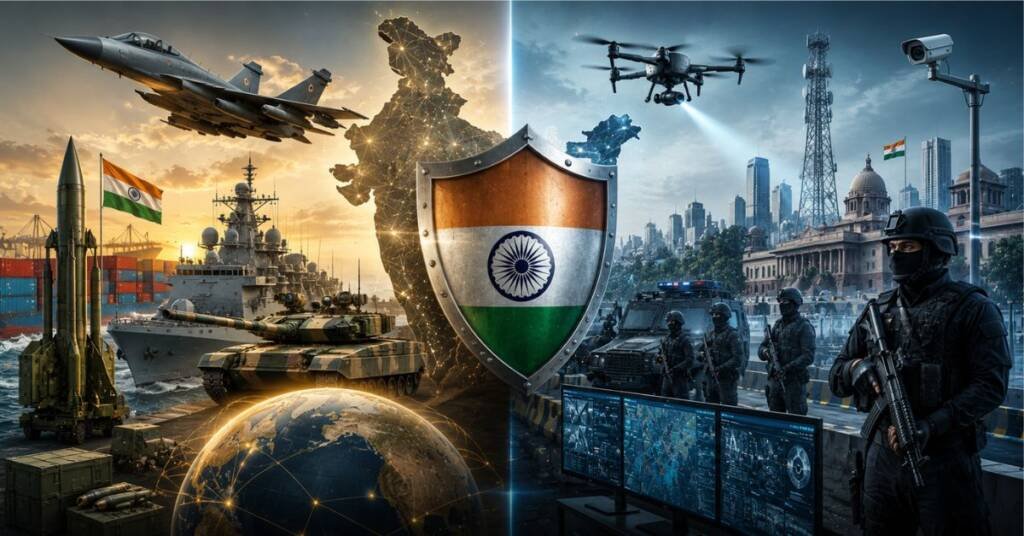
- This comprehensive commentary analyzes the strategic evolution of India’s national security framework over the last decade.
- It details India’s rapid transition from a net defense importer into a global exporter of high-tech defense systems like Akash and BrahMos, supported by aggressive domestic manufacturing reforms (Atmanirbhar Bharat).
- Furthermore, it evaluates the two-pronged national security doctrine designed to maintain external border deterrence while addressing complex internal subversive threats strictly through constitutional, intelligence-led, and legal mechanisms.
India’s Dual Security Doctrine: Defense Exports and Internal Security
I. The Global Paradigm Shift: From Net Importer to Weapons Exporter
For decades, India was classified as one of the world’s largest importers of defense hardware, heavily reliant on foreign Original Equipment Manufacturers (OEMs) for basic military logistics and frontline combat platforms. Over the past ten years, a deliberate policy pivot toward strategic self-reliance (Atmanirbhar Bharat) has fundamentally reversed this dynamic. India has converted its defense sector from a major consumer of global arms into an emerging supplier of advanced missile systems, artillery platforms, avionics, and radar technology.
Key Highlights of the Transformation:
- Global Acceptance of Flagship Systems: Indian defense hardware is actively operationalized by sovereign foreign militaries. The Armenian Armed Forces are undergoing training on the Indian Akash Air Defense Missile System, while the Philippines has integrated BrahMos supersonic cruise missiles into its coastal defense infrastructure.
- Overcoming Basic Hardware Dependence: In previous decades, India imported basic military logistics, including army transport trucks, ballistic helmets, and body armor, at inflated prices. Today, Indian-manufactured body armor and high-grade protective helmets are exported to armed forces across multiple continents.
- Supply Chain Reversal with Israel and Western Nations: During the 1999 Kargil Conflict, India faced acute ammunition shortfalls and required emergency imports of 155mm artillery shells from Israel. Today, that supply chain is reversed: India exports high volumes of 155mm artillery shells back to Israel and various European nations.
- Penetrating Global High-Tech Ecosystems: Indian defense manufacturers now supply avionics, flight controllers, navigation modules, thermal imaging cameras, military drones, and structural aerospace components to tier-1 defense contractors in over 100 countries, including the United States and members of the European Union.
II. Economic Milestones and Structural Policy Catalysts
The rapid expansion of India’s defense industrial base is backed by unprecedented fiscal growth and fundamental structural reforms. By combining policy mandates with public-private integration, the government has created a self-sustaining defense manufacturing ecosystem.
Fiscal and Industrial Highlights:
- Record Defense Exports: India’s defense exports reached an all-time high of ₹38,424 crore in Financial Year 2025–26, marking a 62.6% year-on-year increase from ₹23,622 crore in FY 2024–25. Over the last decade, defense exports have expanded more than 30-fold.
- Domestic Production Surge: Total domestic defense production crossed ₹1.54 lakh crore in FY 2024–25, driven by a combination of Defense Public Sector Undertakings (DPSUs) and private manufacturers.
- Public-Private Synergy: In FY 2025–26, DPSUs accounted for 54.8% (₹21,071 crore) of total exports, while private sector enterprises contributed 45.2% (₹17,353 crore), demonstrating the integration of private industry into global defense supply chains.
Core Policy Drivers:
- Capital Procurement Reservation: Up to 75% of the Ministry of Defense’s capital procurement budget has been reserved specifically for domestic defense enterprises, creating guaranteed domestic demand.
- Corporatization of Legacy Systems: Transforming 41 legacy Ordnance Factories into seven autonomous, corporate-style DPSUs streamlined operational efficiency, improved product quality control, and granted export autonomy.
- Defense Industrial Corridors (DICs): Dedicated corridors established in Uttar Pradesh and Tamil Nadu have concentrated component supply chains, specialized testing facilities, advanced R&D, and manufacturing infrastructure.
- Startup Ecosystem Integration: Initiatives such as Innovations for Defence Excellence (iDEX) and the Technology Development Fund (TDF) actively fund hundreds of defense startups, introducing artificial intelligence, robotics, electronic warfare, and drone technologies into military production.
III. Protecting the Realm: External Border Deterrence
National economic growth and defense export capacity are directly connected to border security and strategic autonomy. India’s external defense posture has shifted from reactive border management to proactive deterrence.
Strategic Objectives and Measures:
- Border Infrastructure Expansion: Comprehensive upgrades to border logistics—including all-weather mountain tunnels, high-altitude roads, strategic bridges, and forward airbases along the Line of Actual Control (LAC) and Line of Control (LoC)—have accelerated troop deployment capabilities.
- Naval Power Projection and Indigenous Platforms: The commissioning of aircraft carriers like INS Vikrant, alongside nuclear-powered submarines and stealth frigates, secures vital Sea Lines of Communication (SLOCs) across the Indian Ocean Region.
- Shielding Strategic Autonomy: Indigenous production of critical platforms insulates India’s combat readiness from foreign supply chain bottlenecks, geopolitical shifts, or international sanction regimes during crises.
IV. Safeguarding Internal Stability Within Constitutional Frameworks
A resilient national security posture requires addressing internal subversive elements, radicalization, and anti-national activities that target domestic stability. As a constitutional democracy, India manages internal threats through institutional intelligence, statutory enforcement, and strict adherence to the rule of law.
Core Frameworks for Internal Security:
- Institutional Counter-Subversion: Law enforcement and intelligence bodies, including the National Investigation Agency (NIA) and the Enforcement Directorate (ED), target illegal financial networks, terror financing pipelines, organized crime syndicates, and radicalization networks through systematic investigation.
- State Monopoly on Lawful Force: In a constitutional democracy, countering internal threats remains the sole prerogative of the state. The legal framework ensures that investigation, prosecution, and neutralization of unlawful activities are executed by statutory law enforcement rather than vigilante action or societal polarization.
- Role of Civil Society and Public Vigilance: Citizens contribute to national security by exercising civic vigilance, reporting suspicious or unlawful activities to appropriate authorities, and resisting extremist propaganda. Preserving social harmony and strengthening community resilience prevent internal fragmentation and reinforce national unity.
V. Strategic Synthesis: The Pathway Ahead
India’s national security strategy operates as an integrated system: robust military deterrence along external borders, constitutional enforcement against internal subversion, and an expanding defense-industrial base that projects economic and strategic influence globally.
Key Strategic Takeaways:
- Defense as an Economic Engine: Defense manufacturing has evolved from a severe drain on foreign exchange reserves into a key export sector and a cornerstone of national industrial capability.
- Diplomatic Leverage: Supplying air defense, missile systems, and artillery establishes India as a security partner across the Indo-Pacific, Caucasus, and broader Global South.
- Institutional Resilience: Protecting the nation from internal threats via statutory channels ensures that domestic stability and the rule of law remain firm as India expands its global footprint.
🇮🇳Jai Bharat, Vandematram 🇮🇳