Summary
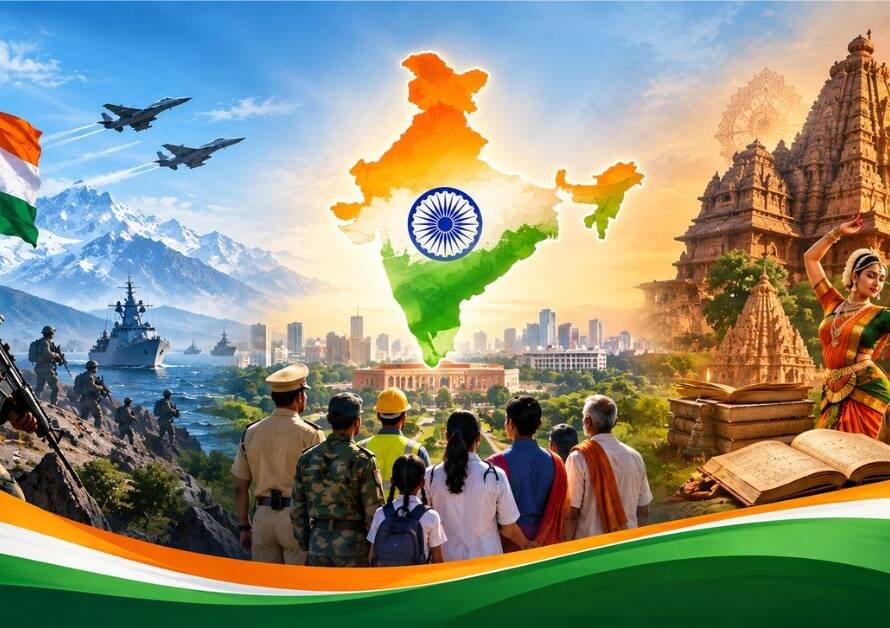
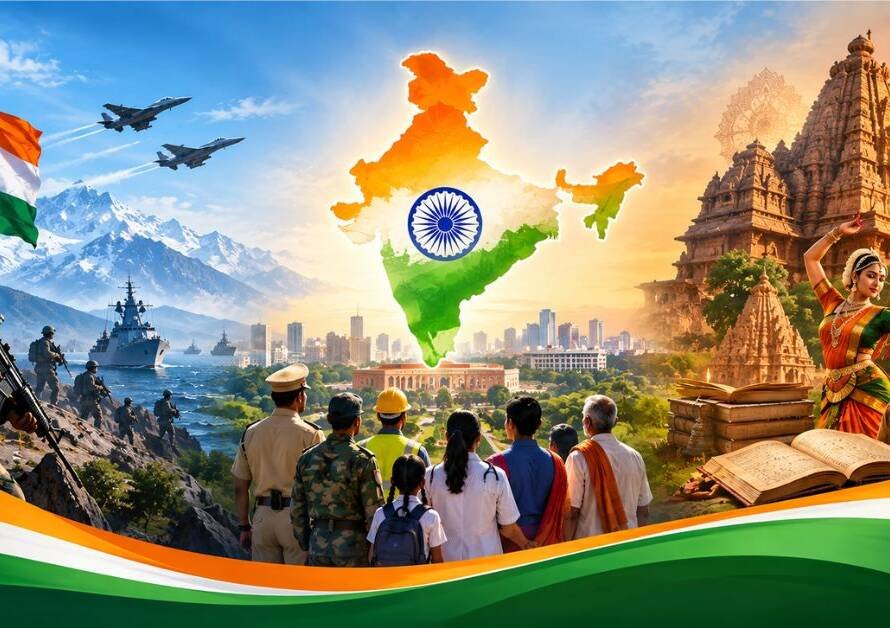
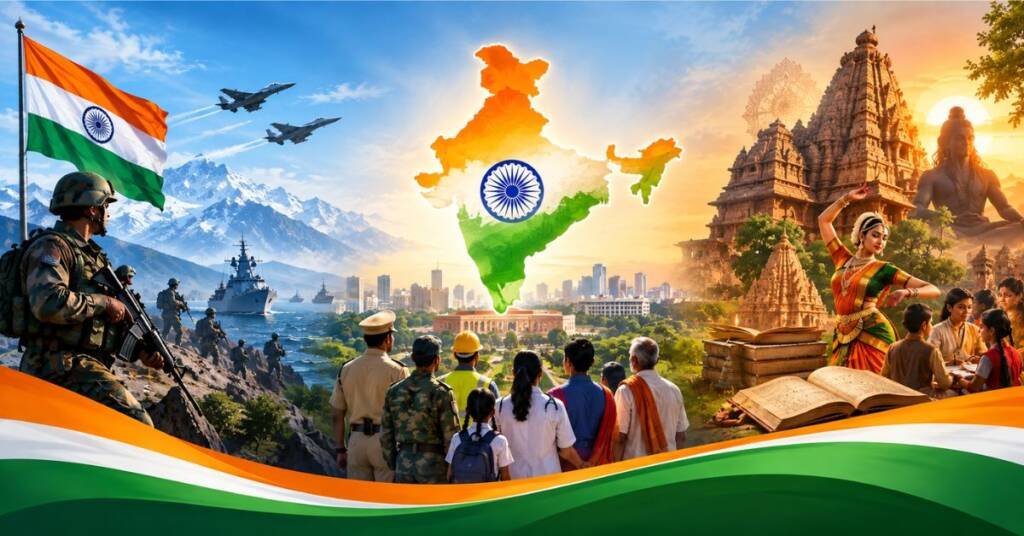
- Under the leadership of Prime Minister Narendra Modi, India’s national doctrine has undergone a historic and structural transformation. Shifting away from a purely defensive or reactive posture, the nation is now focusing on Strategic Autonomy, institutional modernization, zero-tolerance against extremism, and the resurgence of its civilizational identity.
- On the global stage, amid Western sanctions and the uncertainty of the US Dollar, India has introduced a new model of ‘De-dollarization’ through the Special Rupee Vostro Account Mechanism.
- By utilizing triangular trade settlements with countries like Russia, Bangladesh, and Bhutan, India is securing its economic sovereignty. In the realm of internal security, under the national counter-terrorism doctrine ‘PRAHAAR’, the ecosystem of terrorism, digital radicalization, and extremist networks is being comprehensively dismantled.
- Simultaneously, through new legal frameworks like the Bharatiya Nyaya Sanhita, the abrogation of Article 370, and the restoration of cultural corridors like Kashi, Ujjain, and Ayodhya, India is strengthening its administrative, legal, and civilizational foundations.
This doctrine sends a clear message: India is no longer a mere spectator on the international financial and geopolitical stage, but an active, primary agenda-setter.
India’s New Strategic Approach
1. Geoeconomic Engineering & Financial Sovereignty
- Special Rupee Vostro Account System (SRVA): Launched by the Reserve Bank of India (RBI) in July 2022, the Special Rupee Vostro Account mechanism is fully insulated from Western sanctions. When SWIFT sanctions were imposed on Russia, this system allowed foreign banks to open rupee-denominated accounts in Indian banks and conduct trade directly.
- Triangular Trade & Debt Settlement Model: Large-scale crude oil imports from Russia generated a surplus of billions of rupees in Russian Vostro accounts within Indian banks. Russia is transferring these accumulated rupees to Bangladesh’s accounts, allowing Bangladesh to service its loan installments for the $12 billion Rooppur Nuclear Power Plant (Rooppur NPP).
- Balancing Trade Deficits and Forex Reserves: Through this arrangement, Bangladesh offsets its $8 billion import deficit with India in rupees without spending US Dollars. This significantly reduces pressure on the foreign exchange reserves of regional neighbors like Bangladesh and Bhutan.
- Insulation from Western Sanctions: All settlements take place entirely within India’s domestic banking network and national clearing houses. Bypassing the US Federal Reserve and European clearing systems ensures this framework remains completely free from the impact of secondary Western sanctions.
2. Physical & Military Deterrence: Border Security and Defense Self-Reliance
- Integrated Theater Commands and CDS: The creation of the Chief of Defence Staff (CDS) position aims to integrate the Indian Army, Navy, and Air Force into unified theater commands, ensuring swift, synchronized military action during high-intensity conflicts.
- Vibrant Villages Programme (VVP): Reversing historical policies of keeping border regions undeveloped, infrastructure, digital connectivity, and economic activities are being aggressively expanded in frontier villages along the Line of Actual Control (LAC). These settlements now serve as primary nodes for surveillance and forward territorial defense.
- Defense Self-Reliance (Atmanirbhar Bharat): To curb reliance on foreign military imports, import bans have been placed on hundreds of defense platforms. Indigenous aircraft carriers (INS Vikrant), Tejas fighter jets, and advanced artillery systems like ATAGS are being manufactured domestically.
- Maritime Security in the Indian Ocean (SAGAR): Under the ‘SAGAR’ (Security and Growth for All in the Region) vision, India has emerged as a primary net security provider in the Indian Ocean Region (IOR), safeguarding international sea lanes of communication.
3. Internal Security Framework: The ‘PRAHAAR’ Doctrine and Elimination of Extremism
- National Counter-Terrorism Policy ‘PRAHAAR’: India’s comprehensive national counter-terrorism policy, ‘PRAHAAR’, establishes a unified framework built on intelligence-led prevention and rapid tactical response.
- Multi-Agency Intelligence Fusion: Through the Multi-Agency Centre (MAC) and the Joint Task Force on Intelligence (JTFI) under the Intelligence Bureau, real-time intelligence is shared seamlessly between state police forces and central agencies.
- Eradication of Extremist Infrastructure: Under the Unlawful Activities (Prevention) Act (UAPA), nationwide bans have been enforced on organizations like the Popular Front of India (PFI) and affiliated radical modules. The goal is to completely dismantle the ecosystem supporting pan-Islamist ideologies and secessionist networks.
- Digital and Financial Interdiction: The National Investigation Agency (NIA) and Enforcement Directorate (ED) monitor crypto-wallet tracking, dark-web crowdsourcing, and social media channels spreading digital radicalization to block illicit funding streams.
- Community-Based Counter-Radicalization: Under the ‘PRAHAAR’ doctrine, targeted interventions involving police, community leaders, non-governmental organizations, and structured rehabilitation programs work to steer targeted youth back into the national mainstream.
4. Legal Reforms, Administrative Integration, and Civilizational Resurgence
- Administrative Integration of Jammu & Kashmir: The abrogation of Article 370 dismantled decades-old special constitutional status and structures of political separatism. The region has been fully integrated into India’s core administrative and legal framework, accelerating economic development and security.
- Decolonized Legal Framework: Replacing colonial-era penal codes, modern legislative frameworks like the ‘Bharatiya Nyaya Sanhita’ (BNS) have been enacted. These laws prioritize national sovereignty, enforce strict measures against terrorism-related offenses, and ensure high conviction rates through streamlined judicial processes.
- Revival of Cultural Corridors: State-supported projects have restored massive cultural and spiritual landmarks, including the Kashi Vishwanath Corridor, Ujjain’s Mahakal Lok, and the Shri Ram Janmabhoomi Temple in Ayodhya. These sites have re-emerged as vibrant epicenters of civilizational heritage, national pride, and local economic growth.
- Decolonization of the Education System: Dismantling the remnants of colonial-era educational frameworks, the National Education Policy integrates ancient Indian knowledge systems, classical sciences, authentic history, and stories of indigenous national heroes into the curriculum.
- India’s new strategic doctrine demonstrates that national security extends far beyond defending borders.
- It represents a unified synthesis of geoeconomic innovation (Rupee Trade), formidable military infrastructure, robust internal security under the ‘PRAHAAR’ policy, and civilizational consciousness.
- Driven by economic efficiency, legislative rigor, and forward-looking policies, India has established itself on the world stage as an autonomous and leading global agenda-setter.
🇮🇳 Jai Bharat, Vandematram 🇮🇳
Read our previous blogs 👉 Click here
Join us on Arattai 👉 Click here
👉Join Our Channels👈
Reads & Views: 30