Summary:
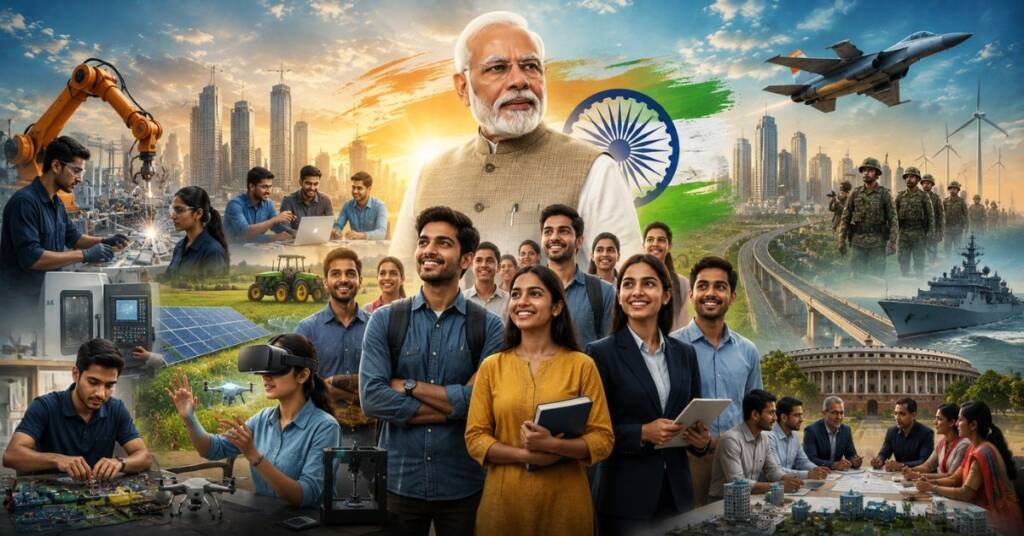
- This comprehensive strategic blueprint outlines an actionable roadmap for state governments across Bharat to systematically engage, skill, and protect Gen-Z (youth aged 16 to 35).
- By fusing Prime Minister Narendra Modi’s direct, unmediated communication model with robust institutional state frameworks—such as Uttar Pradesh’s pioneering Integrated Youth Policy—it establishes a potent counter-strategy against anti-national subversion, narrative manipulation, and political incitement.
- By embedding mandatory, industry-aligned vocational skilling under NEP 2020, facilitating collateral-free credit through Pradhan Mantri MUDRA Yojana to nurture job creators (Rojgar Data), deploying young IAS/IPS officers into schools for direct mentorship, and integrating structured civic and value-based education, state governments can successfully convert Bharat’s vast demographic dividend into an unbreakable pillar of national resilience, economic sovereignty, and global leadership.
The Modi Model: Youth Engagement, Vocational Skilling and Institutional Governance
1. The Modern Vulnerability Landscape: Subversion, Hybrid Warfare, and Narrative Manipulation
In contemporary geopolitics and domestic governance, Gen-Z represents both India’s greatest strength and a prime demographic target for non-state actors, radical agitators, and political subversion networks seeking to engineer public discontent and civil disruption.
- High-Value Target Demographic: With millions of young citizens entering the workforce and electoral rolls every year, Gen-Z possesses immense collective energy. Subversive networks actively seek to hijack this energy to alter political trajectories, block infrastructure projects, and engineer street mobilization.
- Algorithmic Manipulation and Echo Chambers: Today’s youth consume information primarily through short-form, algorithmically driven digital channels. Foreign and domestic narrative warfare campaigns exploit these platforms to spread coordinated disinformation, creating artificial outrage, cynicism, and social polarization.
- Exploitation of Transition Anxiety: Natural structural anxieties regarding examination pressure, rapidly shifting global job markets, and socio-economic mobility are actively weaponized by fringe organizations to delegitimize public institutions and incite civil disobedience.
- The “Color Revolution” Template: Globally, non-state actors leverage student bodies and engineered social media outrage to paralyze state machinery. Anti-national networks attempt to replicate these templates within India by magnifying local grievances into anti-establishment movements.
2. The “Modi Model”: Direct, Unmediated Youth Connection Across All States
To counter stealth subversion and eliminate communication voids, all state governments must abandon distant, top-down administrative models and adopt the direct, empathetic, and participatory engagement framework established by Prime Minister Narendra Modi.
- Direct Dialogue Platforms: Replicating large-scale interactive platforms like Pariksha Pe Charcha, Mann Ki Baat, and youth parliaments builds a transparent, two-way feedback loop between top constitutional leadership and young citizens.
- Preempting Narrative Voids: Maintaining continuous, open, and honest communication with youth prevents agitational networks from exploiting information gaps or distorting government policies for political gain.
- Dignity of Labour and Aspirational Framing: The Modi Model actively elevates technical trades, micro-entrepreneurship, and innovation, changing the societal mindset from passive job-seeking to active value creation.
- A Shared National Vision (Viksit Bharat @ 2047): Aligning youth aspirations with tangible national milestones ensures young citizens view themselves as active co-creators of a sovereign, economically dominant, and self-reliant nation.
3. Institutionalizing Inclusion: UP’s Integrated Youth Policy & State Youth Commission
Uttar Pradesh’s proactive youth engagement framework provides an actionable administrative template for state governments seeking to transform potential youth frustration into structured nation-building.
- Independent State Youth Commission: Establishing a dedicated, expert-led State Youth Commission provides a permanent mechanism to monitor, evaluate, and upgrade youth-centric policies based on real-time ground realities across all districts.
- Bottom-Up Policy Formation: Rather than imposing bureaucratic assumptions, the policy continuously absorbs direct suggestions from students, research scholars, rural athletes, startup founders, and vocational trainees.
- District-Level Youth Platforms (Youth Addas): Setting up physical and digital hubs at the district level provides safe, constructive spaces where youth can access career guidance, discuss local governance, and collaborate on community initiatives.
- Centralized Digital Empowerment: Single-window digital platforms streamline access to competitive exam coaching, scholarships, skill certifications, apprenticeships, and job placements, completely eliminating bureaucratic friction and corruption.
4. Demystifying Authority: IAS/IPS Mentorship and ‘Officers at Your Door’
Radicalization and anti-establishment narratives rely heavily on painting the state machinery as distant, uncaring, or predatory. Deploying young administrators directly into educational institutions systematically dismantles this construction.
- The ‘Officers at Your Door’ Initiative: Conducting mandatory monthly interactive sessions where young IAS, IPS, and IFS officers visit high schools and colleges humanizes state leadership and builds deep civic trust.
- Inoculation Against Anti-Establishment Propaganda: When students engage directly with district leadership on career planning, law enforcement, and governance challenges, they develop a realistic understanding of administration, rendering them immune to subversive propaganda.
- Competitive Guidance and Stress Management: Administrators offer practical strategies for national competitive examinations (UPSC, JEE, NEET) through expanded state networks like the Chief Minister Abhyudaya Coaching Scheme, while actively addressing mental health, cyber hygiene, and stress management.
- Restoring Faith in Meritocracy: Open interactions with young administrators reinforce student faith in constitutional institutions, public examination integrity, and rule-of-law frameworks.
5. Mainstreaming Vocational Skilling & Frontier Tech under NEP 2020
The National Education Policy (NEP 2020) provides the master framework to shift Indian education away from outdated, purely theoretical degree-seeking toward practical, industry-aligned competency and economic self-sufficiency.
- Early Vocational Integration: Schools must embed practical hands-on modules in electronics, coding, financial literacy, agricultural technology, and digital tools starting in middle school, dismantling the stigma around vocational work.
- Frontier Industry Focus: Vocational skilling curricula must aggressively prioritize Industry 4.0 sectors, including Artificial Intelligence (AI), Robotics, Drone Technology, Data Analytics, Cyber Security, Semiconductors, and Renewable Energy.
- Upgraded ITIs & Industry Hubs: Modernizing Industrial Training Institutes (ITIs) through hub-and-spoke models directly connects classroom learning with local industrial hubs for mandatory apprenticeships and immediate job readiness.
- Global Workforce Positioning: Aligning state skilling standards with international certification benchmarks prepares Indian youth to fill massive skilled labor shortages across the global economy.
6. From Job-Seekers to Job-Creators: Capitalizing on MUDRA and Credit
Redirecting youth ambition away from passive waiting lists for government jobs toward active enterprise creation generates sustainable economic momentum and eliminates the frustration born of unemployment.
- Unlocking Collateral-Free Credit (PMMY): State governments must aggressively educate youth on the Pradhan Mantri MUDRA Yojana (PMMY), which provides collateral-free financial support up to ₹20 lakh across structured tiers (Shishu, Kishore, Tarun, and Tarun Plus).
- Frictionless Micro-Financing (Sifr Credit Barriers): Expanding simplified digital application portals (like UdyamiMitra) drastically reduces bureaucratic delays, providing young entrepreneurs fast access to capital for micro-manufacturing, retail, services, and local tech ventures.
- District Startup Incubation: Establishing incubation centers in every district equips MUDRA beneficiaries with practical accounting, legal, branding, and market-access mentorship, ensuring new micro-enterprises scale sustainably and generate local employment.
- High-Value Service & Agri-Tech Addition: Guidance must focus on high-margin sectors—such as food processing, cold-chain logistics, digital content creation, specialized consulting, and export-oriented cottage industries—turning traditional trades into lucrative businesses.
7. Civic and Value-Based Education: Building Character and Patriotic Citizenship
Economic capability without moral grounding leaves a society vulnerable to internal erosion, ethical decay, and ideological manipulation. Character-building must form an core pillar of mainstream education.
- Constitutional Rights and Duties (Kartavya Bodh): School and university curricula must actively teach fundamental duties alongside constitutional rights, instilling deep respect for the rule of law, public property, and civic responsibility.
- Moral Fortitude and Anti-Addiction: Dedicated modules on ethics, integrity, and community service build internal resilience against cybercrime, corruption, and substance abuse—a major vector used by anti-social elements to ruin youth potential.
- Sports Infrastructure for Community Health: Developing playgrounds in every Gram Panchayat, mini-sports complexes at the block level, and district Centers of Excellence provides healthy physical outlets, keeping youth anchored in discipline and teamwork.
- Cultural Consciousness and Heritage Pride: Teaching India’s rich history, scientific legacy, and philosophical traditions fosters national pride, insulating youth from divisive, regionalist, or sub-national narratives.
8. Strategic Takeaway: Converting Demographic Dividend into National Sovereignty
When state governments across Bharat synthesize this integrated approach—combining direct Modi-style leadership engagement, institutional feedback mechanisms, NEP-aligned vocational skilling, aggressive awareness of entrepreneurial credit schemes, and value-based character education—they achieve a fundamental, permanent transformation.
- Eradication of Structural Unemployment: Youth transition from passive job-seekers waiting endlessly for government employment into self-reliant, confident job creators (Rojgar Data).
- Cognitive Immunity Against Subversion: Ethically grounded, economically thriving, and directly connected young citizens become completely immune to agitational politics, street violence, and anti-national narrative manipulation.
- The Unstoppable Engine of Viksit Bharat: This holistic model converts Bharat’s demographic weight into an unbreakable foundation for national security, economic dominance, and global leadership through 2047 and beyond.
🇮🇳Jai Bharat, Vandematram 🇮🇳
Read our previous blogs 👉 Click here
Join us on Arattai 👉 Click here
👉Join Our Channels👈