Summary
- This comprehensive analysis evaluates the defining duality of contemporary India’s national trajectory: the contrast between heightened political friction and unprecedented economic and technological advancement.
- Over the past twelve years, India has undergone a profound structural shift driven by administrative reforms, digital public infrastructure, tax formalization, and deep-tech scaling.
- This narrative examines how political maneuvers—including narratives surrounding “Regime Change,” agitations, and deliberate attempts to delegitimize democratic institutions by opposition alliances and entrenched networks—have repeatedly failed to disrupt the nation’s progress.
- In contrast, milestones such as Jio Platforms joining the global $100-billion valuation club demonstrate robust investor confidence and domestic economic strength.
- By prioritizing constitutional stability over chaotic disruption, the Indian citizenry has reaffirmed its commitment to national sovereignty, steering the country steadily toward becoming a global superpower and realizing Swami Vivekananda’s vision of a self-reliant Vishwaguru.
Political Friction and India’s Economic Growth
1. The Discourse on ‘Regime Change’ and Political Disruption
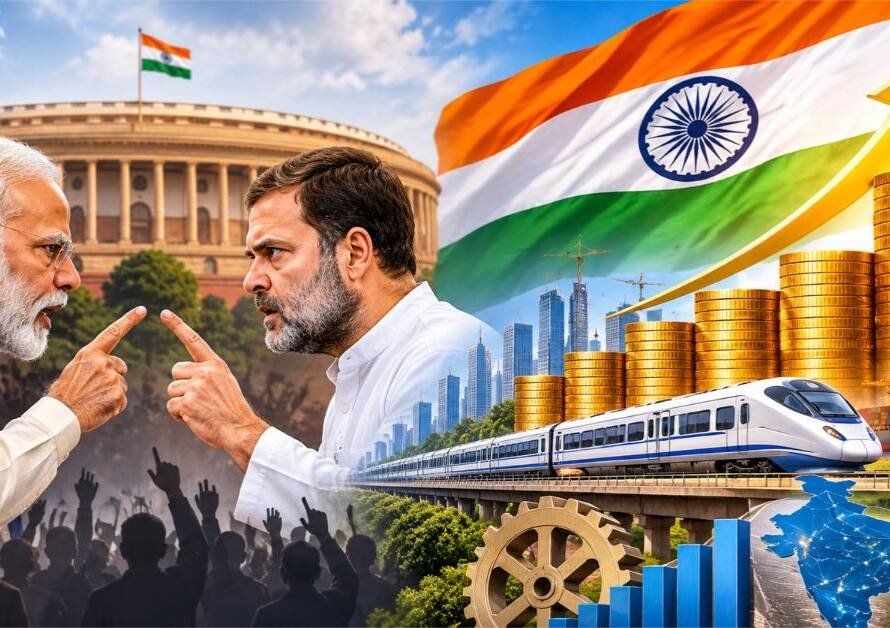
In recent political discourse, particularly following high-profile foreign visits and statements by various opposition leaders, the concept of “Regime Change” has increasingly occupied center stage.
Unlike standard democratic transitions where political parties or leaders change via routine elections, the term “regime change” implies a deep, structural alteration of a nation’s constitutional framework, governing rules, or foundational institutions, often catalyzed by mass civil unrest, prolonged agitation, or external pressures.
- Parallels Drawn from Global Events: Critics and political analysts frequently point to recent upheavals in neighboring nations like Sri Lanka, Bangladesh, Nepal, or civil unrest in European democracies like France, drawing comparisons to suggest similar methods could be mirrored in India. Proponents of this view argue that consecutive electoral defeats have led certain political factions to bypass traditional democratic channels in favor of agitations aimed at creating widespread administrative paralysis.
- The Strategy of Agitation: Planned rallies at historic venues like Ramleela Maidan and sharp rhetorical attacks from regional and national opposition figures are viewed as part of a broader strategy to delegitimize established authority and foster societal friction.
- The Failure of Political Gimmicks: These political maneuvers—driven by legacy opposition parties, coalitions, and an entrenched anti-national ecosystem—are increasingly failing to resonate with a populace that prioritizes stability over chaotic disruption.
2. The Economic Counter-Narrative: Technological Scaling and Market Confidence
While political rhetoric frequently focuses on instability and institutional friction, ground-level economic data tells a radically different story—one defined by massive institutional scaling, digital maturation, and robust global confidence.
The integration of Unified Payments Interface (UPI), direct benefit transfers, and robust corporate scaling demonstrates that India’s economic engine is expanding rapidly, fueled by domestic consumption, deep-tech integration, and a formalized financial architecture.
- The Ascent of Jio Platforms: A prime example of India’s formidable economic momentum is the valuation milestone achieved by Mukesh Ambani’s Jio Platforms, which entered the elite global club of companies valued at over $100 billion—joining corporate giants such as Meta, Alibaba, and SpaceX.
- Record Investor Demand: The overwhelming response to corporate public offerings and digital infrastructure initiatives—evidenced by massive capital commitments and record-breaking applications—refutes narratives that label India’s market as stagnant or a “dead economy.”
- Formalization of the Economy: Sweeping tax reforms, automated compliance systems, and digital identity linkages have brought millions of enterprises into the formal banking and taxation grid, cutting off illicit parallel economies.
3. A Twelve-Year Transformation: Structural Resilience and Innovation
Over the last twelve years, India has undergone a profound transformation anchored in structural strength, self-reliance, and visionary leadership. The nation has built an economic foundation capable of weathering global volatility, inflation shocks, and geopolitical crises.
- Economic Resilience: Infrastructure expansion across highways, dedicated freight corridors, port modernization, and high-speed rail networks has drastically lowered logistical costs and boosted internal trade.
- Technological Innovation: India’s rapid adoption of indigenous digital public infrastructure has established a global benchmark, empowering hundreds of millions of citizens through transparent governance and direct access to state resources.
- Constitutional Stability: The steadfast commitment of the citizenry to constitutional stability has repeatedly rejected attempts to sow chaos. The public’s trust in democratic processes remains the bedrock of national progress.
4. Neutralizing Subversive Narratives and Strengthening Sovereignty
Every major nation undergoing rapid development encounters friction from domestic and external forces seeking to stall its growth. In India, attempts to trigger administrative paralysis or manipulate public sentiment have been neutralized by systemic transparency and public awareness.
- Dismantling Middleman Networks: Direct Benefit Transfer (DBT) and biometric verification have eliminated millions of fake records, ensuring that public funds reach verified citizens directly without leakage.
- Rejection of Chaos-Driven Politics: Voters across diverse demographics have consistently prioritized economic opportunity, infrastructure growth, and national security over rhetoric aimed at dividing society.
- Global Standing: Rather than succumbing to external pressure or domestic disruption, India’s foreign policy and trade alliances operate from a position of strategic autonomy, asserting the nation’s interests on global platforms.
5. Conclusion: Realizing the Vision of a Global Leader
- India’s journey over the past decade reflects a nation confidently advancing toward its destiny.
- As political gimmicks fail and subversive narratives lose traction, the country is progressing steadily on its path to becoming a global superpower and a Vishwaguru.
- In this era of resurgence, economic vitality, and technological leadership, the long-cherished dream of Swami Vivekananda—of a rejuvenated, self-reliant, and globally respected India—is rapidly transforming into a living reality.
🇮🇳Jai Bharat, Vandematram 🇮🇳
Read our previous blogs 👉 Click here
Join us on Arattai 👉 Click here
👉Join Our Channels👈