Summary:
- This comprehensive analysis examines the historical political crisis that emerged following Netaji Subhash Chandra Bose’s democratic election victory at the 1939 Tripuri Congress Session, as well as the 1946 selection process of India’s first Prime Minister, where Jawaharlal Nehru was appointed despite overwhelming organizational support for Sardar Vallabhbhai Patel.
- Furthermore, the article presents an objective evaluation of the far-reaching impact these pivotal moments had on independent India’s governance, foreign policy, constitutional amendments, and economic trajectory.
The Historical Analysis of Post-Independence Indian Politics
1. Historical Background: The 1939 Tripuri Session and Democratic Elections
In the late 1930s, two distinct ideological and strategic currents emerged within the Indian National Congress:
- The Traditional Guard: Led by Mahatma Gandhi, advocating incremental reform, negotiations, and disciplined non-violent movements.
- The Progressive/Revolutionary Wing: Led by Subhash Chandra Bose, advocating direct pressure on the British administration by capitalizing on global geopolitical shifts during World War II.
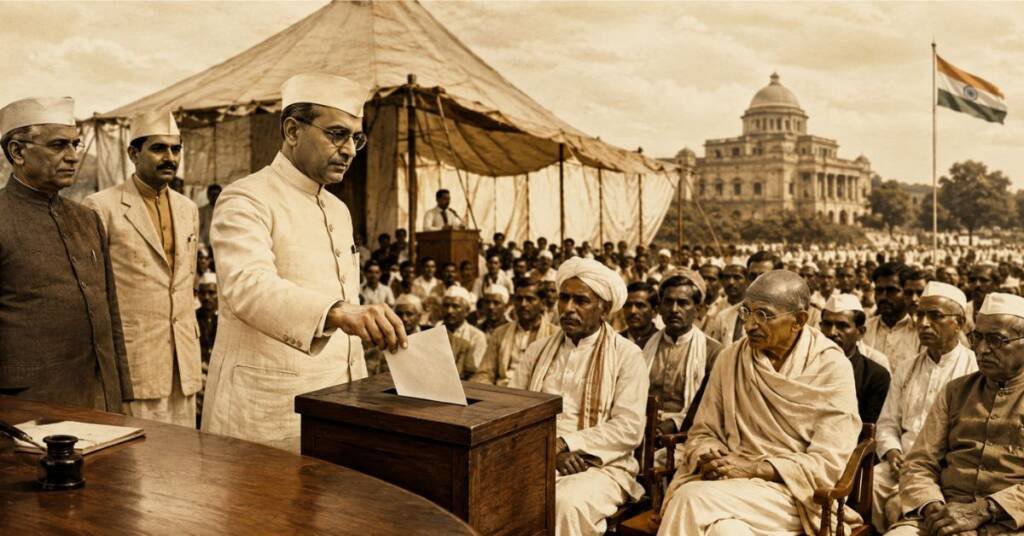
- Announcement of the Presidential Election: An internal election was announced for the presidency of the annual Congress session in Tripuri (Jabalpur, Madhya Pradesh) in 1939.
- Opposing Candidates: Subhash Chandra Bose contested for a second consecutive term to advance a proactive independence roadmap. Pattabhi Sitaramayya entered the race with the explicit endorsement and backing of Mahatma Gandhi.
- Historic Election Results: On January 29, 1939, Subhash Chandra Bose secured 1,580 votes against Pattabhi Sitaramayya’s 1,377 votes, winning the election by a margin of 203 votes.
- Mandate of the Delegates: The victory demonstrated that grass-roots delegates and the youth wing supported Netaji’s decisive and assertive vision for the freedom movement.
2. Gandhiji’s Stance, the “Personal Defeat” Statement, and Internal Crisis
The election result triggered an unprecedented political crisis within the Congress, creating a rift between the democratic mandate of the delegates and the organizational hierarchy.
- The Statement of January 31, 1939: Mahatma Gandhi issued a public statement declaring, “Pattabhi’s defeat is more mine than his.”
- Test of Loyalty vs. Personal Prestige: This statement reframed a democratic election result into a question of personal loyalty to Gandhiji, forcing party members and leaders to choose between his moral authority and the newly elected president.
- Crisis of Power Balance: This reaction underscored that despite formal constitutional voting procedures within the party, supreme decision-making power remained concentrated within the established high command.
3. Organizational Siege, the “Pant Resolution,” and Netaji’s Resignation
Following Gandhiji’s statement, a severe deadlock ensued within the Congress Working Committee (CWC), severely constraining the newly elected president’s operational authority.
- Mass Resignations of the CWC: Twelve prominent members of the Working Committee—including Sardar Vallabhbhai Patel, Dr. Rajendra Prasad, Maulana Abul Kalam Azad, and Govind Ballabh Pant—resigned collectively.
- Jawaharlal Nehru’s Position: Jawaharlal Nehru refrained from formally resigning but issued a separate statement distancing himself from Netaji, leaving the elected president isolated.
- Netaji’s Health: Subhash Chandra Bose was severely ill during the Tripuri session and had to be brought to the venue on a stretcher due to high fever.
- The Pant Resolution: Govind Ballabh Pant introduced a resolution stipulating that the President must form the new Working Committee strictly in accordance with the wishes and approval of Mahatma Gandhi.
- Passage of the Resolution: The resolution was passed by the delegates, effectively neutralizing the executive prerogatives of the elected president.
- Resignation and Disqualification: Facing continuous non-cooperation, Netaji resigned from the Congress presidency in April 1939 at the Calcutta AICC session. He subsequently formed the ‘Forward Bloc’ in May 1939, leading to a three-year disqualification from holding any elective Congress office starting August 1939.
4. The 1946 Prime Ministerial Selection and Sardar Patel’s Nomination
Seven years after the Tripuri session, a similar divergence between organizational consensus and top-tier intervention re-emerged during the selection of India’s first interim Prime Minister in 1946.
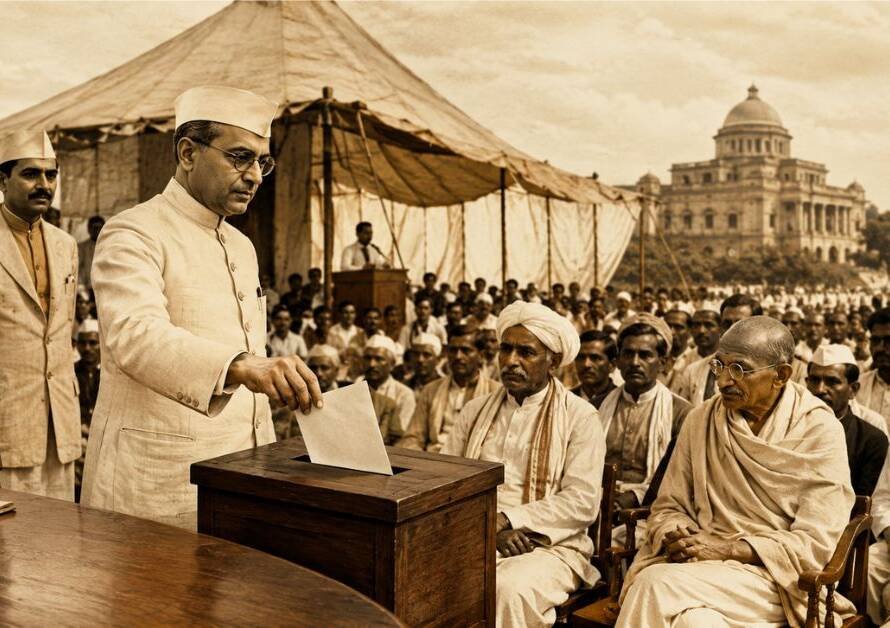
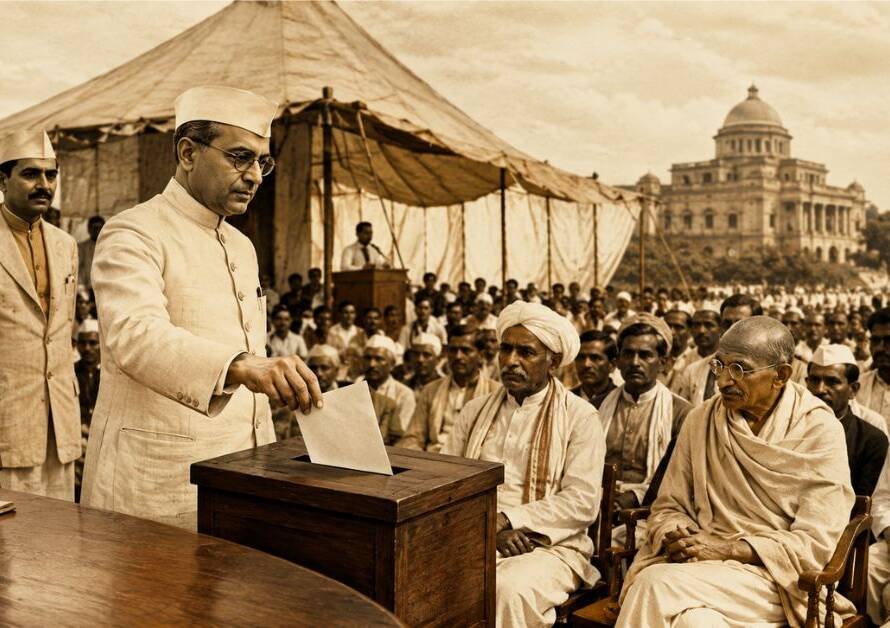
- Stance of the Pradesh Congress Committees (PCCs): In April 1946, nominations were invited for the Congress Presidency—a position that implicitly dictated who would lead the interim government as Prime Minister. Out of 15 Pradesh Congress Committees, over 12 explicitly nominated Sardar Vallabhbhai Patel. Not a single committee formally nominated Jawaharlal Nehru.
- Organizational Support for Sardar Patel: The PCC nominations reflected a strong organizational preference for Sardar Patel’s administrative acumen, pragmatic worldview, and decisive leadership.
- Gandhiji’s Intervention: Mahatma Gandhi favored Jawaharlal Nehru for international representation and foreign relations. Following Gandhiji’s request and Nehru’s unwillingness to serve as second-in-command, Sardar Patel withdrew his nomination.
- Patel’s Withdrawal: Prioritizing national unity, party cohesion, and deference to Gandhiji, Sardar Vallabhbhai Patel stepped aside, leading to Jawaharlal Nehru assuming office as India’s first Prime Minister despite the organizational preference for Patel.
5. Strategic Divergence: Ultimatum vs. Incremental Action
The events of 1939 and 1946 reflected deeper strategic debates regarding India’s liberation and governance:
- The World War II Opportunity: Netaji advocated issuing a 6-month ultimatum to the British government during the outbreak of World War II, to be followed by a mass national movement if demands were unfulfilled.
- The Gandhian Approach: The established leadership felt the country was not yet prepared for an all-out non-violent movement and hesitated to capitalize on Britain’s wartime vulnerability.
- Policies Toward Revolutionaries: Critics point out that the central leadership hesitated to exert decisive pressure on the British government to commute the death sentences of revolutionary figures like Bhagat Singh, Sukhdev, and Rajguru, fearing their radical approach could undermine the party’s non-violent paradigm.
6. Counterfactual Analysis: Had Netaji and Sardar Patel Led the Nation
Historians and political analysts frequently debate how India’s economic and geopolitical trajectory might have unfolded had Subhash Chandra Bose in 1939 or Sardar Vallabhbhai Patel in 1946 been given unhindered leadership:
- Pragmatic Foreign Policy: Both Netaji and Sardar Patel favored Realpolitik. As early as 1950, Sardar Patel warned about potential border security risks following the annexation of Tibet. A leadership guided by this realism might have altered the dynamics surrounding the 1962 conflict and the Kashmir dispute.
- Decisive Administrative Structure: Sardar Patel’s integration of over 560 princely states demonstrated exceptional administrative capability. Their combined vision prioritized industrial strength, national security, and swift decision-making, which could have accelerated economic growth earlier in the post-independence era.
- Military and Strategic Empowerment: Netaji’s formation of the Indian National Army (INA) and his military outlook underscored the importance of strong defense infrastructure to establish early strategic deterrence on the global stage.
7. Post-Independence Governance: Policies, Amendments, and Scams
The post-independence governance model under the long-standing Congress administration has been a subject of critical evaluation regarding constitutional spirit, democratic norms, and policy choices:
- Constitutional Amendments and the Emergency: Despite portraying itself as the primary custodian of the Constitution, the Congress-led government enacted numerous amendments. The imposition of the National Emergency in 1975 under Prime Minister Indira Gandhi is widely viewed as a major setback to civil liberties and democratic institutions in independent India.
- Appeasement and Vote-Bank Politics: Critics argue that electoral considerations led to policies aimed at appeasing specific vote banks. A frequently cited example is the 1985 Shah Bano case, where a progressive Supreme Court judgment on maintenance rights was overturned by parliamentary legislation to satisfy conservative religious elements.
- Corruption Allegations and Financial Scams: Between 1947 and 2014, several high-profile financial controversies emerged under Congress administrations, including the Jeep scandal, Bofors, the 2G spectrum allocation controversy, the Coal scam, and the Commonwealth Games (CWG) financial irregularities.
- Narratives Against Political Opponents: Opposition parties have argued that the ruling establishment systematically labeled rival political organizations—specifically the Rashtriya Swayamsevak Sangh (RSS) and the Bharatiya Janata Party (BJP)—as “anti-democratic” or “extremist” to consolidate electoral support and divert focus from administrative shortcomings.
8. Historical Reappraisal and National Awakening
The events of the 1939 Tripuri Session and the 1946 Prime Ministerial selection demonstrate that the path to India’s independence and modern nation-building involved diverse ideological streams and complex internal politics.
- Re-evaluating Democratic Traditions: True democracy extends beyond formal voting to encompass internal party transparency and respect for dissenting opinions. The events of 1939 and 1946 remain key case studies in how organizational dynamics can reshape democratic outcomes.
- Objective Historical Understanding: A comprehensive view of history acknowledges that India’s freedom was secured through the collective sacrifices of revolutionaries, the Azad Hind Fauj, leaders like Sardar Patel, and millions of ordinary citizens alongside the Congress party.
- Commitment to Nation First: Overcoming vote-bank politics, administrative inertia, and policy delays remains essential for India to achieve the economic strength, security, and global standing envisioned by leaders like Netaji Subhash Chandra Bose and Sardar Vallabhbhai Patel.
🇮🇳Jai Bharat, Vandematram 🇮🇳
Join us on Arattai 👉 Click here
👉Join Our Channels👈