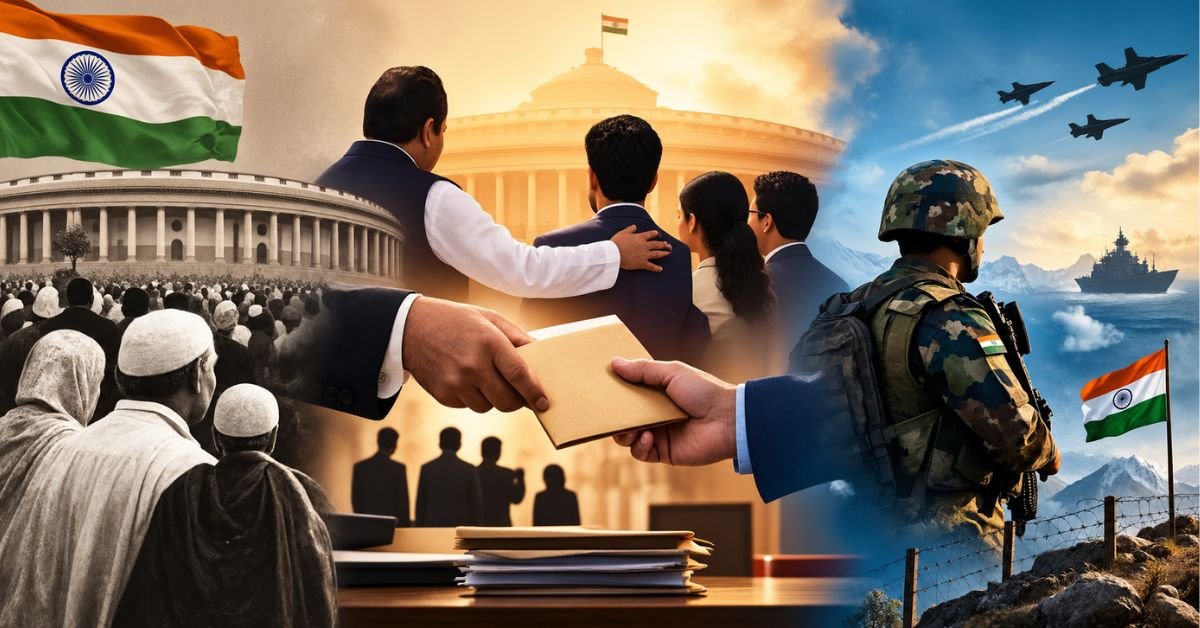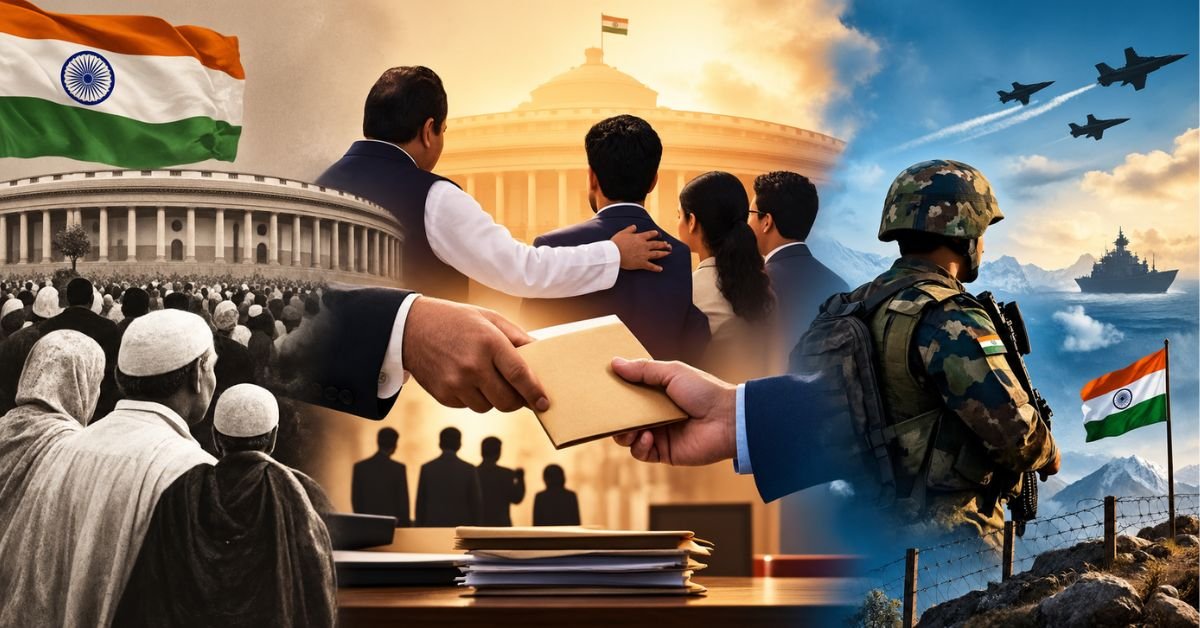
This detailed narrative presents a historical and contemporary analysis of independent India’s initial policy framework, the ideological structure of the education system, and the tradition of political appeasement that flourished over the past seven decades. It conducts a nuanced evaluation of how the policies adopted by post-independence governments—from the tenure of the first Education Minister, Maulana Abul Kalam Azad, through subsequent administrations (especially the Congress and UPA eras)—promoted a one-sided perspective within the country’s key administrative and constitutional institutions. Furthermore, it examines the unprecedented threats to internal security that continuously loomed during the first 70 years of independence as a result of religious appeasement and the direct or indirect protection granted to extremist elements.
It highlights the current Bharatiya Janata Party (BJP) government’s ‘Zero Tolerance’ policy against terrorism and radicalism, alongside its efforts to neutralize appeasement politics through ‘Sabka Saath, Sabka Vikas’ (Together with All, Development for All). Ultimately, this analysis exposes the stark reality that the government is fighting this war against internal traitors and ideological adversaries largely alone. To achieve absolute victory in this battle for national security, the complete political, social, and ideological support of Indian society is an imperative necessity.
1. Post-Independence Education Policy Formation and Initial Ideological Foundation
The foundation on which independent India’s educational and cultural institutions were laid deeply influenced the outlook and national consciousness of future generations.
- Traditional Religious Education vs. Modern Framework: India’s first Education Minister, Maulana Abul Kalam Azad, received his primary education in traditional and religious institutions (such as madrasas in Mecca and Al-Azhar in Egypt). He lacked formal schooling or experience within a modern Indian educational system, yet Pandit Jawaharlal Nehru entrusted him with the vital responsibility of shaping independent India’s education framework.
- Administrative Appointments and One-Sided Perspective: Upon assuming office, Maulana Azad appointed Khwaja Ghulam Saiyidain as India’s Education Secretary. Critics and thinkers argue that during this era, India’s ancient history, Sanatan knowledge traditions, Vedic science, and great national heroes were sidelined in the curriculum in favor of a specific ideological and appeasement-oriented narrative.
- Politicization of National Honors: During the Congress regime, Maulana Azad was posthumously awarded the ‘Bharat Ratna’, and his Education Secretary, Khwaja Ghulam Saiyidain, received the ‘Padma Bhushan’. Serious allegations arose that national honors were distributed based on ideological proximity and political alignment rather than merit.
2. Institutional Nepotism and UPA-Era Appeasement
In independent India’s administrative history, favoring specific families and ideologies over merit caused severe damage to institutional balance.
- Top Positions Without Administrative Experience: Khwaja Ghulam Saiyidain’s daughter, Syeda Hameed, was given top administrative roles in Congress governments despite having no Civil Services (IAS) background. During Indira Gandhi’s tenure, she was assigned secretary-level responsibilities directly in the Prime Minister’s Office (PMO) and was later honored with the ‘Padma Shri’.
- The Planning Commission and Sonia Gandhi’s NAC: During former Prime Minister Dr. Manmohan Singh’s tenure, when Sonia Gandhi’s ‘National Advisory Council’ (NAC) functioned as an unconstitutional parallel government, Syeda Hameed was appointed as a member of the Planning Commission and granted Cabinet Minister status.
- Continuation in Alliance-Ruled States: The same model of appeasement that ran at the Center during the first 70 years continues unchecked today in states ruled by Congress and its opposition alliances, where national interests and the sentiments of the majority community are compromised for vote-bank politics.
3. Illegal Infiltration, Bangladeshi Migrants, and the Challenge of Internal Treason
Amidst uncontrolled demographic shifts and threats to border security, statements by certain influential figures have directly challenged the nation’s sovereignty.
- Attack on the Constitution and Borders: Former Planning Commission member Syeda Hameed’s controversial statement—“This earth was created by Allah, so Bangladeshi Muslims also have every right to live in India and you cannot expel them”—is a direct attack on India’s Constitution, citizenship laws, and national sovereignty.
- Political Protection to Illegal Immigrants: Facilitating the illegal occupation of resources, jobs, and the social fabric by Bangladeshi infiltrators and Rohingyas has been part of a deliberate strategic design. For vote-bank arithmetic, opposition parties and their patronized intellectuals have consistently provided legal and social shields to these illegal elements.
- The Threat of Internal Traitors: These internal traitors and pseudo-secular elements operate within the country to pave the way for external enemies, creating unprecedented security crises in border states.
4. The BJP’s ‘Zero Tolerance’ Policy and ‘Sabka Saath, Sabka Vikas’
Since the formation of the government under Prime Minister Narendra Modi in 2014, a decisive and firm shift has occurred in India’s security and administrative approach.
- Decisive Blow to Extremism: The Bharatiya Janata Party (BJP) government adopted a strict ‘Zero Tolerance’ policy against terrorism, Naxalism, and religious extremism. Dismantling the 70-year-old pattern of appeasement, security agencies were granted full operational freedom to take stern action against anti-national elements.
- Strategic Impact of ‘Sabka Saath, Sabka Vikas’: The inclusive policy of ‘Sabka Saath, Sabka Vikas’ extended development benefits to the last mile without religious or caste discrimination. This transparent policy dismantled the foundation of appeasement politics that extremist organizations and political parties had exploited for decades.
- Institutional Reforms: Alongside bolstering border security, historic steps such as the Citizenship Amendment Act (CAA) and strict crackdowns on infiltration have been implemented to protect the nation’s demographic balance.
5. A Government Fighting Alone, the Internal Battle, and Society’s Duty
The battle for national security and integrity is not limited to firing guns at the borders; it is a complex warfare fought against ideological enemies within.
- The Government’s Solitary Struggle: Today, the government is fighting this battle against extremism, illegal infiltration networks, and deep-seated ecosystems largely alone. Sections of the judiciary, human rights NGOs, and opposition-aligned media networks frequently attempt to create hurdles at every firm step taken by the administration.
- Need for Social and Political Support: Government orders and legislation alone are insufficient to uproot internal traitors and the 70-year-old entrenched network of appeasement. Until Indian society stands united behind the government politically, culturally, and socially, this battle cannot reach a decisive conclusion.
- Conscious National Awareness: Enlightened citizens must discern which political entities stand with national interest and which ones are willing to push the nation toward internal conflict for vote banks.
6. Conclusion: National Resurgence and the Path to Becoming a Global Power (Vishwaguru)
The time has arrived to correct historical blunders and permanently end the vicious cycle of appeasement that began after independence.
- Learning from History: It is the duty of every patriot to reject political components attempting to revive appeasement policies that crippled the nation for decades.
- Resolve for a Secure and United India: India can become a powerful, secure, self-reliant, and prosperous nation only when we keep our borders and internal systems free from all forms of radicalism. United under the spirit of ‘Nation First’, India will establish itself as a global superpower and ‘Vishwaguru’ in the years to come.