Summary:
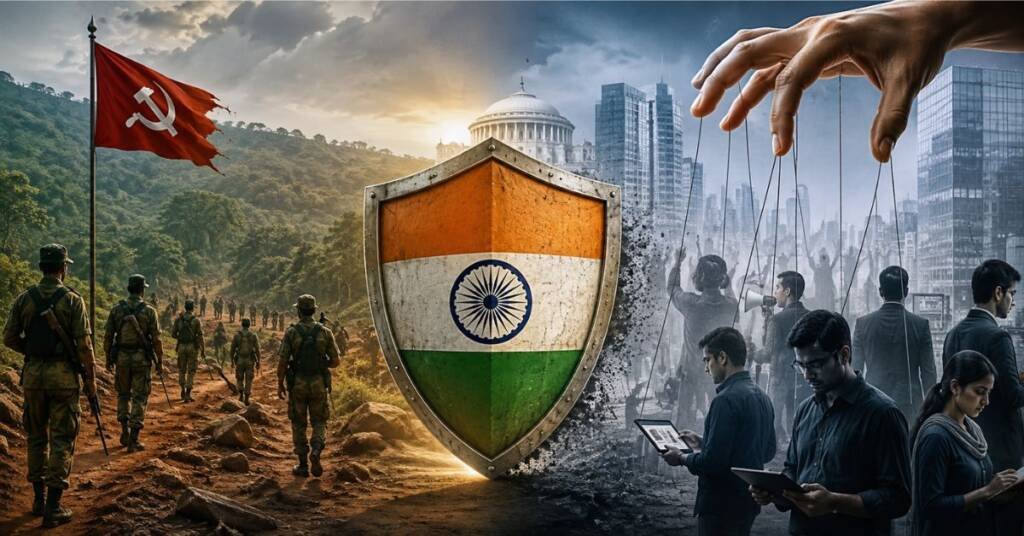
- This detailed analysis provides an in-depth evaluation of India’s internal security landscape. It contrasts the pre-2014 era—when India faced a dual attack from armed red terrorism in forests (the Red Corridor) and intellectual Naxalism in cities—with the current scenario.
- The text highlights how firm security measures have dismantled jungle Naxalism, yet ‘Urban Naxals’ remain highly active with the backing of anti-national and international networks. Ideological extremism is identified through condensed, actionable indicators across five major domains.
- It calls upon citizens and the majority population to rise above passive indifference and actively cooperate with sovereign security agencies to unmask these invisible internal .
The Reality of India’s Security After the Destruction of the ‘Red Corridor’
1. Historical Perspective: Pre-2014 Dual Crisis vs. The End of the Red Corridor
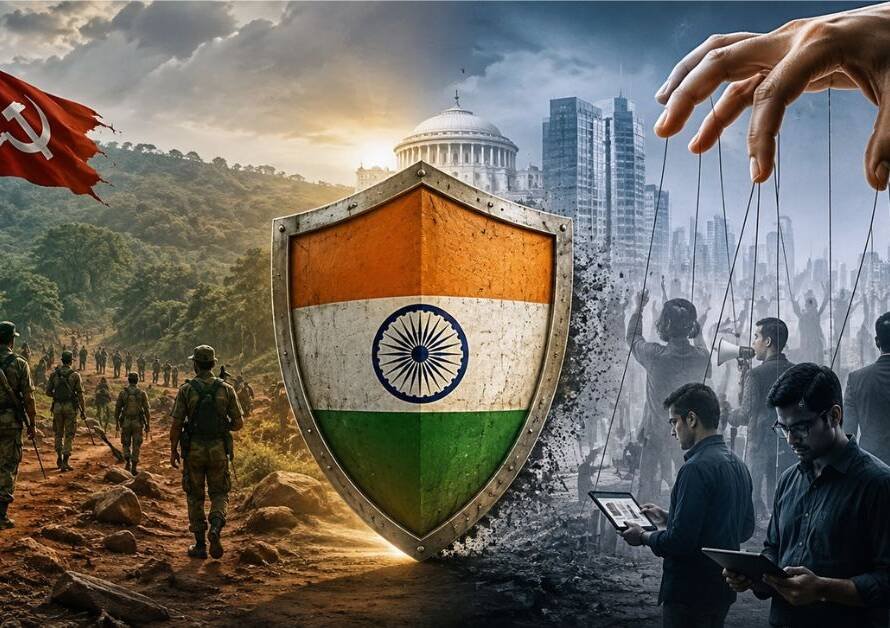
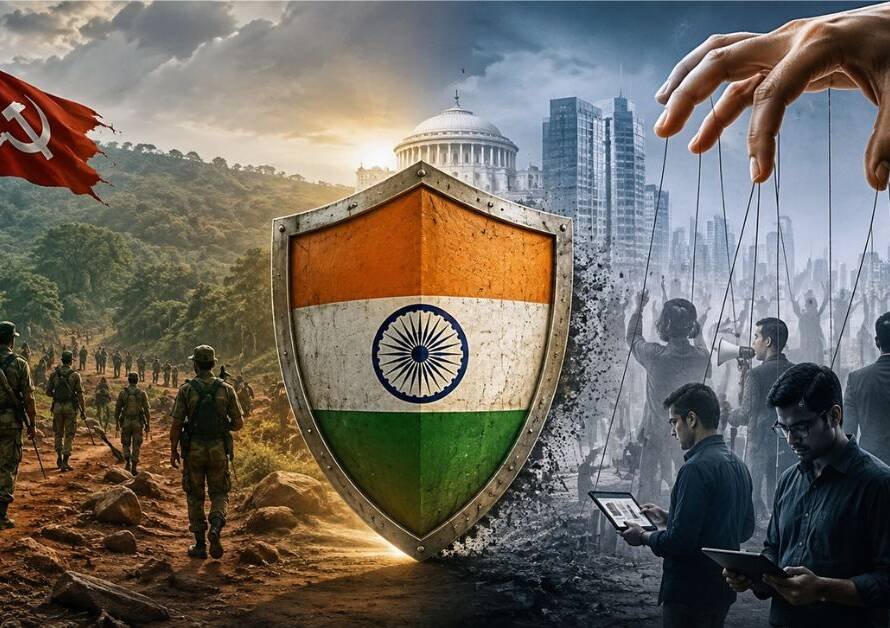
Prior to 2014, India’s internal security was undergoing a harrowing phase. The country was not only battling expanding armed red terrorism in its forests but was also falling victim to a well-entrenched network sitting in air-conditioned city rooms, providing ideological and legal cover to this extremism.
- The Pre-2014 ‘Red Corridor’:
- A vast swath of land extending from Pashupatinath (Nepal) to Tirupati (Andhra Pradesh) was known as the ‘Red Corridor,’ where state authority was directly challenged.
- Development projects were halted, security forces faced continuous ambush attacks, and local populations were held hostage at gunpoint.
- Security Blanket and the Destruction of the Red Corridor:
- Post-2014, the Central Government’s ‘Zero Tolerance’ policy, infrastructure development in remote areas, and aggressive security operations broke the spine of armed Naxalism.
- Today, armed Naxals in forests are at an all-time low, with their network gasping for its final breath.
- Shift in Strategic Battleground:
- After suffering defeat in the forests, this violent ideology shifted its entire focus toward cities, universities, legal forums, and digital media.
- This war is no longer fought with bullets, but through narratives, misleading information, and social polarization.
2. The Urban Naxal Network: International Alignment and the Conspiracy of Internal Instability
Compared to forest Naxalism, ‘Urban Naxalism’ is proving to be far more lethal and destructive because it directly targets the social fabric and national institutions.
- Support from International and Anti-National Forces:
- Urban Naxals receive heavy financial and ideological support from disruptive elements within the country, alongside foreign toolkit ecosystems and strategic adversaries.
- Their primary objective is to damage India’s economic momentum, global standing, and internal peace.
- Creation of Social Tension and Chaos:
- These groups possess the capability to swiftly turn any policy decision, reform, or local dispute into a major protest or riot.
- Firing guns from the shoulders of farmers, students, tribals, and laborers to enforce their violent and anti-establishment mindset is an old strategy of theirs.
- Intellectual and Legal Cover:
- These elements move freely in society under the guise of human rights activists, journalists, lawyers, and academicians.
- Whenever an anti-national or terrorist is apprehended, this entire ecosystem rallies together—from the courtrooms to the streets—to defend them.
3. The Threat of the Invisible Enemy: External Foes vs. Internal Termites
As a nation, India can easily manage enemies deployed at its borders, but tackling this invisible poison dissolved within society remains the toughest challenge.
- Overt vs. Invisible Enemy:
- An enemy at the border (such as Pakistan or China) is clearly visible; their uniforms and weapons are marked. The military knows who and where to strike.
- An Urban Naxal is an ‘invisible enemy.’ They live among us, speak our language, and use the rights granted by democracy to dismantle democracy itself.
- Risk of Institutional Decay:
- This network has infiltrated deep into our judicial system, education framework, media, and administrative apparatus.
- Like a slow poison, it instills hatred among the youth toward the nation, culture, and armed forces, neutralizing society’s collective defense capacity.
4. Civic Responsibility: The Need for Active Cooperation Over Passive Spectatorship
National security is not the sole responsibility of the police, military, or government. When war becomes ideological, every citizen must step up as a frontline warrior.
- Abandoning the ‘Everything is Fine’ Illusion:
- A large segment of society lives under the misconception, amid personal prosperity, luxury cars, and comfortable living, that this threat will never reach them.
- It must be understood that when systems and society weaken, this affluent and careless class becomes the very first casualty.
- Awareness and Unmasking Policy:
- Citizens must move beyond merely complaining or remaining passive on social media and actively identify these deceptive narratives.
- Immediate, fact-based opposition to anti-national ideas and subversive agendas across universities, workplaces, and digital platforms is essential.
- Sovereign Cooperation with Security Agencies:
- Within the boundaries of the law and constitution, reporting any suspicious network, fund transfer, or separatist activity to constitutional agencies is every citizen’s duty to the nation.
5. The Key Traits of ‘Ideological Naxalism’: A Guide to Identification
Supporting anti-national violence and unrest at a conceptual level defines Ideological Naxalism. Its core indicators can be grouped into five primary domains:
A. Attacks on Constitutional and Democratic Systems
- 1. Street Hegemony & Anti-Democratic Tactics: Forcing decisions through street violence, blockades, and chaos rather than through dialogue, parliamentary debates, or constitutional processes.
- 2. Defending Separatism & Subversive Slogans: Justifying and protecting slogans or movements that call for the balkanization of India (such as “Bharat Tere Tukde Honge”) under the guise of ‘freedom of expression.’
- 3. Disrespecting Armed Forces & National Symbols: Questioning the bravery of the Indian Armed Forces, demanding proof of military strikes, and showing disdain toward the National Flag, Anthem, and Song.
B. Threatening Territorial Integrity and Nurturing Foreign Agendas
- 4. Kashmir Separatism & Article 370 Agenda: Denying that Kashmir is an integral part of India, stoking local separatist mindsets, and demanding the reinstatement of Article 370.
- 5. Echoing Hostile Foreign Narratives: Endorsing the language, geopolitical interests, and strategic agendas of adversary nations (such as China or Pakistan) against India’s security and development.
C. Systematic Attacks on Cultural and Religious Faith
- 6. Anti-Sanatana Hostility & Ridicule of Deities: Single-mindedly mocking Hindu deities, sacred traditions, and cultural heritage under the guise of art or progressiveness, while actively opposing symbols of cultural renaissance like the Ram Mandir.
- 7. Selective Secularism & Double Standards: Launching aggressive attacks on the faith, festivals, and practices of the majority community while maintaining a sympathetic silence toward radical or extremist tendencies from other groups.
D. Glorifying Anti-National Figures and Sowing Seeds of Violence
- 8. Glorification of Terrorists & Extremist Ideologues: Portraying convicted terrorists (e.g., Afzal Guru) and radical figures accused of inciting social riots or secessionist agendas (e.g., Umar Khalid, Sharjeel Imam) as ‘martyrs’ or ‘intellectual heroes.’
- 9. Sympathy for Extremism & Exploitation of Tribals: Justifying radical violence as a ‘reaction to social oppression’ while keeping rural and tribal youth alienated from education and employment to use them as fuel for violent agitation.
E. Sabotaging National Development & Anti-Patriotism
- 10. Blind Opposition to Infrastructure & Growth: Politically opposing critical national projects—such as expressways, industrial corridors, and defense manufacturing—to stall the country’s progress.
- 11. Hostility Toward ‘Nation First’ Patriotism: Labeling national pride, cultural confidence, and the core ethos of ‘Nation First’ as ‘dangerous extremism’ or ‘fascism.’
Disagreement vs. Anti-National Extremism
- Divergence of thought, strong criticism of government policies, and constructive opposition are welcomed features of a vibrant, healthy democracy. However, when disagreement crosses the line into endangering national integrity, sovereignty, security, and the lives of ordinary citizens, it ceases to be democracy and becomes ‘Ideological Violence.’
- Final Warning: A Naxal carrying a gun is dangerous, but far more dangerous is the urban intellectual who crafts legal, social, and ideological arguments to justify that gun.
- The time has come for Indian society to awaken, straighten its spine, identify these ‘urban termites,’ and secure the nation.
Nation First, Everything Else Second. 🇮🇳
🇮🇳 Jai Bharat, Vandematram 🇮🇳
Read our previous blogs 👉 Click here
Join us on Arattai 👉 Click here
👉Join Our Channels👈