Summary:
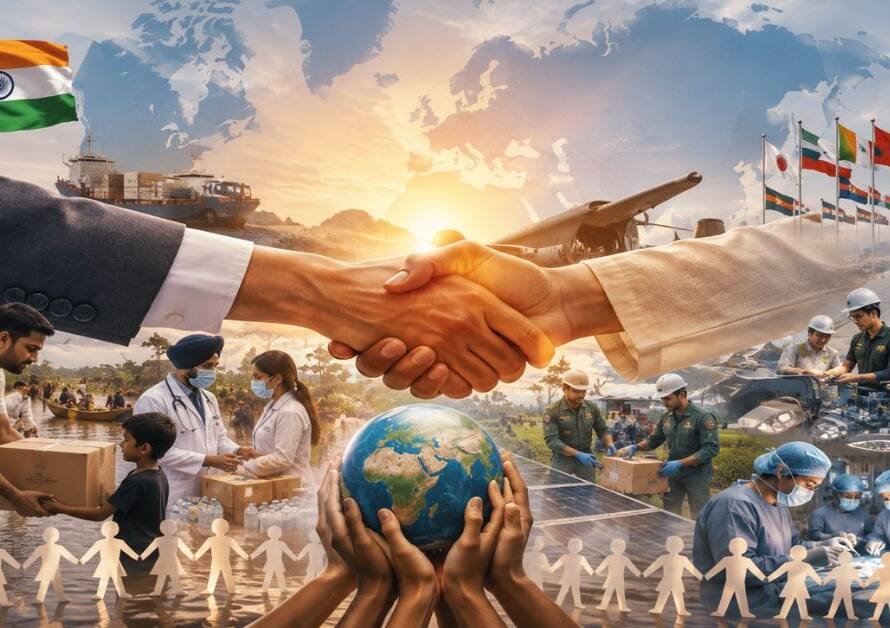
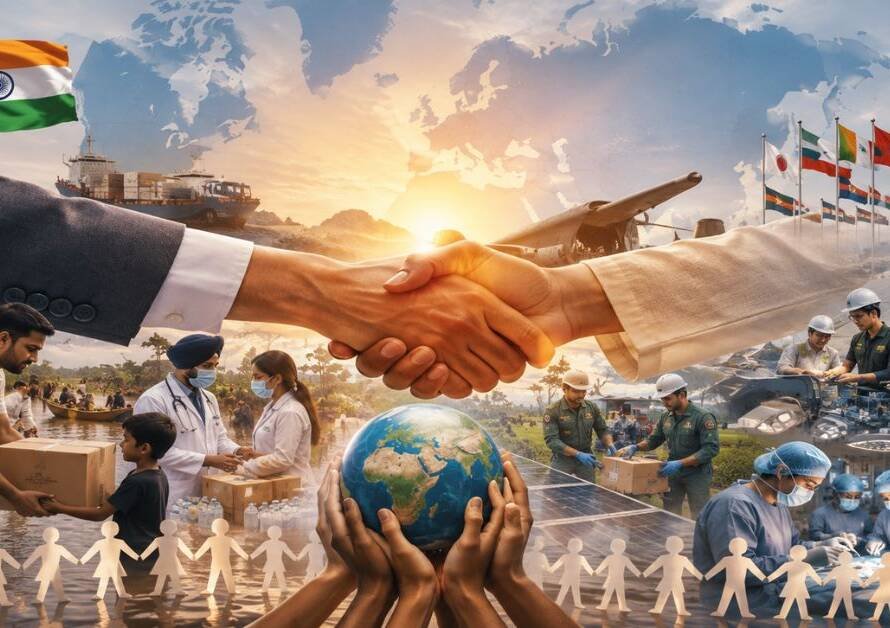
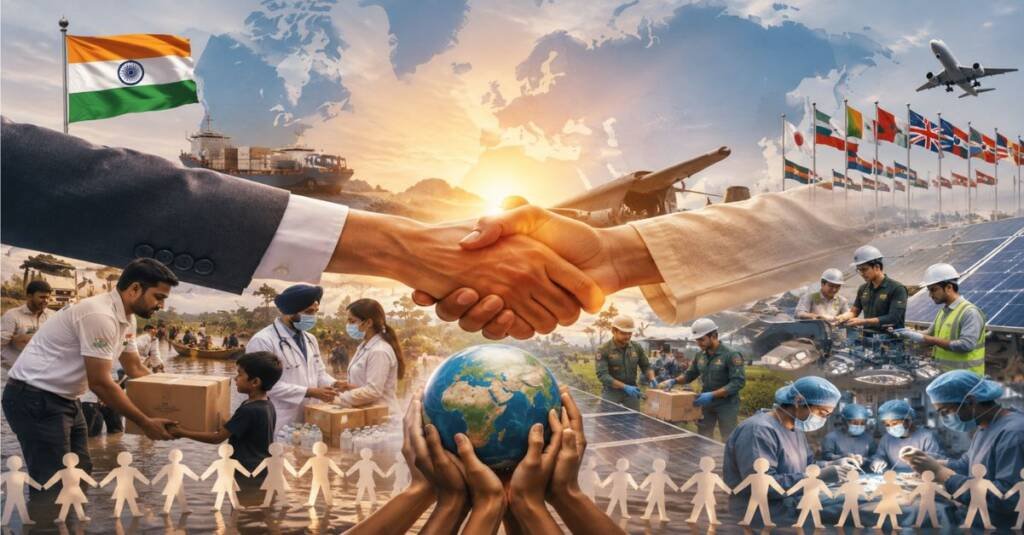
- This comprehensive analysis demonstrates that India’s civilizational ethos of Vasudhaiva Kutumbakam (“The World is One Family”) is not merely a rhetorical slogan, but an operational philosophy governing its foreign policy and First Responder doctrine.
- By examining India’s rapid Disaster Relief and Humanitarian Assistance (HADR) missions—ranging from earthquake relief in Nepal to high-risk evacuations and food aid in Afghanistan under Taliban control—this narrative illustrates how India delivers swift, condition-free assistance based strictly on human need.
- It further explores how this moral clarity generates deep goodwill among foreign populations, effectively neutralizing hostile regional narratives and establishing India as a trusted global power.
‘Vasudhaiva Kutumbakam’ and India’s Humanitarian Diplomacy
1. Introduction: From Philosophical Ideal to Geopolitical Action
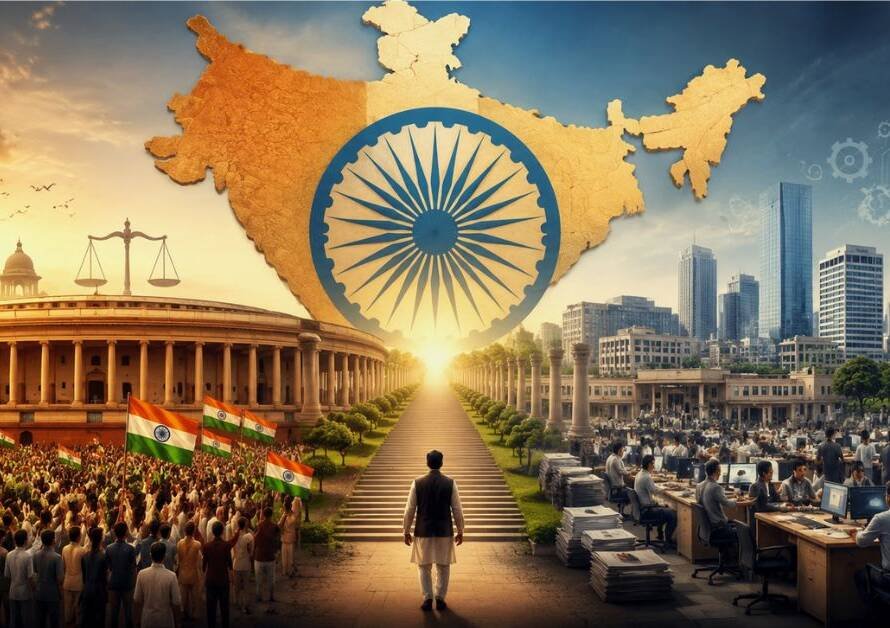
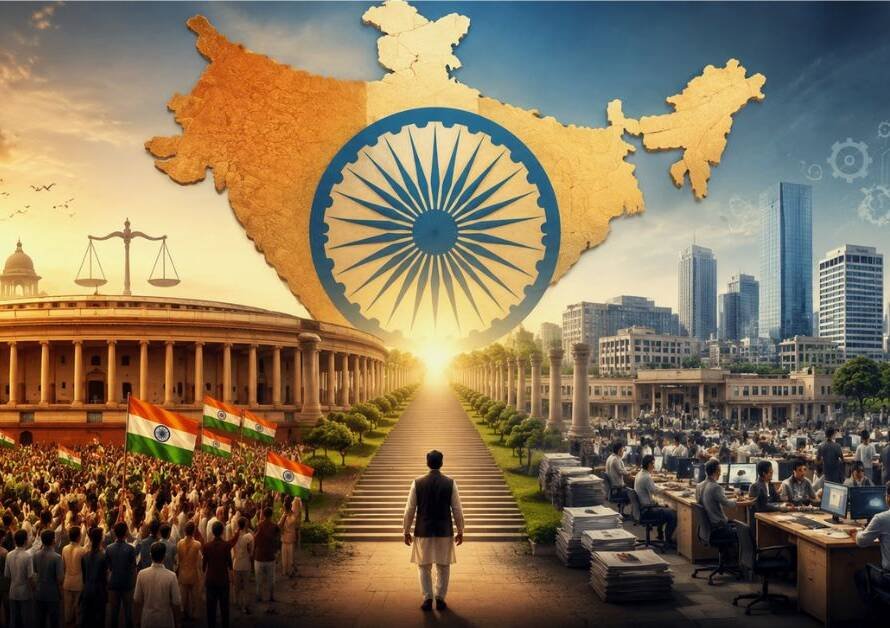
For centuries, Indian civilization has adhered to the principle of Vasudhaiva Kutumbakam—the belief that humanity forms a single interconnected family. In the modern era, this ancient philosophy has been integrated directly into India’s strategic doctrine and foreign policy.
- Beyond Rhetoric: While many nations view foreign aid through the lens of transactional diplomacy or geopolitical leverage, India approaches humanitarian relief as a fundamental moral duty.
- Neighborhood First Policy: India’s immediate periphery is prioritized in times of disaster. The operational mandate requires Indian agencies to act instantly when a neighboring nation experiences a crisis, bypassing bureaucratic delays.
- The “First Responder” Doctrine: Across the Indian Ocean Region (IOR) and South Asia, India has established the military and logistical infrastructure necessary to deploy relief missions within hours of a crisis, whether caused by natural disasters, economic collapses, or political upheavals.
2. Case Study 1: The Nepal Operation – Speed, Precision, and Solidarity
When natural disasters strike neighboring countries, time is the single most critical factor in saving lives. India’s response to crises in Nepal showcases the operational readiness of its defense and disaster management forces.
A. Immediate Air Mobility and Crisis Response
- Rapid Deployment: Within hours of a major disaster signal, the Indian Air Force (IAF) mobilizes heavy-lift aircraft from hubs like Hindon Air Force Station.
- Strategic Assets:
- C-130J Super Hercules: Deployed for rapid insertion of specialized teams and high-priority relief materials into short or degraded runways.
- C-17 Globemaster III: Utilized for massive airlift capabilities, transporting heavy engineering equipment, mobile hospitals, and bulk food supplies.
- Helicopter Fleets (Mi-17 V5 & ALH Dhruv): Dispatched to operate in high-altitude, inaccessible mountainous terrain to conduct search, rescue, and medical evacuation operations.
B. Inter-Agency Synergy on the Ground
- NDRF Integration: National Disaster Response Force (NDRF) teams, recognizable by their orange uniforms, deploy equipped with urban search-and-rescue (USAR) gear, canine units, and life-detection technology.
- Essential Supplies: Every crate delivered carries medical kits, temporary shelters, water purification units, hygiene supplies, and solar lighting to restore basic dignity to affected populations.
- The Symbolism of the Tricolor: Supplies marked with the Indian national flag signal solidarity from 1.4 billion citizens, delivered without political preconditions or financial strings attached.
3. Case Study 2: The Afghanistan Crisis – Humanity Beyond Geopolitical Barriers
India’s humanitarian commitment was severely tested during the August 2021 political crisis in Afghanistan. Despite the lack of formal diplomatic recognition of the incoming regime and extreme security risks, India’s operational focus remained squarely on human welfare.
A. Operation Devi Shakti
- High-Risk Evacuations: As Kabul descended into chaos, the IAF and security agencies launched Operation Devi Shakti, navigating hostile airspace and airfield panic to evacuate hundreds of individuals.
- Uncompromising Inclusivity: India evacuated its own diplomats and citizens while also extending safe passage to Afghan nationals, minority communities (Hindus and Sikhs), and international personnel facing immediate threats.
- Respect for Cultural and Religious Heritage: Special care was taken to safely transport historical artifacts and sacred scriptures, including the Saroops of Sri Guru Granth Sahib Ji, demonstrating deep respect for cultural preservation amidst active conflict.
B. Sustained Humanitarian Lifelines
- Food Security Support: Recognizing that international sanctions and collapse of local systems threatened millions with starvation, India committed tens of thousands of metric tons of wheat to the Afghan people, working through international agencies to ensure direct distribution.
- Medical Aid and Vaccine Diplomacy: India supplied millions of doses of essential life-saving medicines, pediatric vaccines, and medical equipment directly to hospitals in Kabul, such as the Indira Gandhi Children’s Hospital.
- Infrastructure Legacy: Over two decades, India built enduring national assets in Afghanistan—including schools, transmission lines, the Salma (India-Afghanistan Friendship) Dam, and the Afghan Parliament building—focusing on long-term societal development rather than short-term extraction.
4. Neutralizing Hostile Narratives Through Soft Power
India’s humanitarian diplomacy has fundamentally altered public perception across South and Central Asia, frequently invalidating hostility and state-sponsored propaganda from rival neighbors.
- Contrast in Regional Approaches: While neighboring regimes have historically exported instability, insurgent proxy networks, or debt-trap development models, India delivers tangible social assets, emergency food, and life-saving medical care.
- Afghani Public Sentiment: Despite Afghanistan being a Muslim-majority nation where external powers have often tried to stoke religious division, the Afghan public maintains overwhelmingly positive views of India.
- Undermining Propaganda: When citizens experience Indian aid directly during periods of starvation or disaster, state-sponsored anti-India propaganda loses its effectiveness. Practical assistance builds an unshakeable reservoir of public goodwill that transcends political shifts.
- Conditional Aid vs. Unconditional Solidarity: Western aid often comes with heavy bureaucratic conditions, while rival regional aid often demands strategic concessions. India’s HADR model is strictly need-based, respecting the sovereignty and dignity of the recipient nation.
5. Comparative Framework: Modes of Indian Humanitarian Intervention
- Disaster Response (e.g., Nepal, Sri Lanka, Myanmar): Focuses on rapid mobilization of search-and-rescue teams, air-dropping supplies, establishing field hospitals, and restoring critical water and power infrastructure.
- Conflict & Crisis Evacuation (e.g., Operation Devi Shakti in Afghanistan, Operation Kaveri in Sudan, Operation Ganga in Ukraine): Focuses on securing safe transit corridors, mobilizing strategic airlift assets, and extracting vulnerable populations without geopolitical bias.
- Developmental & Sustained Aid (e.g., Afghanistan, Maldives): Focuses on constructing essential public works, supplying long-term food security, training local healthcare personnel, and providing educational scholarships.
6. The Blueprint of a Responsible Global Power
- India’s foreign policy demonstrates that true global leadership is measured by a nation’s capacity to assist others in times of extreme vulnerability.
- By consistently acting as the first nation to respond to regional emergencies—whether clearing earthquake debris in the Himalayas or shipping wheat to conflict zones in Central Asia—India proves that Vasudhaiva Kutumbakam is a living operational mandate.
- This combination of strategic capability, rapid logistical deployment, and genuine empathy establishes India not merely as a rising economic power, but as an indispensable, morally grounded pillar of global stability.
🇮🇳 Jai Bharat, Vandematram 🇮🇳
Read our previous blogs 👉 Click here
Join us on Arattai 👉 Click here
👉Join Our Channels👈