Summary
- This detailed political and social analysis examines how the genuine outrage of students and young aspirants was systematically transformed into an anti-government and anti-system campaign through a planned “toolkit” and “Breaking India Module.”
- By comparing the history of paper leaks across various states—such as Rajasthan, Telangana, West Bengal, Jharkhand, Himachal Pradesh, Punjab, and Uttar Pradesh—the article raises a critical question: Why was such an unprecedented, aggressive, and selective rage displayed specifically during the Delhi protest?
- Divided into four core sections, this analysis clarifies how the valid demands of genuine candidates were hijacked and converted into a strategic pressure group through religious-ideological slogans and violent marches toward Parliament. Furthermore, the piece exposes how self-proclaimed leaders operating from safe rooms use students on the streets as human shields against police action.
- It highlights that despite prompt government measures—including swift investigations, a public apology from the Education Minister, and re-examinations conducted within a month—the insistence on “overthrowing the system” remains fundamentally contrary to democratic norms.
When Student Anger Becomes a Political Agenda
Section 1: Selective Outrage: The Questions That Must Be Asked
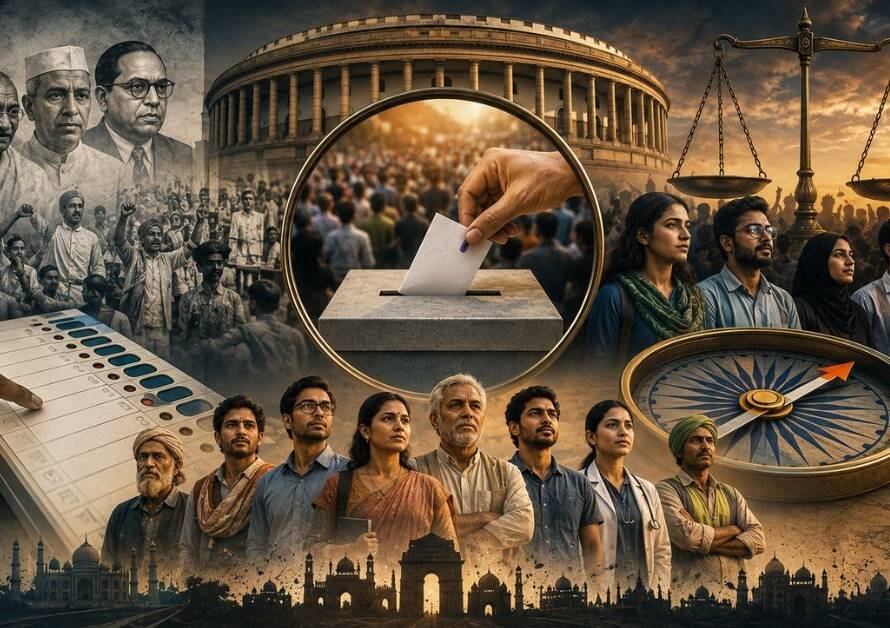
- Raising a voice against unjust rules, administrative failures, or systemic malpractice is the primary condition of a conscious and vibrant society within a democratic framework. Sociologists and socio-political thinkers have consistently acknowledged that students, youth, farmers, and workers serve as the primary drivers of societal and administrative change in every era. However, in a healthy democracy, concern does not stem from the emergence of protests themselves; rather, it arises from how selective these movements are, the direction they take, and the hidden agendas served under their cover.
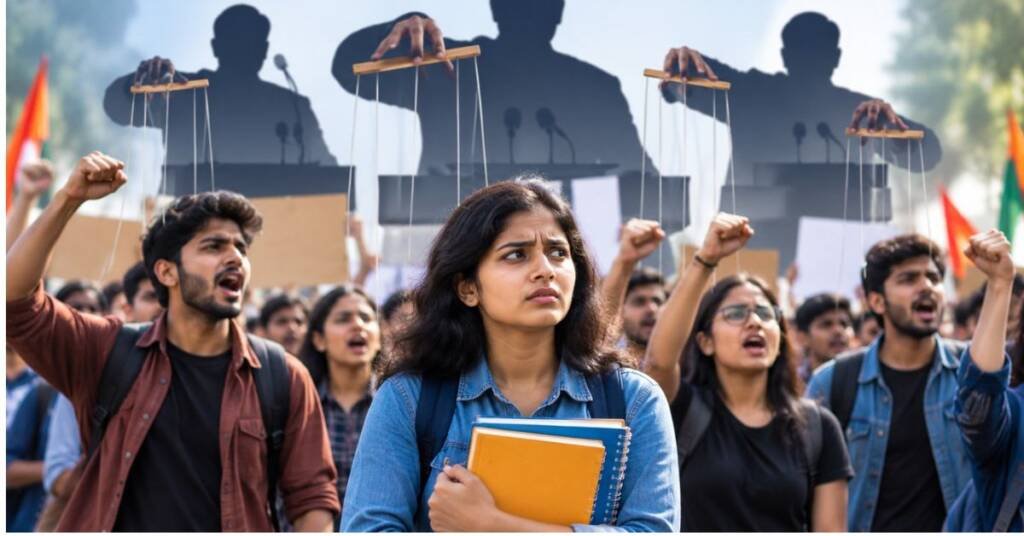
- The recent paper leak controversy saw an unprecedented level of aggression, damage to public property, and chaos, raising a grave and vital question for the entire nation: Was this protest truly aimed at securing justice, transparency, and exam integrity for candidates, or were its strings attached to a much larger political, geopolitical, and ideological polarization?
A History of Selective Silence and Double Standards: A non-partisan look at the history of the past decade reveals numerous severe cases of paper leaks and recruitment irregularities across various states in India, yet the socio-political response in those instances was entirely different:
- The Rajasthan Experience: In 2014, the Army recruitment exam paper was leaked during a BJP administration. Later, in 2021, the REET Level-2 exam paper was leaked and subsequently cancelled. In 2022, candidates appearing for the Senior Teacher Recruitment exam were caught red-handed solving papers inside a moving bus in Udaipur just before the exam. Despite these recurring incidents, no national-level movement or attempt to paralyze the capital took place.
- Irregularities in Telangana: In 2023, the TSPSC Group-1 Prelims paper was leaked. The exam was cancelled, and candidates faced hardship, yet no massive central protest was manufactured.
- West Bengal Teacher Recruitment Scam: In 2022, widespread OMR sheet tampering and data leaks surfaced in the Primary Teacher Recruitment Examination (SSC). Despite judicial intervention and ongoing CBI/ED investigations, the matter remained contained as a state-level legal and administrative issue.
- Jharkhand and Hill States: In 2024, the General Knowledge paper for the Jharkhand CGL exam leaked on the very day of the test. Similarly, in 2022, paper leaks occurred in the Junior Office Assistant recruitment in Himachal Pradesh and the Naib Tehsildar recruitment in Punjab. Main rings were busted and exams were cancelled, but no national storm was created.
- The Case of Uttar Pradesh: In a large state like Uttar Pradesh, paper leaks for police constable recruitment and the Teacher Eligibility Test (TET) occurred during the Chief Minister Yogi Adityanath-led administration. However, aspirants recognized that the administration was taking strict punitive measures against culprits, ranging from gangster act charges to property demolitions. Students clearly understood the operational difference between the UP Police and the Delhi Police.
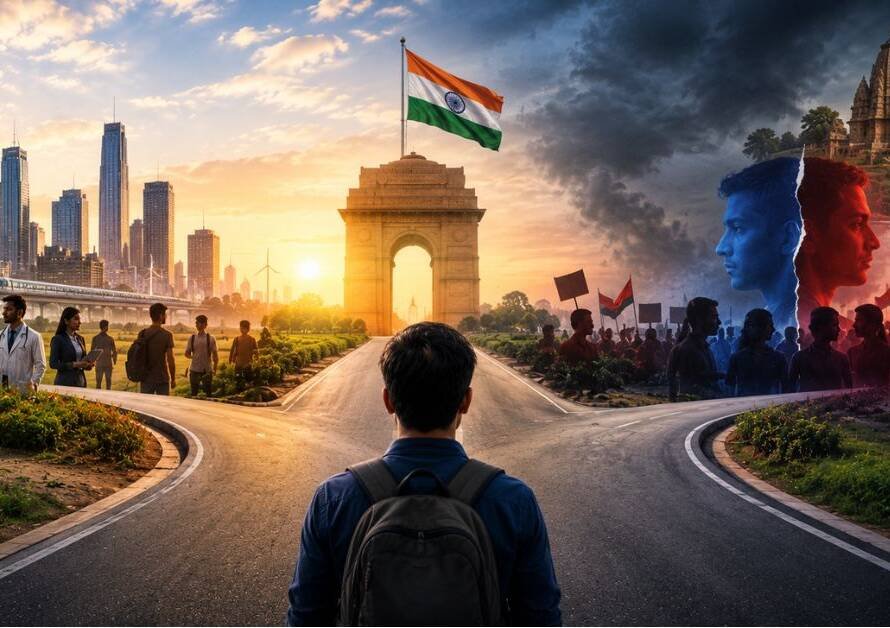
- Answering the Core Question: Why did the outrage that typically remained contained at the state level suddenly transform into calls to “overthrow the government” the moment it reached the borders of Delhi? The straightforward answer is that this anger was not utilized to deliver justice to candidates, but rather to execute a hidden political agenda.
Section 2: The ‘Breaking India’ Module: From Student Welfare to Regime Change
- When a legitimate, sensitive, and moral issue is hijacked to abruptly alter the character of a protest, it ceases to serve the public or students and instead becomes a tool for forces seeking to paralyze the nation. In modern security parlance, this operational framework is termed the “Breaking India Module.”
- This process is executed through a meticulous, step-by-step plan. First, a universal and sensitive issue is selected—one that no section of society can reasonably oppose, such as the future of students. Few parents or citizens would withhold sympathy when the future of youth is at stake.
Capitalizing on Existing Discontent: This agitation was stoked at a time when public frustration was already brewing over certain administrative matters (such as new UGC regulations or alleged irregularities in religious-social institutions). Digital media was mobilized to channel and direct this underlying discontent.
- Planned Hijacking of Core Issues: The primary objective of the candidates was clear and limited: restore exam integrity, jail the corrupt syndicates, and conduct transparent re-examinations within a strict timeframe. However, as crowds gathered, the orchestrators behind the scenes steadily pushed these core demands into the background.
- Dangerous Transformation of Slogans and Postership: What began with slogans focused on administrative accountability—such as “Down with the Education Minister,” “Stop NTA Malpractice,” or “We Want Justice”—swiftly pivoted toward an entirely different ideological direction. Postership featuring radical ideological slogans like “Smash Brahminical Hindutva” and religious chants suddenly surfaced within the crowds.
- Marches Toward Parliament and Engineered Confrontation: A peaceful democratic protest turned violent when agitators breached a pre-designated boundary, tore down four tiers of police barricades, and attempted to march on Parliament. This confrontation was engineered to force security forces into using physical measures, thereby allowing operatives to paint the State as repressive on international platforms.
Section 3: Protected Leaders, Bleeding Students: The Reality Behind the Scenes
The most tragic aspect of this engineered sequence of events is that the innocent aspirants and youths—in whose name the crowds were gathered—were the ones who ultimately suffered the brunt of administrative action and police batons.
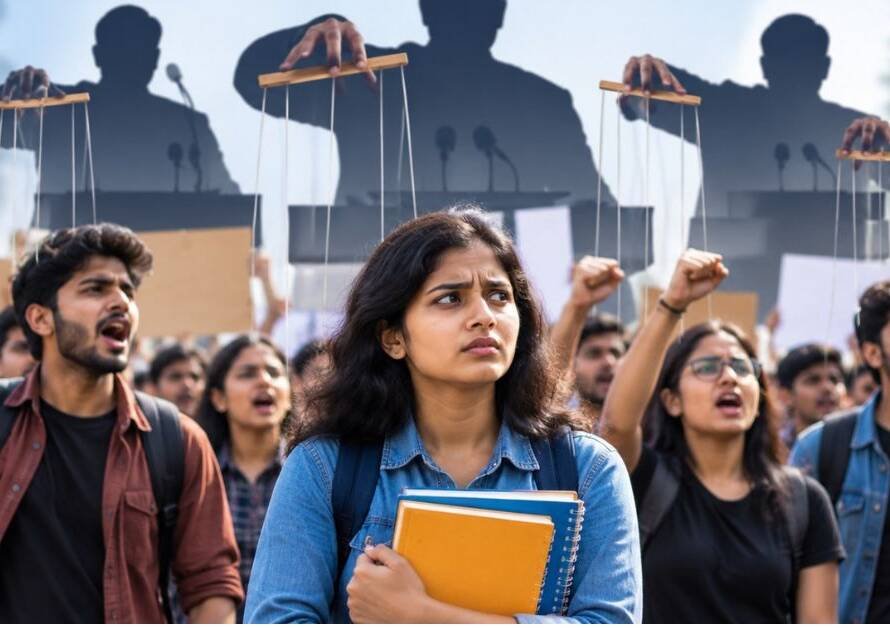
- Comfortable Politics from Air-Conditioned Rooms: While ordinary students taking to the streets were left bleeding from police lathi-charges, losing precious academic years, and facing legal complications, the key strategists running the stage, delivering provocative speeches, and operating the digital toolkits remained completely safe.
- Immense Comfort and Political Bargaining: As barricades were torn down on the streets and young aspirants bore the force of police batons, the self-proclaimed leaders of the movement were enjoying meals in closed rooms or sipping tea at the residences of political leaders, negotiating their next strategic moves.
- Using Students as a ‘Human Shield’: The ultimate truth of this module is that ordinary students were deployed as human shields. Strategists knew that placing students at the front lines during police actions would generate media headlines accusing the government of “inhumane” and “unconstitutional” behavior, damaging the administration’s moral authority. Once violence broke out, these handlers vanished from the scene.
Section 4: Administrative Accountability vs. Sponsored Anarchy
Following the escalation and police actions, a one-sided narrative emerged asserting that the government acted in an unconstitutional, authoritarian, and inhumane manner. However, a mature society must analyze where the line between administrative accountability and sponsored anarchy lies.
- Prompt and Transparent Administrative Action:
- Immediate Punitive Action: As soon as the paper leak surfaced, investigative agencies (CBI) were brought in, and key operators of the leak syndicates were identified and jailed.
- Public Acceptance of Responsibility: The Education Minister personally appeared before national media to issue a public apology to the candidates and the nation, setting an unprecedented standard of administrative accountability.
- Re-Examination in Record Time: Within a month, the examination framework was restructured, a fair re-examination was organized, and updated results were declared while protests were still ongoing.
- Political Blackmail Under the Guise of Accountability: If an expensive item ordered online is stolen by a delivery driver and replaced with a stone, the consumer demands a refund, systemic correction, and punishment for the thief—they do not demand the resignation of the company owner or attempt to set the corporate building on fire.
- The Real Game Behind Demanding Resignations: When the administrative machinery actively works to rectify flaws, punish culprits, and re-conduct exams within a set timeframe, continuing to insist strictly on the “resignation of the Education Minister” or the “prime minister’s exit” demonstrates that the objective was not reform, but political destabilization. Had a minister resigned under pressure, the toolkit syndicate would have leveraged that success to trigger a larger disruption aimed at forcing out a democratically elected government.
Conclusion
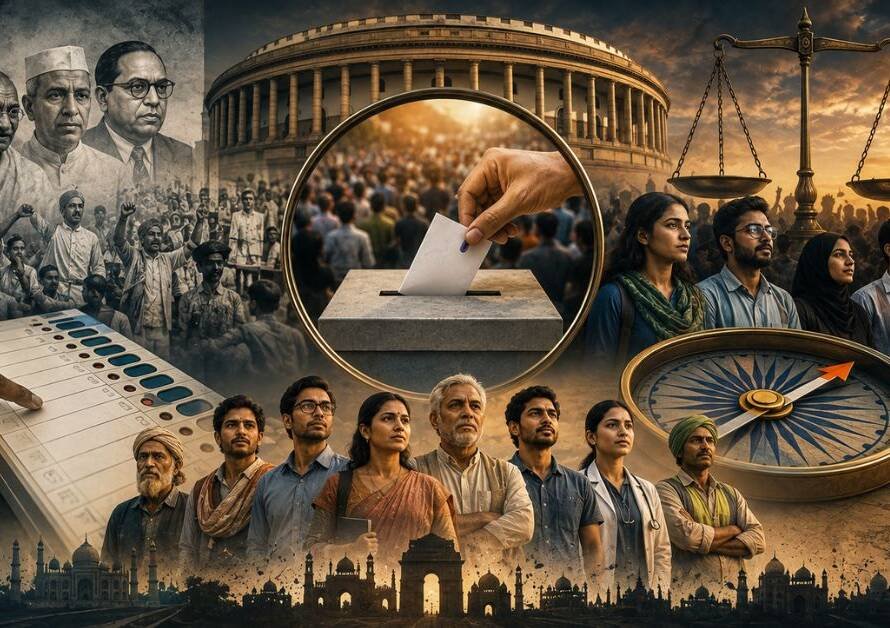
- This entire sequence of events extends beyond the success or failure of a single competitive examination system; it serves as a critical warning for India’s future policymakers and youth. The outrage of hardworking aspirants and their families was completely justified, and exam syndicates must face severe legal consequences.
- However, young citizens must recognize the importance of retaining direct ownership over their movements whenever they take to the streets for legitimate rights.
- Allowing external political operatives, PR agencies, and foreign-funded toolkits to leverage their platform ultimately sacrifices their own aspirations, while figures behind the scenes exploit their struggle for political gain before quietly stepping away.
🇮🇳Jai Bharat, Vandematram 🇮🇳
Read our previous blogs 👉 Click here
Join us on Arattai 👉 Click here
👉Join Our Channels👈