Summary:
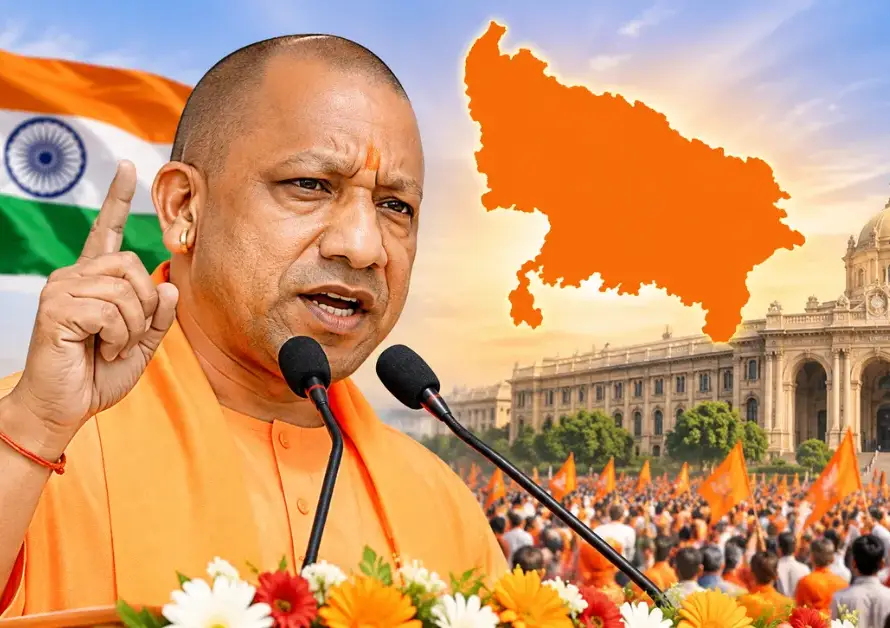
- This political analysis examines Yogi Adityanath’s three decades of unblemished public representation, his administrative reforms, and his growing organizational coordination within the Bharatiya Janata Party.
- The article provides a detailed account of achievements in law and order, infrastructure, economic growth, and cultural renaissance during his tenure as Chief Minister of Uttar Pradesh.
- Furthermore, it highlights that following the strong governance records of nationalist leaders such as Prime Minister Narendra Modi, Yogi Adityanath, Himanta Biswa Sarma, Suvendu Adhikari, and Pushkar Singh Dhami, the Indian electorate has become thoroughly politically aware.
- Citing electoral outcomes over the past two years—where the BJP and NDA have secured decisive victories across most parts of the country—the piece concludes that divisive and anti-national elements hoping to return to power in the 2027 Uttar Pradesh Assembly elections and the 2029 Lok Sabha elections through misleading narratives will no longer succeed.
Yogi Adityanath’s Leadership and Governance Model
1. Three Decades of an Unblemished Journey and the Support of Guiding Leadership
Yogi Adityanath’s public life and journey as a people’s representative symbolize 30 continuous years of dedicated, struggle-filled, and spotless experience.
- Unblemished Image: Whether during his 20 consecutive years of public service and struggle as the Member of Parliament from Gorakhpur or his nearly 10-year administrative tenure as the Chief Minister of Uttar Pradesh—despite numerous political challenges, not a single allegation of corruption or impropriety has stained his record.
- The Strategic Role of Modi-Shah: Prime Minister Narendra Modi stands senior in terms of age, experience, and constitutional stature. According to political analysts, the autonomy granted to Yogi Adityanath to prove himself and his administrative refinement owe significantly to the strategic roles of Narendra Modi and Amit Shah—credit that Yogi Ji himself gladly attributes to the Prime Minister.
- Maturing Organizational Acceptance: In a cadre-based political party, alongside administrative efficiency, a strong grip on the organization and widespread organizational acceptance are the most decisive factors. Having long established himself as an accepted leader of the public and the government, Yogi Adityanath is now steadily emerging as an equally cohesive and strong force within the party organization—a continuous, natural process that political opponents unnecessarily attempt to portray as controversy.
2. The Administrative, Economic, and Infrastructural Model of Yogi Adityanath’s Governance
As Chief Minister of Uttar Pradesh, Yogi Adityanath’s tenure has transitioned the state out of its former ‘BIMARU’ image to place it among the country’s leading economies:
- ‘Zero Tolerance’ on Law and Order:
- Taking stringent action against organized crime and mafia networks, 53 major gangs have been dismantled, and illegal properties worth over ₹4,000 crore belonging to mafias have been seized or demolished.
- To modernize the police force, over 2.19 lakh personnel were recruited transparently, bringing down the response time of the emergency service ‘UP-112’ to roughly six minutes. ‘Mission Shakti’ has significantly enhanced women’s safety and their participation in the workforce.
- World-Class Infrastructure and Connectivity:
- Whereas the state had only two expressways in 2017, Uttar Pradesh has now emerged as India’s ‘Expressway State’ with 22 expressways (operational and under construction).
- The number of operational airports has grown from 2 to 16 (with several others, including the Noida International Airport, under construction), metro services are operating in 7 cities, and the ‘Namo Bharat’ rapid rail between Delhi and Meerut has accelerated regional transit.
- Economic Surge and Employment Generation:
- Uttar Pradesh’s Gross State Domestic Product (GSDP) has expanded from ₹13 lakh crore to nearly ₹36 lakh crore, raising the state’s contribution to the national economy to 9.1%.
- Initiatives like ‘One District-One Product’ (ODOP), the Defence Corridor, and the establishment of semiconductor and deep-tech hubs in Noida have sparked industrial growth. Over the past nine and a half years, more than 9.5 lakh government jobs have been provided without nepotism or recommendations, and according to NITI Aayog reports, 6 crore people in the state have risen above the poverty line.
- Cultural Renaissance and Tourism:
- The construction of the grand Shri Ram Temple in Ayodhya, the Kashi Vishwanath Dham Corridor, and the historic organization of the Prayagraj Maha Kumbh 2025 have brought global recognition to the state’s cultural heritage.
3. An Aware Electorate in the Modi Era and the Clear Mandate for 2027 & 2029
Today, not only in Uttar Pradesh, but across the nation, the governance records of Prime Minister Narendra Modi at the Center and strong nationalist leaders in the states—such as Yogi Adityanath, Himanta Biswa Sarma (Assam), Suvendu Adhikari (West Bengal), and Pushkar Singh Dhami (Uttarakhand)—have established a distinct benchmark of good governance and cultural nationalism.
- A Decisive Answer to Misleading Politics and Anti-National Elements:
- Divisive and anti-national elements harbouring the delusion that they can return to power in the 2027 Uttar Pradesh Assembly elections and the 2029 Lok Sabha elections on the back of caste divisions or false narratives must recognize that the Indian voter of the Modi era can no longer be misled.
- Testimony of Election Results Over the Past Two Years:
- The outcomes of assembly and local elections held across the country over the past two years stand as direct proof that the public stands firmly behind development, security, and ‘Nation First’ policies.
With continuous victories, the BJP and NDA have swept away the opposition across most states—even securing historic mandates in states like West Bengal and Assam. Even in the handful of states where opposition parties remain in power, they are facing a stiff and decisive challenge from the BJP and NDA.
Conclusion
- Yogi Adityanath’s 30 years of unblemished public dedication, solid record of good governance, and growing coordination with the party organization are laying a strong foundation for India’s future.
- Today, the country’s electorate has decisively rejected the politics of appeasement and anarchy.
- The public’s unwavering trust in this mission of good governance, national security, and cultural pride indicates that the victory march of nationalist leadership will continue unobstructed in Uttar Pradesh in 2027 and across India in 2029.
🇮🇳Jai Bharat, Vandematram 🇮🇳
Read our previous blogs 👉 Click here
Join us on Arattai 👉 Click here
👉Join Our Channels👈