Summary
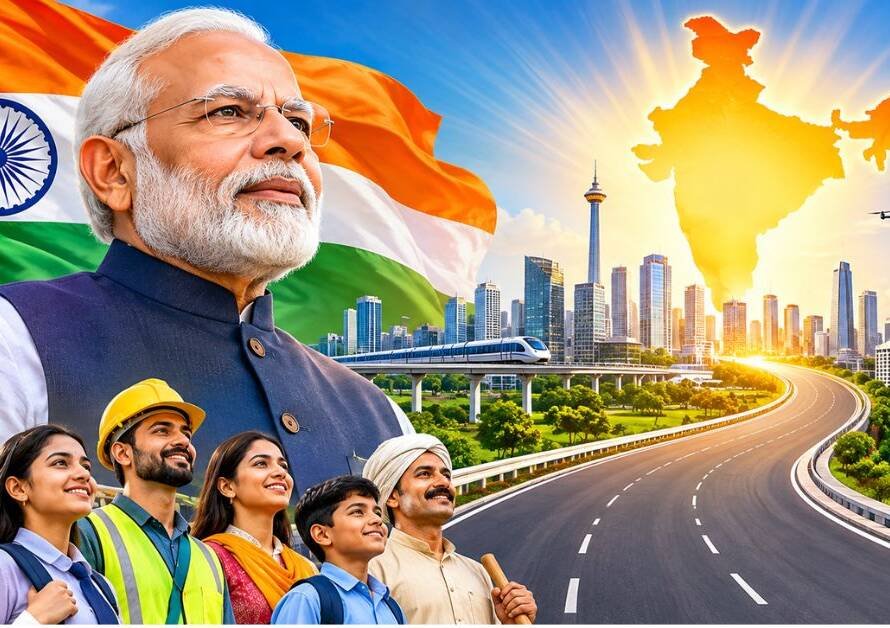
- The quarter-century arc of Narendra Modi’s executive leadership (2001–2026)—and specifically the transformative 12 years at the helm of the national government—represents a monumental turning point in modern history.
- By moving away from foreign governance templates and deploying an indigenous doctrine rooted in Ram Neeti, Krishna Neeti, and Chanakya Neeti, the administration has systematically rebuilt state capability.
- India has evolved from chronic infrastructure deficits, welfare leakages, and strategic vulnerability into a high-growth, technologically empowered, and militarily self-reliant nation. Coordinated domestic abuse and foreign-backed destabilization campaigns have failed to break the bond of trust between the leadership and the patriotic populace.
12 Years of Transformation and the Vision for Viksit Bharat @2047
A Epochal Shift in Civilizational Statecraft
- Quarter-Century Executive Continuity: On October 7, 2001, Narendra Modi assumed executive office as Chief Minister of Gujarat, initiating an unbroken 25-year arc of public leadership comprising 13 years in Gujarat (2001–2014) and 12 years as Prime Minister of India (2014–2026).
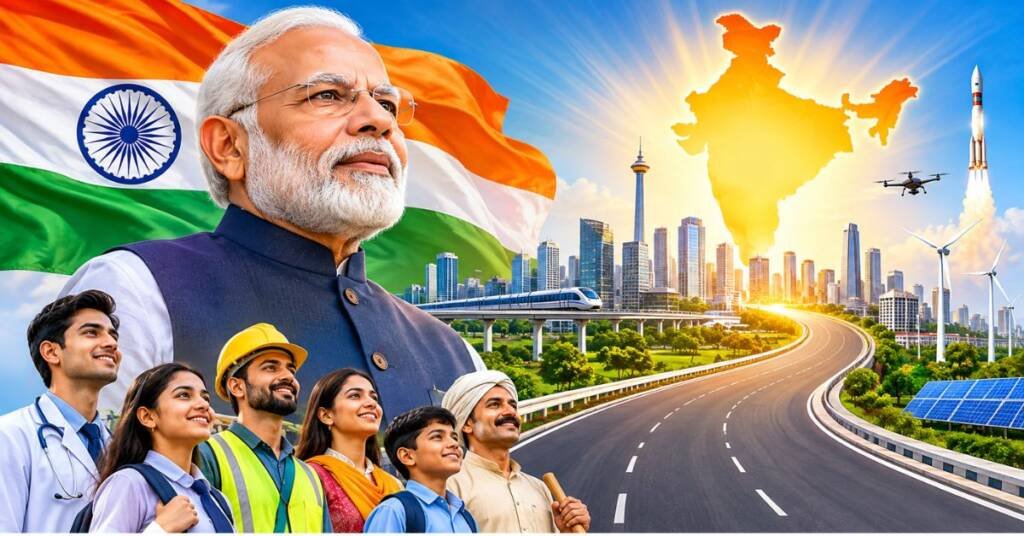
- The 12-Year Paradigm Pivot: Between 2014 and 2026, India transitioned from a state burdened by administrative paralysis, systemic leakages, and strategic hesitation into a confident, self-reliant global power operating on high-speed execution.
- The Triad of Classical Statecraft: The administration’s operational doctrine integrates Ram Neeti (ethical governance and last-mile welfare), Krishna Neeti (proactive deterrence, moral clarity, and agile diplomacy), and Chanakya Neeti (economic scale, institutional strength, and financial security).
- Mindset & Sovereignty: Beyond physical assets, the last 12 years have dismantled civilizational amnesia, instilling an aspirational ethos of Atmanirbhar Bharat (Self-Reliant India) and laying the groundwork for full developed-nation status by 2047.
Phase I: How India Has Transformed in the Last 12 Years (2014–2026)
- Economic Scale, Formalization & Financial Inclusion:
- Ascent to Top Growth Engine: Elevated India’s economy from the “Fragile Five” ranking to the top-tier fast-growing major economy, expanding national GDP and building massive capital reserves.
- Tax & Market Integration: Unified the internal market through the Goods and Services Tax (GST), formalizing millions of small enterprises and widening the tax base.
- Eradication of Leakages: Deployed the JAM Trinity (Jan Dhan, Aadhaar, Mobile) to power the world’s largest Direct Benefit Transfer (DBT) system, eliminating middleman corruption.
- Infrastructure & Transportation Revolution:
- Highways & Expressways: Doubled the speed of national highway construction, building world-class expressways and dedicated freight corridors to drastically lower logistics costs.
- Aviation-Grade Railway Overhaul: Transformed decrepit, legacy railway stations into modern, airport-like transit hubs, supported by the nationwide deployment of indigenous Vande Bharat and Amrit Bharat trains.
- Port-Led & Maritime Growth: Doubled national port capacity and operationalized inland waterways, accelerating supply chain speed through PM Gati Shakti.
- Digital Public Infrastructure (DPI) & Tech Leadership:
- Financial Sovereignty: Created the Unified Payments Interface (UPI), processing billions of instant transactions monthly and establishing global benchmarks for digital payment adoption.
- Startup Surge: Expanded the startup ecosystem from fewer than 500 recognized ventures in 2014 to over 2.3 lakh startups by 2026, creating an engine for indigenous deep-tech innovation.
- Last-Mile Dignity & Universal Welfare (Antyodaya):
- Basic Infrastructure as Entitlement: Delivered tens of millions of permanent homes (PM Awas Yojana), piped drinking water connections (Jal Jeevan Mission), clean cooking gas (PM Ujjwala), and sanitation coverage (Swachh Bharat).
- Health Security: Established Ayushman Bharat, providing free tertiary healthcare coverage to over 500 million citizens, ensuring welfare without identity-based appeasement.
- Defense Autonomy & Internal Security Hardening:
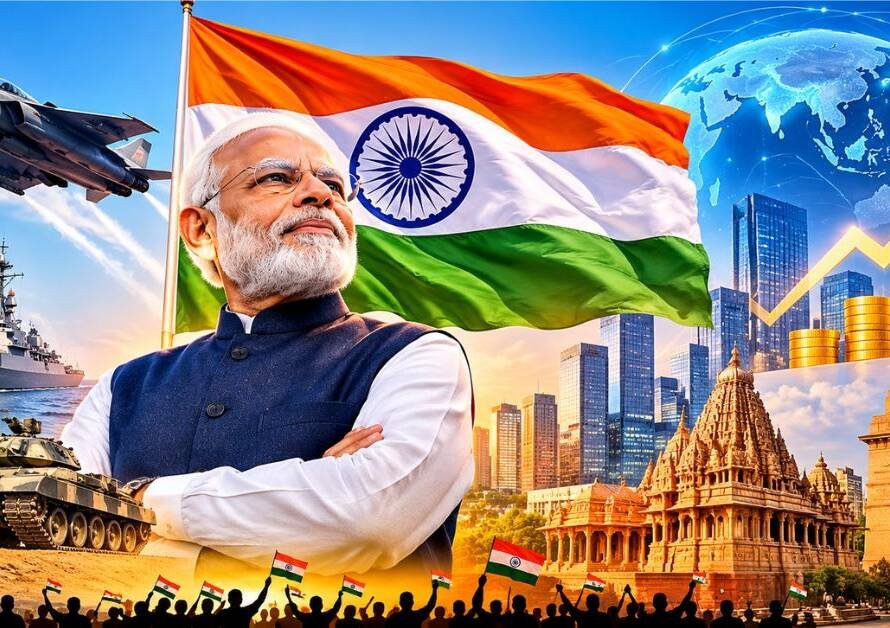
- Proactive Deterrence: Replaced strategic hesitation with active deterrence, demonstrated by the 2016 surgical strikes, 2019 Balakot airstrikes, and rapid border infrastructure buildup along the Line of Actual Control (LAC).
- Defense Indigenization (Swayam Siddhi): quadrupled domestic military production, deploying indigenous platforms such as the Tejas LCA and INS Vikrant, while transforming India into a net defense exporter.
- Internal Stability: Neutralized Left-Wing Extremism (LWE) to historic lows, dismantled terror-funding networks (Artha-Choking), and achieved complete legal integration of Jammu & Kashmir via the abrogation of Article 370.
Phase II: Neutralizing Subversion & The Shield of Unshakable Trust
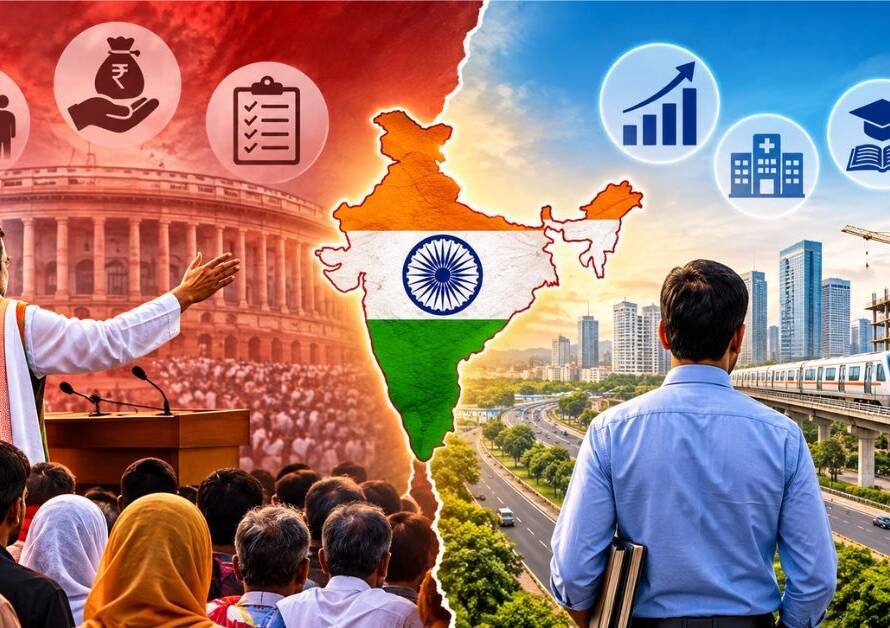
- Futility of Opposition Vitriol: Chronic electoral defeats have driven opposition factions into deep frustration, replacing constructive debate with personal abuse, crude taunts, and unparliamentary rhetoric against Prime Minister Modi.
- Collapse of “Regime Change” Conspiracies: Coordinated narrative warfare, foreign-backed disinformation, and attempts to manufacture social paralysis have consistently collapsed against an alert, politically mature citizenry.
- Exposing the Past Record: The public remembers past decades of policy paralysis, mega-scams, and weak security postures. No amount of media spin or political whitewashing can erase the memory of past misgovernance.
- An Impervious Civilizational Bond: The connection between Prime Minister Modi and the people is built on 25 years of unbroken public service (Seva). He lives in the hearts of patriotic citizens across India and the global diaspora, ensuring that Narendra Modi is nowhere going.
Phase III: Future Strategic Directions — The Roadmap to Viksit Bharat @2047
- Economic Hegemony ($30 Trillion Goal):
- Transition India into a high-income developed economy by expanding high-value manufacturing (Make in India), deep-sea mining, and dominating critical global supply chains.
- Deep Tech & Technological Sovereignty:
- Secure full independence in strategic technology domains, including domestic semiconductor fabrication units, commercial AI ecosystems, quantum computing networks, and bio-manufacturing hubs.
- Clean Energy Independence & Green Dominance:
- Achieve complete energy security by 2047 through green hydrogen corridors, fast-breeder nuclear expansion, and global leadership in the International Solar Alliance.
- Advanced Defense & Space Command:
- Project blue-water naval dominance across the Indo-Pacific, master hypersonic weapon systems, and build autonomous defense-space operational capabilities.
- Vishwaguru as a Global Moral Anchor:
- Lead global governance anchored in Vasudhaiva Kutumbakam (The World is One Family), acting as a dependable Vishwamitra (global friend) that balances cutting-edge technology with human-centric Sanatana values.
Conclusion
- The structural achievements of the past 12 years demonstrate that civilizational statecraft provides a practical, highly effective blueprint for 21st-century nation-building.
- As India marches toward Viksit Bharat @2047, the institutional groundwork laid over the last 25 years ensures that the nation is no longer a passive bystander in world affairs, but an active architect of global destiny.
- Prime Minister Narendra Modi’s vision remains securely anchored in public trust, driving Bharat toward its rightful destiny as a sovereign, prosperous, and respected Vishwaguru.
🇮🇳Jai Bharat, Vandematram 🇮🇳
Read our previous blogs 👉 Click here
Join us on Arattai 👉 Click here
👉Join Our Channels👈
Reads & Views: 72