Summary
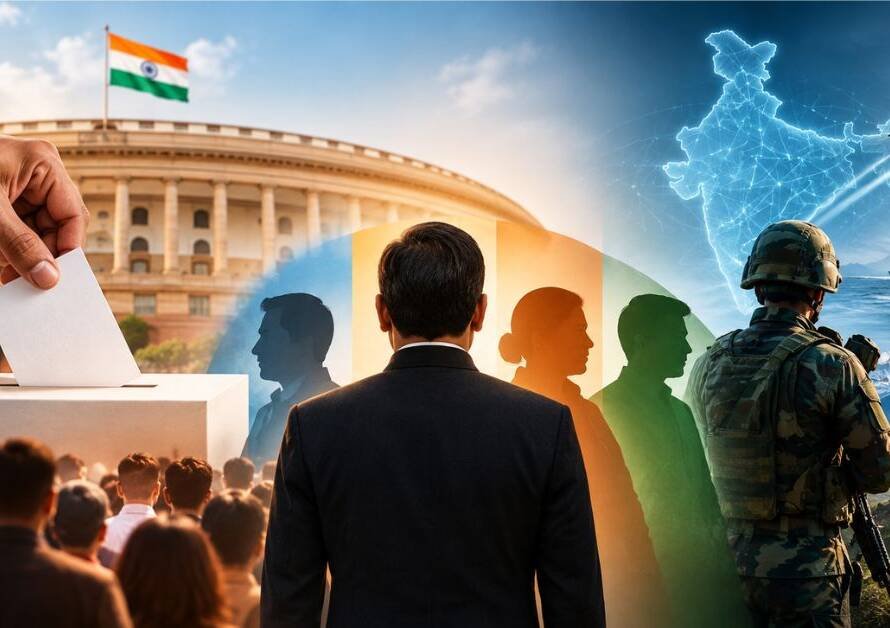
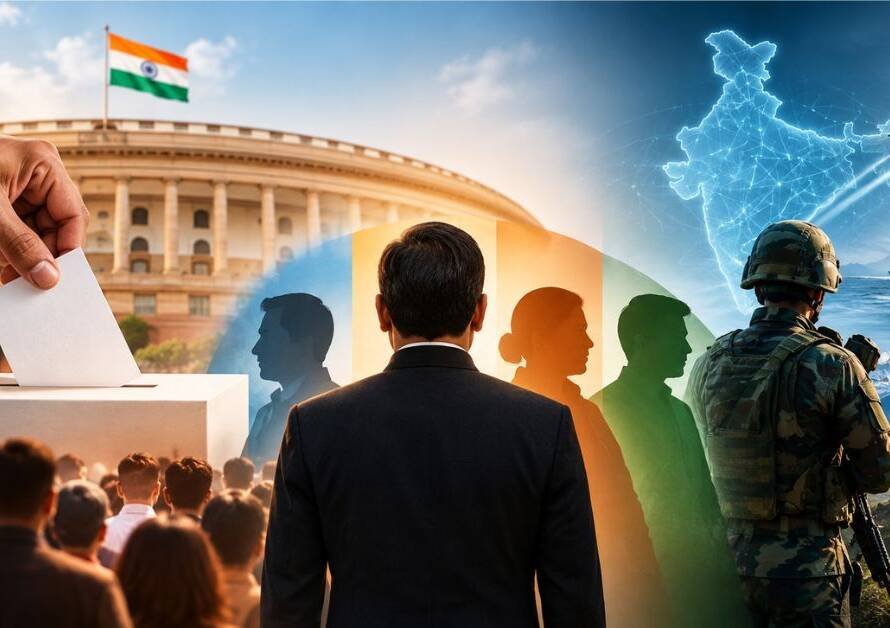
- This strategic analysis presents an in-depth examination of a momentous shift in contemporary Indian politics—the decline of the politics of dynasticism, appeasement, and caste-based polarization.
- Through striking examples from both global and Indian political history, this piece highlights that the nation’s electorate has become thoroughly awakened.
- The discourse establishes how an enlightened society and a discerning public have tasted the benefits of development-oriented, transparent, and honest governance.
- Consequently, if the opposition fails to replace its outdated colonial stratagems with a nation-centric alternative strategy, it risks fading from the active political landscape into the pages of history.
The Importance of Accountability in Democracy
I. Global and Indian Democracy: Defeat and Moral Accountability
The greatest hallmark of a healthy, robust, and mature democratic system is that while success is celebrated with grandeur, the responsibility for electoral failure is accepted with equal grace, dignity, and morality. Accountability is the very soul of democracy.
- Global Examples (Lessons from the UK and Canada): In recent times, former British Prime Minister Rishi Sunak not only stepped down immediately following his Conservative party’s defeat in the general election but also took full moral responsibility for the loss. Similarly, in Canada, as Justin Trudeau’s declining popularity brought an existential crisis upon his party, internal demands for a leadership change naturally emerged. Prior to this, the stellar political careers of heavyweight leaders in the UK, like Ed Miliband, shifted to the background following a single major electoral failure because their system demands accountability.
- High Standards in Indian Politics: Even if we set aside Western examples, India’s own political history offers shining examples. Leaders like P.V. Narasimha Rao and Sitaram Kesri of the Congress, as well as the towering icon of the Bharatiya Janata Party, L.K. Advani, embody this principle. Whenever the party weakened or faced major electoral defeats under their watch, these stalwarts unhesitatingly took responsibility for the loss and paved the way for new leadership.
II. The Exception in the Indian Opposition: Endless Defeat and the Shield of Narratives
However, in the history of contemporary Indian democracy, we are witnessing an unprecedented, peculiar political paradigm where all established rules of defeat, principles of accountability, and democratic norms have been inverted.
- A Leadership Immune to Accountability: The central face of the country’s oldest political party—Rahul Gandhi—experiences electoral setbacks that become strategically more pronounced with each election cycle. Yet, with equal speed and orchestration, the surrounding ecosystem systematically constructs a protective narrative (a shield) that insulates him from any structural accountability.
- Celebrating Defeat as Victory: Despite dozens of consecutive electoral losses—whether in national general elections or various state assembly polls—every failure is redefined by the opposition as a ‘moral victory’ or a ‘new chapter of struggle.’ This irony openly mocks the core principles of democratic accountability.
III. Ideological Decay: The End of Dynasticism, Appeasement, and Divisive Politics
The current political landscape and the social atmosphere of the country bear clear witness that the ideological crutch that sustained the opposition’s grip on power for decades is now completely broken.
- An Awakened Society and the Failure of Appeasement: Breaking free from linguistic and regional silos, India’s majority society is now thoroughly awakened and unified. The decades-old politics of one-sided appeasement and the colonial strategy of fracturing society along caste lines to capture power have proved to be absolute failures. The public now fully sees through this dangerous game of pseudo-secularism.
- The Resolve of Dynasticism vs. Nationalism: The era when the public voted blindly based purely on a ‘surname’ or lineage belongs to the past. Today’s enlightened, tech-savvy, and smart electorate has looked beyond a single family’s political monopoly, having tasted a progressive and transparent model driven by a Nation-First spirit (Honest Governance). The ordinary citizen has witnessed on the ground that rapid, inclusive growth is entirely possible without dynastic corruption.
IV. A Weakened Opposition: An Existential Crisis and the Risk of Becoming History
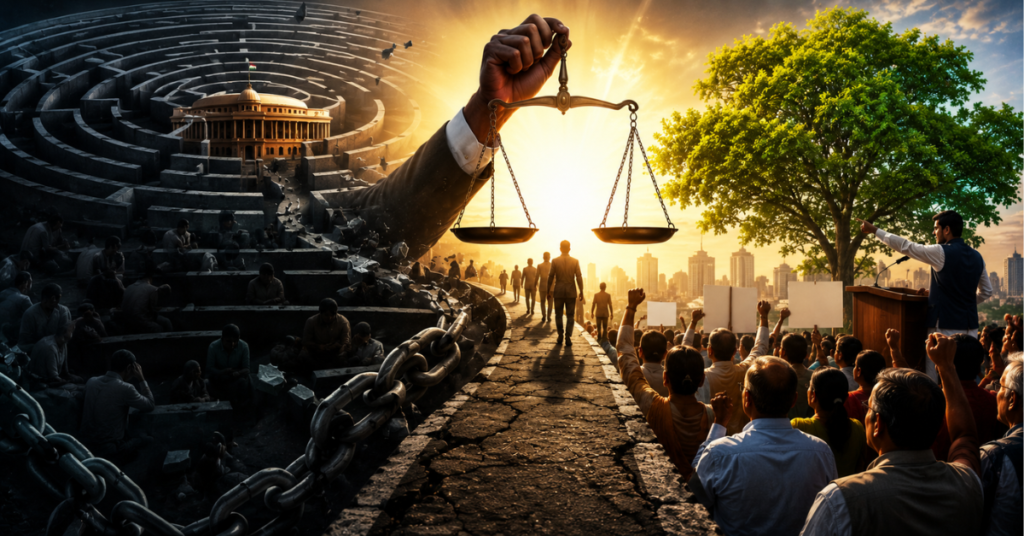
This issue extends far beyond the internal friction of a single political party; it directly impacts the equilibrium of Indian democracy itself. If the opposition does not radically overhaul its strategies in time, its very existence faces erasure.
- The Imperative for an Alternative Strategy: Politics can no longer be sustained over the long term on hollow claims, the culture of short-term freebies, or narratives designed to turn communities against each other. The opposition has only one viable path left to preserve its relevance—it must present itself to the public with a positive, pragmatic, and viable alternative blueprint (Alternate Strategy) centered on national development, security, and public welfare.
- The Risk of Fading Into History: If the opposition rigidly clings to its outdated, anti-development colonial stratagems, it will soon vanish entirely from India’s active political landscape, remaining confined only to the pages of history textbooks.
V. A Call to the Veteran Leadership and the Need for Restructuring
If the Congress party still possesses grounded, deeply experienced, and organizationally capable leaders (such as Digvijaya Singh, Kamal Nath, Ashok Gehlot, or D.K. Shivakumar), this is not the time to remain passive spectators—it is the time for a final strategic intervention.
- Maturity and the Time to Hand Over the Reins: A leadership that has been given more than a decade of time and dozens of electoral opportunities (an experience spanning over 99 elections) as an experiment should now, upon crossing the age of 56, be formally congratulated and respectfully transitioned away from core organizational and strategic roles.
- The Dawn of a New Political Era: The health and strength of Indian democracy lie in the opposition rising above its internal contradictions, its old attachment to appeasement, and its dynastic shackles. If senior and experienced hands assume control even now, the restructuring of a thoughtful, serious, policy-driven, and robust opposition remains possible. Otherwise, time is an unyielding force, and history proves that time waits for no one.
🇮🇳 Jai Bharat, Vandematram 🇮🇳
Read our previous blogs 👉 Click here
Join us on Arattai 👉 Click here
👉Join Our Channels👈