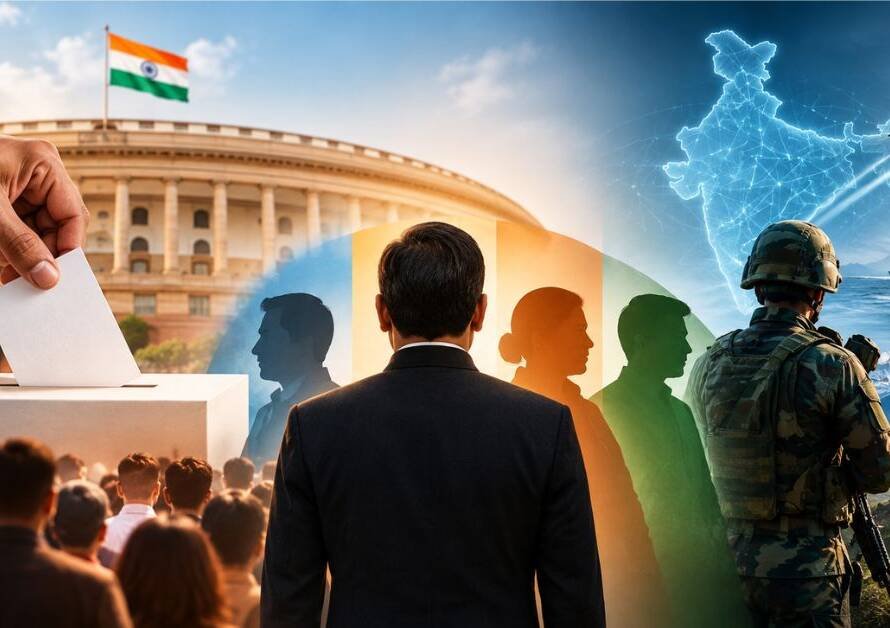
Executive Summary
- This strategic analysis exposes the ongoing ‘Grey-Zone Warfare’ in South Asia, specifically focusing on India’s Northeast, Myanmar, and Bangladesh.
- This article posits that the ethnic violence in Manipur, the civil war in Myanmar, the narco-syndicates of the ‘Golden Triangle’, and the regime change in Bangladesh are not isolated incidents but interconnected international intelligence fronts.
- The analysis highlights how India is adopting an aggressive and deterrent security policy to safeguard its strategic autonomy.
‘Grey-Zone’ Tactics in South Asia
1. The Modern Doctrine of Grey-Zone Warfare
- The balance of power in South Asia is no longer dictated solely by conventional military borders. Global superpowers are resorting to ‘Grey-Zone Warfare’—an invisible front operating in the twilight between peace and open conflict.
- This battle is fought through internal ethnic fault lines, digital espionage, control over deep-sea ports, and drone corridors.
- Following Donald Trump’s return to the White House, it became clear within Washington’s strategic circles that India would not compromise its ‘strategic autonomy’.
- India’s refusal to become a ‘junior partner’ triggered the deployment of a complex intelligence chessboard designed to encircle New Delhi from Dhaka to Manipur.
2. Project K and India’s Northeast
Intelligence corridors are abuzz with discussions surrounding a long-term blueprint codenamed “Project K,” aimed at creating permanent instability across India’s northeastern states, the Myanmar border, and the hill tracts of Bangladesh.
- Weaponization of Ethnic Links: This strategy exploits the cultural and kinship ties of the Kuki-Chin-Mizo communities spanning India, Myanmar, and Bangladesh to fuel demands for an ‘independent corridor’.
- The Manipur Nexus: The violence in Manipur was not merely a localized ethnic dispute. According to security agencies, it was a orchestrated plot prolonged for months via cross-border sophisticated weaponry, illegal immigrants, and highly organized narcotics corridors.
- Revival of Colonial Policies: Foreign entities are weaponizing British-era policies like ‘Excluded Areas’ to revive separatist tendencies, directly undermining India’s federal integrity.
3. Myanmar Civil War and ‘Golden Triangle 2.0’
The 2021 military coup in Myanmar has directly impacted India’s security and trans-national economic projects.
- Blow to ‘Act East’: Due to intense conflict in Myanmar’s Chin and Arakan states, multi-billion-dollar strategic initiatives like the Kaladan Multi-Modal Transit Transport Project and the Trilateral Highway remain in limbo.
- Narco-Terrorism: Myanmar’s Ethnic Armed Organizations (EAOs) have revived the ‘Golden Triangle’ drug networks to fund their insurgencies. Synthetic drugs have emerged as their primary revenue stream.
- Poppy Cultivation: When Indian authorities cracked down on illegal poppy cultivation in the border regions, the drug mafia successfully manipulated local grievances into armed rebellion.
4. The Bangladesh Crisis and the Geopolitics of the Bay of Bengal
The political upheaval in Bangladesh emerged as a massive security threat for the entire South Asian landscape.
- St. Martin’s Island: This island became the epicenter of a geopolitical tug-of-war. The United States sought logistical access to the island to monitor the Strait of Malacca, while China pressured Dhaka to prevent American entry.
- The Fall of Sheikh Hasina: When Hasina refused to grant any foreign power a military base on the island, a conspiracy was set in motion. The student protests were hijacked by Jamaat-e-Islami and foreign intelligence sleeper cells, eventually forcing her to seek refuge in India.
5. Counter-Intelligence and Preventive Strikes
India has taken several aggressive measures to neutralize foreign interference:
- Crackdown on Foreign Elements: A US national lobbying for Chin rebel groups died under suspicious circumstances in Aizawl. Following this incident, several other American agents caught operating in restricted zones were summarily deported.
- Foiling the Dhaka Coup: A military mutiny against Army Chief General Waker-uz-Zaman was plotted in collaboration with Pakistan’s ISI. Indian intelligence intercepted the plot and averted the coup by handing over decisive digital evidence to the Bangladeshi military in a timely manner.
- VVIP Protection: A foreign sharpshooter plotting an assassination attempt on Prime Minister Modi during an international summit was neutralized inside a Dhaka hotel. This was a classic preemptive strike.
6. The Pragmatic Aspect of India-China Relations
- While India and China remain fierce border rivals, both nations share a consensus that no third superpower (specifically the US or NATO) should establish a permanent military footprint in South Asia.
- Furthermore, both New Delhi and Beijing face shared security threats from rising religious radicalism in their immediate neighborhood.
7. The NIA and the International Drone Syndicate
- The National Investigation Agency (NIA) busted a major international syndicate. Matthew Aaron VanDyke, an American national and founder of ‘Sons of Liberty International’, was arrested.
- Investigations revealed that under the guise of ‘humanitarian aid’, this organization was smuggling military-grade drones, night-vision optics, and encrypted communication equipment to rebel factions inside Myanmar.
8. America’s New ‘Logistical Chess Game’
- Instead of establishing traditional, overt military bases, Washington is now pressuring Bangladesh to sign agreements like ACSA (Acquisition and Cross-Servicing Agreement) and GSOMIA (General Security of Military Information Agreement).
- The objective is to secure ‘logistical access’ to the Chittagong and Matarbari ports, which would place India’s Eastern Naval Command and military movements in the Andaman and Nicobar Islands under direct US surveillance.
- South Asia is the primary theater for the 21st century’s ‘Great Game’. For India, the stakes have never been higher. By sealing vulnerable borders, dismantling transnational drone syndicates, and deploying aggressive diplomacy,
- New Delhi has signaled that it is no longer a mere spectator on the South Asian chessboard—it is the principal player writing the rules.
🇮🇳 Jai Bharat, Vandematram 🇮🇳
Read our previous blogs 👉 Click here
Join us on Arattai 👉 Click here
👉Join Our Channels👈
Reads & Views: 117