Summary
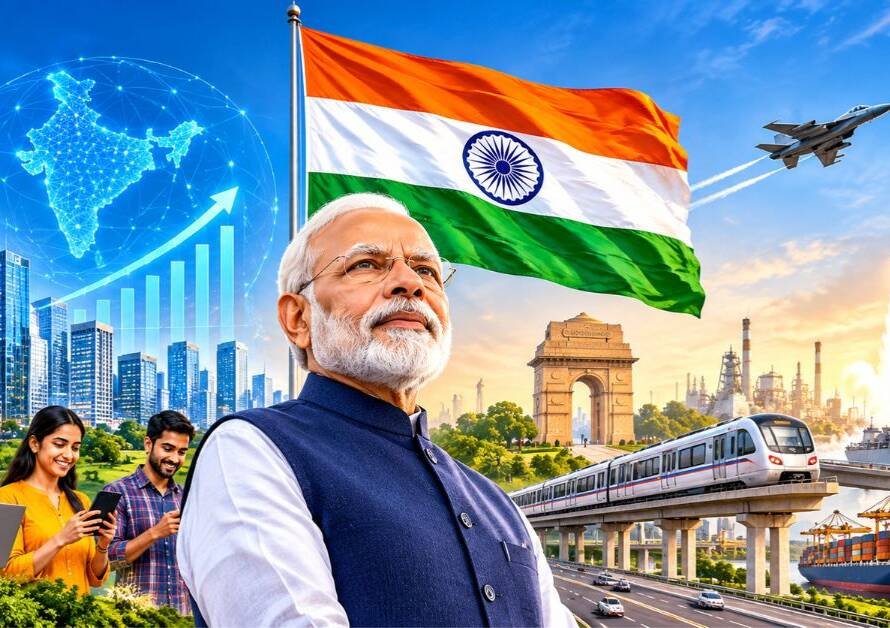
- Over the past decade, India has undergone a historic paradigm shift, redefining its global standing across economic, technological, and strategic dimensions.
- Driven by structural reforms, domestic manufacturing initiatives like “Make in India” and Production Linked Incentive (PLI) schemes, and a revolutionary Digital Public Infrastructure (DPI), the nation has transitioned from being one of the “Fragile Five” to the world’s fastest-growing major economy.
- Concurrently, India’s proactive diplomacy—anchored by the “Necklace of Diamonds” strategic doctrine and maritime engagements across the Indo-Pacific—has secured vital sea lanes, enhanced defense exports, and established the country as a pivotal anchor of the Global South.
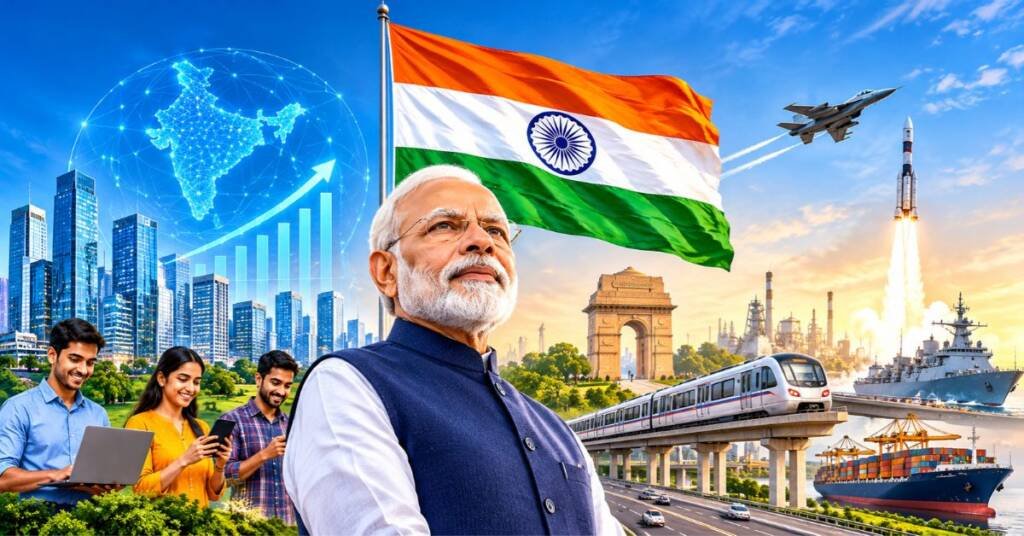
- This narrative details India’s multi-faceted growth story, highlighting its economic resurgence, technological innovations, infrastructure expansion, and unwavering commitment to nation-building.
India’s Growth: Economy, Digital Progress, and Sovereignty
1. Economic Resurgence and the Manufacturing Renaissance
India’s economic trajectory over the last ten years demonstrates unparalleled resilience amidst global supply chain disruptions and macroeconomic volatility. By leveraging domestic demand and fostering a competitive manufacturing ecosystem, the country has become a primary destination for international capital and industrial diversification.
- Emergence as a Global Growth Engine: India consistently outpaces major economies in GDP growth, driven by strong domestic consumption, financial sector reforms, and record high foreign direct investment (FDI) inflows.
- The “China+1” Paradigm and PLI Impact: Global corporations seeking to de-risk supply chains have found an ideal hub in India. Production Linked Incentive (PLI) schemes spanning 14 critical sectors—including semiconductors, electronics, pharmaceuticals, and automobiles—have catalyzed billions in private investment and domestic production.
- Defense Sector Self-Reliance: Shifting from a historical reliance on defense imports, India’s defense manufacturing ecosystem now produces state-of-the-art platforms, including the Tejas light combat aircraft, indigenous aircraft carriers, and missile systems. Defense exports have reached all-time highs, supplying partner nations across Asia, Africa, and South America.
- Critical Minerals and Resource Security: Through strategic partnerships with nations like Australia and strategic investments worldwide, India is securing essential supply chains for lithium, cobalt, and rare earth elements required for electric mobility and advanced high-tech industries.
2. Digital Public Infrastructure (DPI): Democratizing the Future
India’s Digital Public Infrastructure has redefined how a country delivers public goods, empowers citizens, and drives financial inclusion. The seamless integration of identity, payment, and data-sharing layers has created a world-class model of public technology.
- The Unified Payments Interface (UPI) Revolution: UPI processes billions of transactions monthly, accounting for nearly half of global real-time digital payments. From small street vendors to large enterprises, digital payments are fully integrated into daily economic life, and the technology has been adopted by international partners including France, Singapore, and the UAE.
- JAM Trinity (Jan Dhan-Aadhaar-Mobile): The integration of universal bank accounts, unique digital identification, and mobile connectivity has enabled direct benefit transfers (DBT) worth trillions of rupees, eliminating leakage and ensuring government welfare reaches targeted beneficiaries without intermediaries.
- Thriving Startup Ecosystem: India now boasts the world’s third-largest startup ecosystem, spawning tech unicorns in fintech, edtech, healthtech, and deep-tech sectors, fueled by accessible digital networks and entrepreneurial talent.
3. Infrastructure Transformation: Building at Unprecedented Scale
Modern, integrated infrastructure is the foundation of India’s long-term competitiveness. Through master planning initiatives like PM GatiShakti, the country is executing multi-modal connectivity projects at a speed and scale rarely seen globally.
- Next-Generation Expressways and Highway Grid: National highway construction speeds have set historic records, significantly reducing logistics costs, inter-state transit times, and connecting rural hinterlands directly to major urban markets.
- Railway Modernization and Modern Transit: The introduction of Vande Bharat express trains, rapid rail transit networks, and dedicated freight corridors (DFCs) is revolutionizing passenger comfort and high-speed cargo movement across the sub-continent.
- Port-Led Growth and the Blue Economy: The Sagarmala project, alongside deep-water transshipment ports such as Galathea Bay in the Andaman & Nicobar Islands, is strengthening maritime trade efficiency and positioning India as a primary shipping crossroads.
- Regional Air Connectivity (UDAN): Dozens of tier-2 and tier-3 cities have been integrated into the domestic aviation grid, expanding tourism, regional economic activity, and localized job creation.
4. Strategic Foreign Policy and Maritime Sovereignty
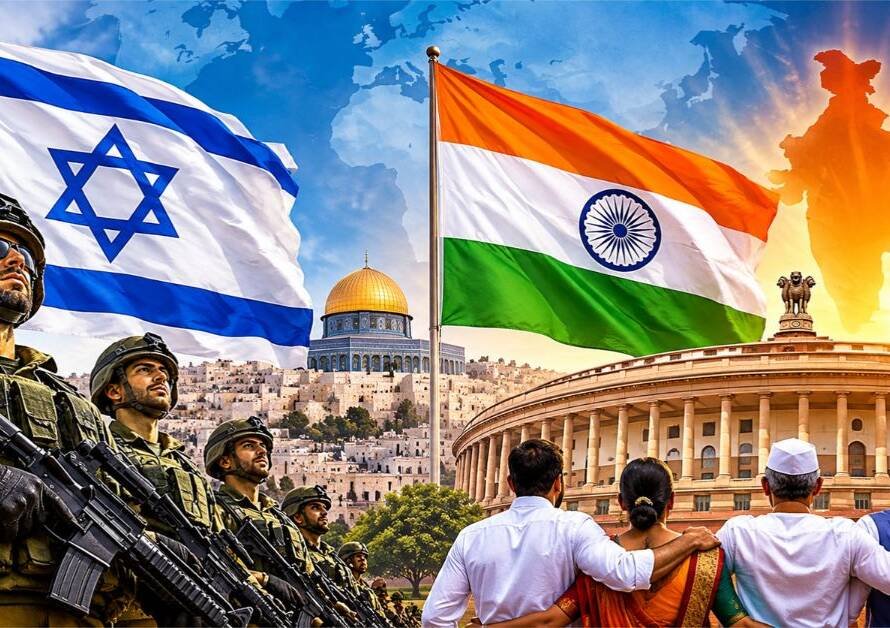
India’s foreign policy is rooted in the doctrine of strategic autonomy, regional stability, and “Nation First.” By actively participating in multi-aligned forums, Bharat acts as a bridge between the East and West, and as the definitive voice of the Global South.
- The “Necklace of Diamonds” Doctrine: Countering maritime encirclement, India has built a strategic counter-ring of maritime access agreements, naval logistics hubs, and surveillance systems spanning Sabang (Indonesia), Duqm (Oman), Assumption Island (Seychelles), and Changi (Singapore).
- Indo-Pacific and Quad Synergy: Deepening cooperation with Quad allies (Japan, Australia, USA) and key regional partners (Indonesia, New Zealand) reinforces maritime domain awareness, counter-piracy operations, and international rules-based order across vital sea lanes of communication.
- Leadership in the Global South: Through its G20 presidency and leadership in institutions like the International Solar Alliance (ISA) and Coalition for Disaster Resilient Infrastructure (CDRI), India advocates effectively for energy transition equity, food security, and debt sustainability for developing nations.
5. Inclusive Social Development and Human Capital
Economic development in India is intrinsically linked with human welfare, social dignity, and the upliftment of marginalized communities. Government initiatives prioritize basic necessities while encouraging aspirational growth.
- Universal Housing and Sanitation: Millions of permanent homes have been constructed under the Pradhan Mantri Awas Yojana, paired with the Swachh Bharat Abhiyan to provide dignified sanitation facilities across rural and urban centers.
- Comprehensive Healthcare Security: Ayushman Bharat, the world’s largest health insurance framework, offers free secondary and tertiary healthcare coverage to over 500 million vulnerable citizens, shielding families from catastrophic medical expenses.
Women-Led Development: From empowering rural self-help groups (SHGs) to facilitating micro-loans through the PM Mudra Yojana, women are at the forefront of financial independence, community leadership, and economic development.
6. Conclusion: The Blueprint for Viksit Bharat @ 2047
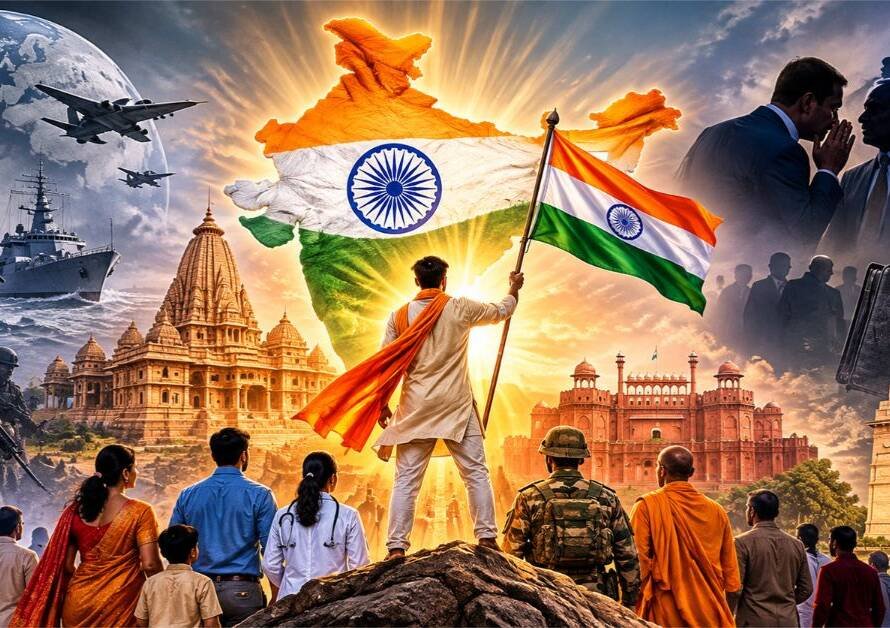
- India stands at a pivotal historical juncture. The convergence of economic reforms, digital innovation, robust infrastructure, and strategic clarity has laid a firm foundation for sustainable growth.
- As the nation moves steadily toward its centenary of independence in 2047, the collective determination of 1.4 billion citizens, supported by clear visionary leadership, guarantees that India will not only meet its developmental targets but will continue to act as a anchor of stability, peace, and prosperity for the entire world.
🇮🇳Jai Bharat, Vandematram 🇮🇳
Read our previous blogs 👉 Click here
Join us on Arattai 👉 Click here
👉Join Our Channels👈