Summary
- This article explains that supreme and vibrant ideal of Sanatan culture where spirituality (internal purification and penance) and power (external security and statecraft/punishment) achieve a wonderful harmony.
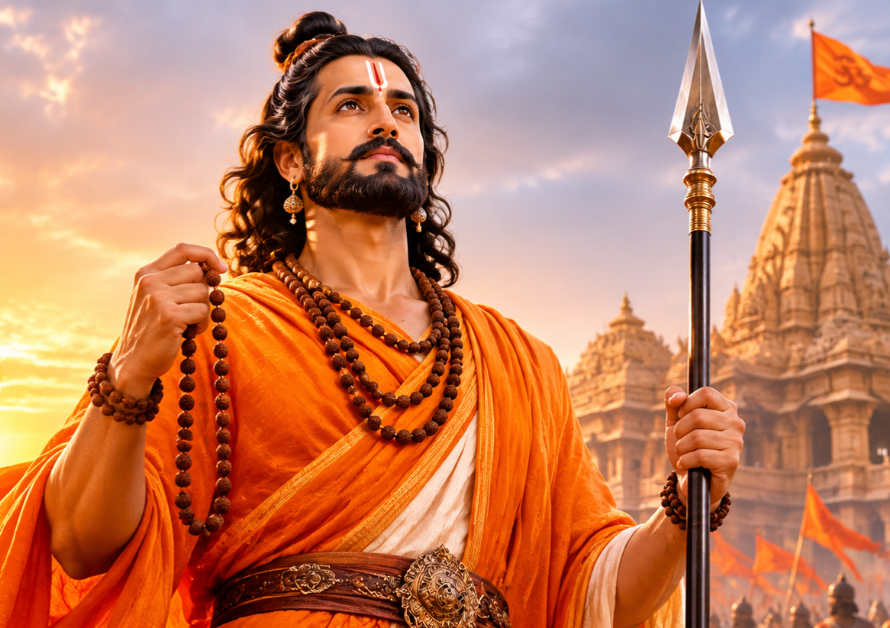
- The present article expands on the idea that “If I chant the rosary with one hand, I also keep a spear in the other; I am both a chosen head of a monastery (mathadheesh) and an elected ruler (sattadeesh), I am a Yogi.”
- This declaration symbolizes how the convergence of a saint and a ruler makes a nation secure, prosperous, and powerful. It deeply explores the core character of Sanatan Dharma—the protection of righteousness and the destruction of the unrighteous—from historical, mythological, and philosophical perspectives.
Introduction: The Eternal and Indissoluble Bond Between Spirituality and Power
Sanatan culture has never been a path of escapism, weakness, or mere empty preaching. Within the Indian psyche, this consciousness has been clear from the very beginning: the path of peace, compassion, and liberation can remain secure only when society possesses sufficient strength and capability to protect it.
In today’s modern political and social landscape, the notion has rapidly spread that religion and politics, or spirituality and governance, are two completely separate and opposing spheres. However, Sanatan tradition establishes the exact opposite truth. When a Yogi balances his internal discipline (the rosary) with his external duty (the spear), he not only guides society with his spiritual energy but, when necessary, becomes a thunderbolt against the enemies of the nation.
First Dimension: The Rosary of the Mathadeeish — Spiritual Consciousness and Moral Discipline
When a person holds the role of a mathadhish, it does not merely mean being the head of a monastery or religious institution; rather, they serve as the moral and ideological guide of society.
- Selflessness and Detachment: The rosary is a symbol of spiritual practice, restraint, concentration, and surrender to the Divine. The person who has conquered their mind, who has risen above personal gratification, greed for office, and dynastic politics, alone possesses the eligibility to provide impartial leadership to society.
- Cultivation of Values: A Yogi who chants the rosary is not bound by personal desires. Their entire life is dedicated to the welfare of society, the preservation of culture, and the elevation of Dharma. The position of a mathadhish imparts not ego, but a profound sense of supreme responsibility.
Second Dimension: The Spear of the Sattadheesh — The Imperative of Valor, Justice, and Statecraft
Spirituality is not limited to sitting in rooms and chanting mantras. When crisis befalls society, when tyrants and invaders advance to destroy culture and religion, mere sermons do not suffice.
Third Dimension: From Mathadheesh to Sattadheesh — The Coordination of Saint and Statesman
The greatest characteristic of Indian culture has been that it never regarded religion (spirituality) and politics (governance) as entirely separate; rather, it always kept politics subservient to Dharma.
- The Rajarshi Tradition: Our ancient kings were Rajarshis—they managed governance with one hand (sattadhish) while remaining immersed in self-knowledge and spiritual practice with the other (mathadhish). King Janaka and Maryada Purushottam Shri Rama are the greatest examples of this.
- Relevance in the Contemporary Context: When a Yogi, forged in the furnace of detachment and spirituality to become a mathadhish, is chosen by the people to become a sattadhish (at the highest seat of governance), corruption, appeasement, and nepotism find no room in the administration. Such leadership does not live and work to accumulate personal wealth or family property, but for nation-building. For them, the chair is not a luxury of power, but a sacred yajna of national service.
The Core Character of Sanatan Dharma: Protection of Dharma and Destruction of the Unrighteous
The scriptures and history of Sanatan Dharma clearly teach us that protecting the virtuous and destroying the wicked (the unrighteous) is the highest duty.
- The Lives of Shri Rama and Shri Krishna: Bhagwan Shri Rama went into the forests to destroy demons and protect sages. Yogeshwar Shri Krishna inspired Arjuna on the battlefield of the Mahabharata and annihilated the unrighteous.
- Forms of Power (Mata Durga and Mahakal): Our adored divine energies wield tridents, swords, and chakras. This symbolizes that alongside creation and sustenance, the destruction of the wicked is equally essential.
- Saints Taking Up Arms: In the medieval period, when foreign invaders were destroying temples, Guru Gobind Singh Ji established the Khalsa Panth and raised the sword. Samarth Ramadas inspired Chhatrapati Shivaji Maharaj to establish Swarajya.
Conclusion
“I am a Yogi” means—a person who is entirely a saint from within (free from illusion and selfishness), but harsh as a thunderbolt on the outside toward the enemies of the nation and Dharma.
When the rosary and the spear come together, when spirituality and state power are coordinated, only then is Dharma established in society, humanity remains secure, and the nation attains supreme glory.
“धर्मो रक्षति रक्षितः — Those who protect Dharma are protected by Dharma.”
🇮🇳Jai Bharat, Vandematram 🇮🇳
Read our previous blogs 👉 Click here
Join us on Arattai 👉 Click here
👉Join Our Channels👈