Summary:
- Prime Minister Narendra Modi’s assertion that the world—including citizens of developed nations like the United States—will increasingly seek opportunities and visas in India marks a decisive shift in national ambition. Proponents highlight India’s rapid economic, technological, and geopolitical rise over the past 12 years as evidence of an emerging superpower and Vishwaguru, invoking a civilizational legacy spanning two millennia.
- This trajectory contrasts sharply with post-independence decades, which supporters view as having prioritized political patronage, dynastic interests, and administrative inefficiency over public welfare. Highlighted by a historic reduction in multidimensional poverty—where roughly 24.82 crore people (nearly 25% of the population) moved out of poverty—this transformation is backed by record foreign direct investment, massive infrastructure projects, and manufacturing drives extending into remote and border regions.
- Proponents emphasize that with an increasingly educated youth population, job creation must evolve beyond traditional government and corporate white-collar roles toward entrepreneurship, driven by vocational skilling, innovation ecosystems, and collateral-free credit.
- Systematic progress over the last 12 years has systematically addressed longstanding structural challenges in human capital, regulatory compliance, and regional connectivity. While voters continue to strongly back this vision politically, debates persist over the nature of political opposition—with supporters arguing that while constructive democratic dissent is vital, obstructionist narratives fail to counter the ground realities of national progress.
PM Modi’s Vision for India’s Global Influence
A Paradigm Shift in Global Standing and National Pride
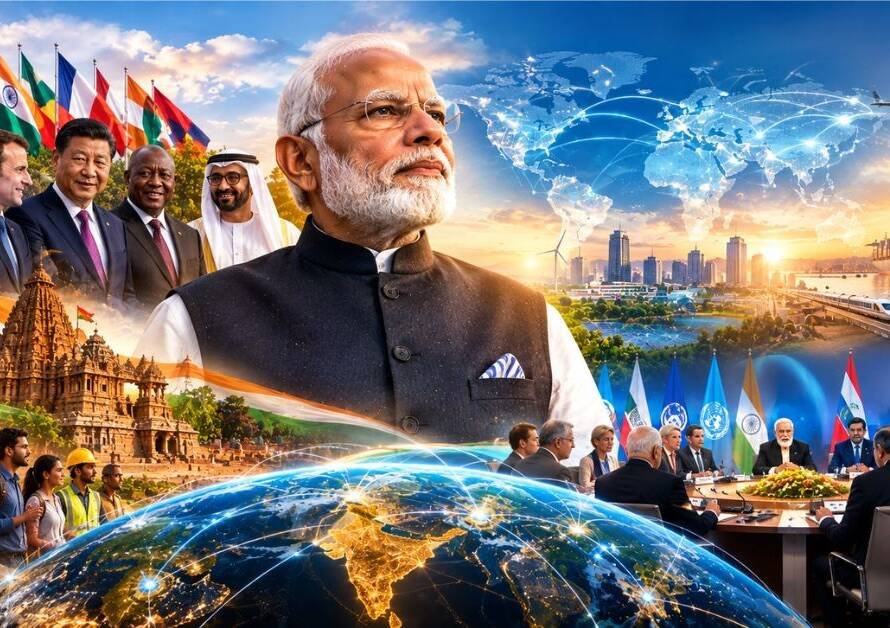
Prime Minister Narendra Modi’s vision reflects a deliberate attempt to reframe India’s position in the global order, transitioning from a traditional exporter of skilled labor to an international destination for capital, talent, and innovation.
- Reversing the Brain Drain: For decades, India’s public discourse was dominated by the outward migration of doctors, engineers, and researchers seeking higher wages and advanced infrastructure abroad. The current vision establishes domestic ecosystems capable of retaining native talent and attracting global professionals.
- Assertive Global Ambition: The expectation that citizens from established Western economies will seek Indian visas signals unprecedented national self-assurance and international stature.
- Civilizational Legacy (Vishwaguru): Rooted in a historical tradition of global guidance spanning two millennia, the movement toward Viksit Bharat (Developed India) positions the nation as an economic powerhouse, technological leader, and moral guide for the Global South.
Economic Transformation, Industrial Expansion, and the Job Paradigm
Supporters point to structural economic shifts over the last 12 years that have reshaped nationwide employment, extended development to neglected regions, and redefined economic self-reliance (Atmanirbhar Bharat).
- Unprecedented Poverty Alleviation: Official data from NITI Aayog confirms that 24.82 crore people (nearly 25% of the population) escaped multidimensional poverty over a nine-year period, driven by targeted social welfare, universal housing, sanitation, and Direct Benefit Transfers (DBT).
- Manufacturing Boom via ‘Make in India’ and Foreign Investment: Backed by Production-Linked Incentive (PLI) schemes and regulatory easing, FDI inflows into manufacturing surged nearly 69% over the past decade. This industrial expansion has generated millions of direct and indirect jobs across electronics, defense production, pharmaceuticals, and green energy.
- Inclusive Regional and Border Infrastructure: Unlike the pre-2014 era—when infrastructure was largely restricted to major metropolitan hubs—mega projects under PM GatiShakti, national highway expansions, industrial corridors, and the Vibrant Villages Programme have brought manufacturing, logistics, and employment to remote, interior, and border areas.
- Reframing Employment Toward Innovation and Credit: With millions of educated youth entering the workforce annually, relying strictly on traditional government or corporate white-collar roles is economically unfeasible. Realizing national potential requires a cultural shift toward self-reliance and entrepreneurship. Initiatives such as PM MUDRA Yojana, Startup India, and Stand-Up India—paired with widespread vocational skilling—provide easy, collateral-free credit, enabling youth to become job creators rather than job seekers.
- Digital Public Infrastructure (DPI): World-leading digital frameworks such as UPI, Aadhaar, and ONDC have democratized financial access, lowered transaction costs, and established a scalable global blueprint studied worldwide.
Domestic Debates, Civic Responsibility, and Political Realities
The discourse surrounding India’s global trajectory has intensified domestic political debates, highlighting contrasting views on historical governance, political dissent, and civic action.
- Critique of Pre-2014 Governance: Proponents argue that the current era marks a clean break from the previous 70 years of Congress-led rule, which they contend favored political dynasts, corruption, and systemic inefficiency at the expense of national interests and the common citizen.
- Electoral Mandates and Civic Action: While voters have repeatedly affirmed Prime Minister Modi’s vision through democratic mandates, supporters emphasize that political backing alone is insufficient. Faster progress requires citizens to actively identify, isolate, and socially, politically, and economically boycott internal elements and anti-national narratives that obstruct national unity and economic progress.
- Constructive Dissent vs. Partisan Obstructionism: Proponents acknowledge that independent analysis and dissent are vital pillars of a vibrant democracy, provided they serve constructive national interests. However, they argue that purely political opposition—attempting to regain power by projecting negative narratives about the last 12 years while romanticizing past failures—fails to deceive an increasingly discerning electorate.
- Ground Realities of the Opposition Stance: From the vantage point of current political dynamics, opposition parties and critical policy analysts argue that robust opposition is essential for institutional accountability which serves as a necessary check against administrative overreach, ensuring growth remains equitable.
Structural Challenges and Strategic Outlook: 12-Year Milestones
Translating long-term national ambition into sustained global leadership requires continuous structural progress. Over the last 12 years, key reforms have converted historical vulnerabilities into measurable growth drivers:
- Human Capital & Healthcare Transformation: The National Education Policy (NEP) 2020 restructured learning around vocational training, digital fluency, and critical inquiry. Simultaneously, Ayushman Bharat—the world’s largest public health insurance scheme—alongside a massive increase in medical colleges and AIIMS institutions, has safeguarded public health and labor productivity.
- Ease of Doing Business & Deregulation: Administrative hurdles have been dismantled through digital single-window portals like SPICe+ and the National Single Window System (NSWS). The decriminalization of hundreds of minor technical offenses under the Jan Vishwas Act, combined with corporate tax rationalizations, has significantly boosted investor confidence.
- Decentralized Regional Growth: Investments in multi-modal logistics networks, freight corridors, and tier-2/tier-3 airport connectivity have integrated regional markets into global supply chains, driving decentralized industrialization and social cohesion.
🇮🇳Jai Bharat, Vandematram 🇮🇳