Summary:
- This narrative presents an in-depth analysis of a complex paradox in contemporary Indian politics alongside the global geopolitical landscape.
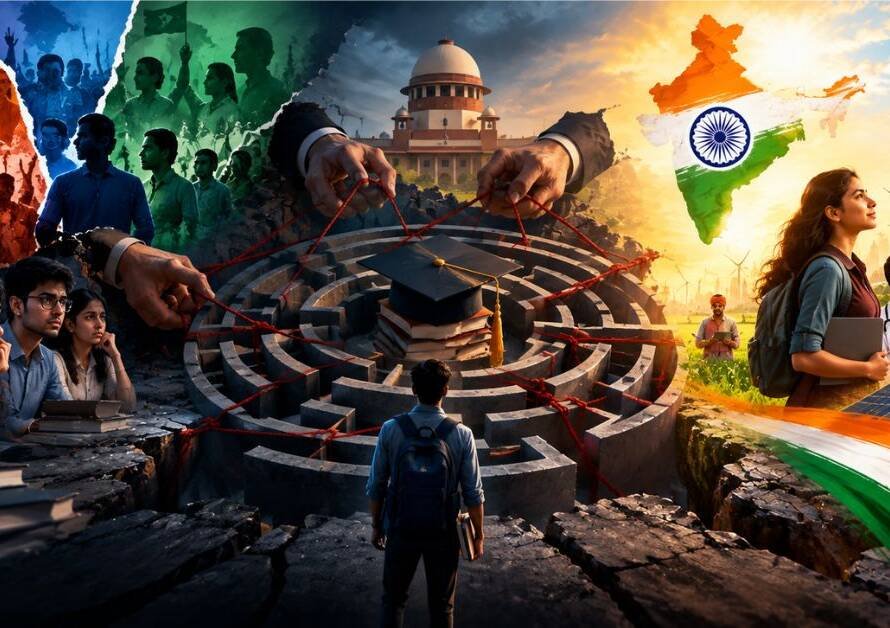
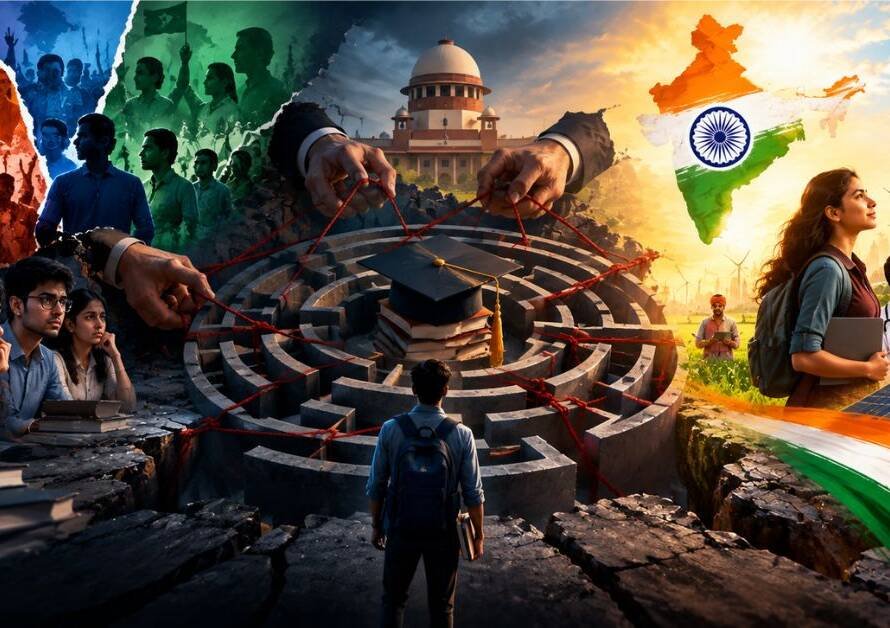
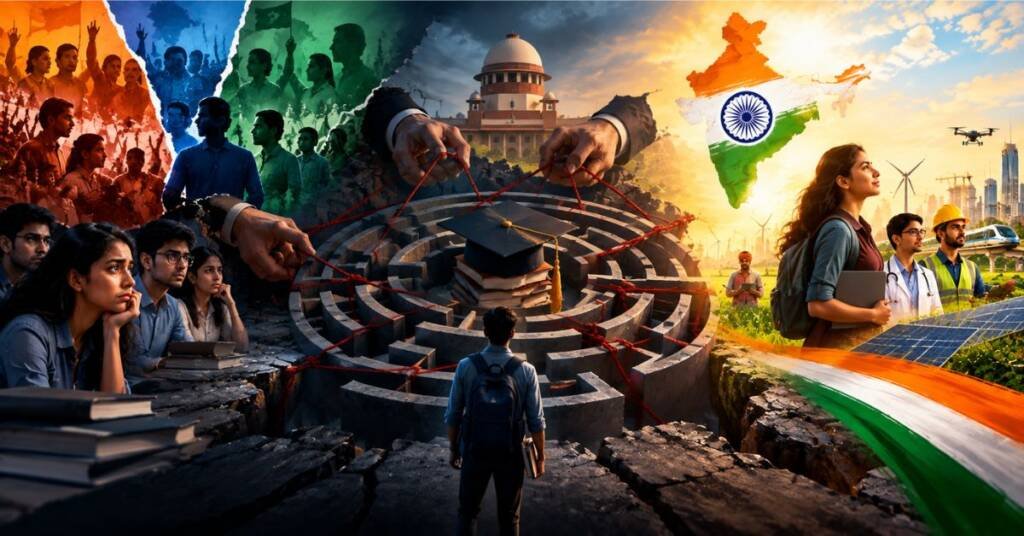
- On one hand, internal domestic politics is witnessing a well-crafted political trap designed to confuse, incite, and create discontent among students using issues like the ‘UGC rollback’, the caste census, and newly sponsored protests like the ‘Remove Reservation Movement’.
- On the other hand, the unwavering trust of the Indian electorate in Prime Minister Narendra Modi’s leadership continues to dismantle these strategies.
- Since 2014, India has steadily emerged as a strong, self-reliant, and assertive global economy, while the anti-national ecosystem stands utterly defeated before a nationalist and progressive government.
Caste Mobilization, and the Self-Reliant ‘New India’
I. The Political Trap: UGC Rollback, the ‘Remove Reservation Movement’ Trap, and the ‘INDI Alliance’ Game Plan
What appears on the surface in politics is rarely the complete truth. Strategic distance maintained by various regional parties and opposition groups from the ‘UGC rollback’ campaign, or the deployment of new pawns like the ‘Remove Reservation Movement’, is no coincidence—it is part of a calculated political strategy.
- Prashant Kishor’s 2023 Strategic Blueprint and Its Execution:
- The script for these political developments was prepared back in 2023. The INDI Alliance executed this model during the 2024 Lok Sabha elections, successfully crossing the 200-seat mark.
- A direct test of this model was witnessed during the Bankipur by-election in Bihar, where the UGC rollback campaign, slogans like “Dharmendra Pradhan Resign”, the NEET controversy, and caste-based mobilization were woven together to build momentum against the ruling party.
- Opposition strategists understand well that eroding the voter base through institutional and academic discontent is far more effective and safer than a direct political confrontation.
- The New ‘Remove Reservation Movement’ Team and the Plot to Incite Students:
- The New Pawn (Remove Reservation Movement): As older tactics began losing steam, a new team under the banner of the ‘Remove Reservation Movement’ was brought to the forefront to give opposition politics a fresh angle.
- Politics of Confusion and Outrage: The primary objective of this new movement is to create confusion among youth and students, incite anger, and foster an atmosphere of revolt against the government to disrupt academic institutions.
- Failure Against Electorate Trust in the Modi Government: Despite these plots and provocations, students and voters across the nation maintain firm confidence in the policies and intentions of the Modi government. Consequently, this newly sponsored movement has also flopped completely.
- The Rotation Model of ‘Team A’ and ‘Team B’:
- Team A (Street Protests): Whenever this group is forced to step down from public demonstration sites like Jantar Mantar, another team is strategically deployed to take over the front lines.
- Team B (UGC and Institutional Opposition): This team keeps the flames of discontent burning under the guise of academic, administrative, and policy reforms to keep the government on the defensive.
- A Cocktail of Issues: Strategists combine issues from these different teams into a potent narrative cocktail to continuously manufacture negativity against the central government.
- Calculated Vote-Bank Arithmetic and Ignoring the General Category:
- Strategy to Monopolize OBC-Dalit Vote Banks: Raising aggressive demands—such as expanding reservations beyond the 90% cap and introducing reservations in private land and property—aims to detach this massive 85–90% demographic entirely from the ruling party.
- The Strategy for General Category Votes: The opposition feels no need to actively court or stand up for General Category votes. Through the UGC campaign, anti-reservation protests, and institutional discontent, the task of distancing the General Category from the ruling party is being driven automatically behind the scenes.
- Division of Regional and Social Pawns:
- The Karni Sena Model: Old contacts and social equations within Karni Sena were strategically leveraged across Rajasthan, Gujarat, and western Madhya Pradesh to cultivate an anti-government atmosphere.
- Pro-Brahmin and Pro-Shankaracharya Organizations: Given Karni Sena’s limited geographical reach, other social-religious figures were brought to the forefront in Uttar Pradesh, Bihar, Jharkhand, and Chhattisgarh to fan discontent among the General Category.
- Decisive Defeat of the Anti-National Ecosystem: The singular shared goal of all these pawns, sponsored movements, and the broader anti-national ecosystem was to destabilize the country. However, their entire network has failed miserably when confronting a nationalist and progressive administration.
II. Global Slowdown vs. ‘New India’: The Major Shift Since 2014
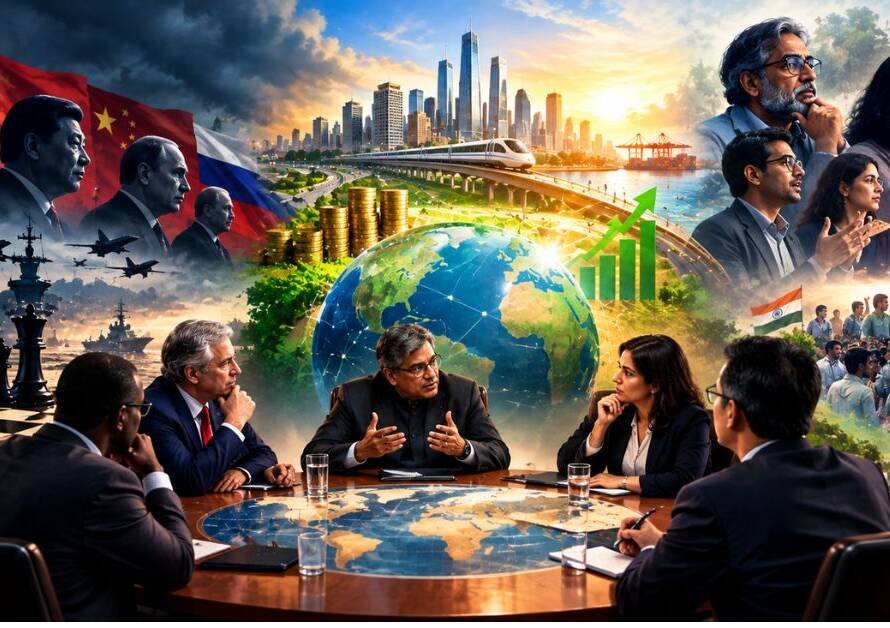
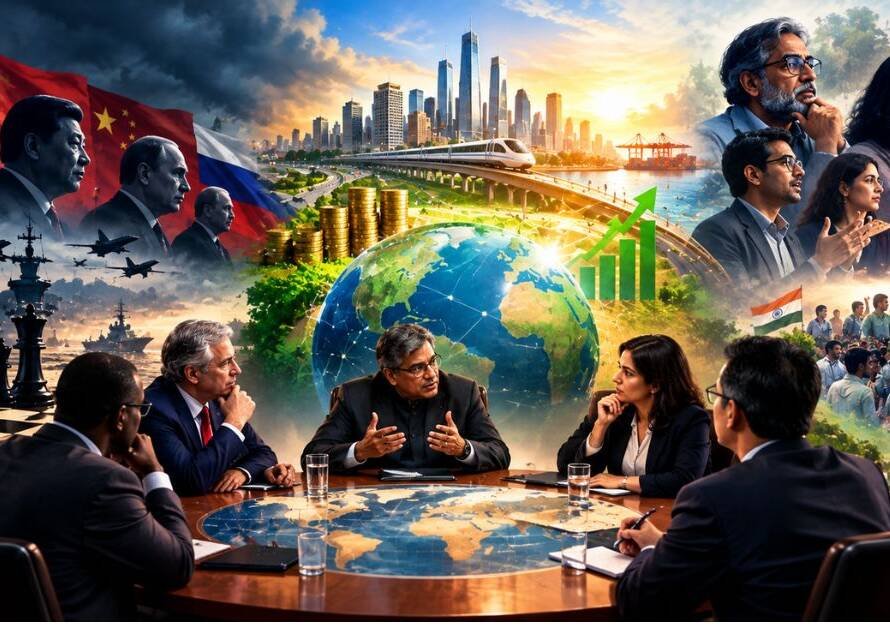
While games of caste and institutional discontent are being played internally, India’s economic and strategic dominance on the global stage tells the story of an epochal transformation.
- Economic Crisis Facing Global Superpowers:
- United States: The U.S. economy is burdened by a national debt exceeding 130% of its GDP and faces severe financial instability.
- Europe and Japan: Major industrial nations in Europe alongside Japan are experiencing negative GDP growth rates or struggling with prolonged economic stagnation.
- China and Russia: Russia remains constrained by war and international sanctions, while China grapples with falling foreign investment, a collapsing property sector, and shrinking export markets.
- The Economic Shield of ‘Make in India’ and ‘Self-Reliant India’:
- While major global economic centers retreat, India’s GDP growth rate remains among the fastest in the world. This is no accident—it is the direct outcome of a decade of vision behind ‘Make in India’ and ‘Atmanirbhar Bharat’ (Self-Reliant India).
- India, which was once treated merely as a dumping ground for pharmaceuticals, defense hardware, and consumer goods from the U.S., Europe, and China, is now exporting indigenous products and manufactured goods to developed nations.
- Aggressive Strides in Defense and Agitation Among Global Lobbies:
- Recent global conflicts—including Iran-Israel tensions and the Ukraine war—have exposed vulnerabilities in expensive and complex Western weaponry. Meanwhile, India’s indigenous weapon systems are proving their accuracy and durability across operational theaters.
- Multi-billion-dollar export deals—such as the Akash missile system and BrahMos supersonic cruise missiles exported to the United Arab Emirates (UAE)—serve as undeniable proof that India has transitioned from a defense importer to a major exporter.
- International arms lobbies and foreign corporations whose multi-billion-dollar markets closed due to these Indian policies will naturally attempt to sponsor unrest and instability within the country.
III. Comprehensive Comparative Analysis: Pre-2014 vs. Post-2014
For those who ask what has changed in the country since 2014, this itemized comparison highlights the ground reality:
- National Discourse and Public Consciousness:
- Pre-2014 (UPA Era): Daily headlines were dominated by massive corruption scandals—2G spectrum, Coal-gate, Commonwealth Games scams, and systemic administrative paralysis. A pervasive sense of pessimism prevailed.
- Post-2014 (Modi Era): The national conversation centers on record GDP growth rates, monthly GST collections, major infrastructure expansion, and overall economic resilience.
- Infrastructure Development:
- Pre-2014 (UPA Era): Infrastructure projects remained buried in corruption files and bureaucratic red tape. Projects routinely took decades to complete.
- Post-2014 (Modi Era): New AIIMS institutes, IITs, IIMs, world-class expressways, and modern airport terminals are being built and operationalized in record time across the nation.
- Transformation of Transport Networks:
- Pre-2014 (UPA Era): Dilapidated national highways, slow conventional trains, and neglected railway stations defined India’s transit infrastructure.
- Post-2014 (Modi Era): New national highways are constructed at record daily speeds, modern trains like ‘Vande Bharat’ and ‘Amrit Bharat’ are running across networks, and railway stations are being redeveloped to airport standards.
- Internal Security and Defense Policies:
- Pre-2014 (UPA Era): Major cities experienced frequent bomb blasts, the armed forces suffered from acute shortages of basic bulletproof vests and ammunition, and military leadership faced political handcuffs.
- Post-2014 (Modi Era): Indigenous defense production is prioritized, the armed forces operate with full operational autonomy, defense exports are breaking records under ‘Make in India’, and critical border infrastructure is rapidly expanding.
- India’s Global Standing:
- Pre-2014 (UPA Era): India was viewed as a reactive country reliant on foreign aid, Western terms, and international pressures.
- Post-2014 (Modi Era): Across international forums like the G20 and BRICS, India is no longer an onlooker—it acts as a leading, assertive nation shaping global agendas and international policy.
IV. Conclusion: From Defensive to Assertive ‘New India’
- Political traps, the UGC debate, engineered ‘Remove Reservation’ protests, and opportunistic vote-bank tactics will continue in domestic political arenas. However, ground realities and historical shifts cannot be erased.
- Despite relentless attempts to misguide the youth, the electorate stands firmly behind the Modi government’s vision, leaving the anti-national ecosystem powerless.
- A nation that was once dependent on foreign imports even for basic items or pharmaceutical raw materials is today negotiating trade, diplomacy, and foreign policy on its own terms with global superpowers.
- Political conspiracies will continue, but post-2014 India is no longer a defensive nation bowing to pressure—it is a self-reliant, proud, assertive ‘New India’ marching toward becoming a global leader (Vishwaguru).
🇮🇳 जय भारत, वन्देमातरम 🇮🇳
Read our previous blogs 👉 Click here
Join us on Arattai 👉 Click here
👉Join Our Channels👈
Reads & Views: 43