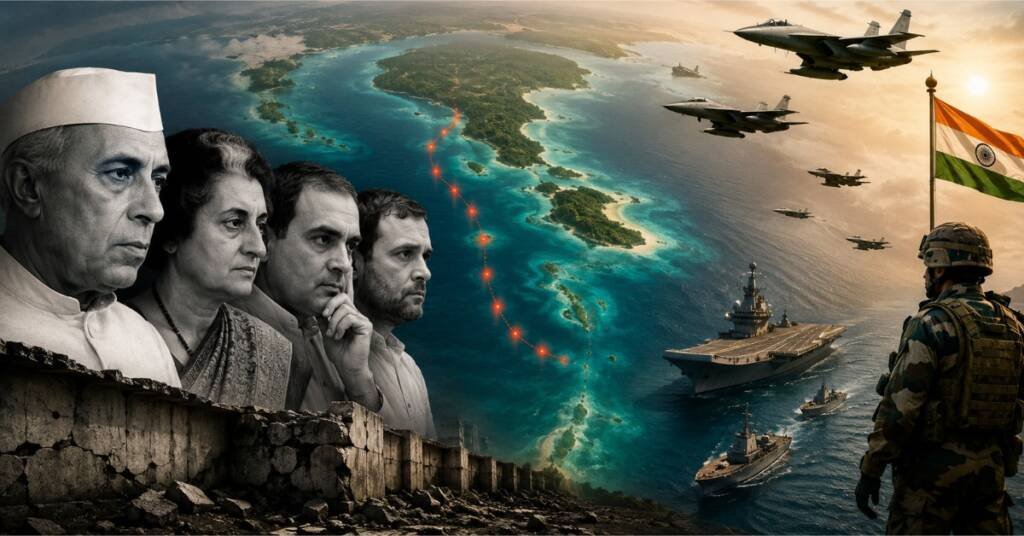
- This analysis explores the history and contemporary challenges of India’s maritime and geopolitical sovereignty. The article outlines evidence showing how, since independence, governments led by the Nehru-Gandhi family compromised India’s highly critical maritime territories due to an idealistic foreign policy, the illusion of non-alignment, and diplomatic vacillation.
- Failing to assert claims over the Coco Islands near the Andamans and ceding Katchatheevu Island to Sri Lanka in 1974 were monumental historical blunders—the consequences of which are borne today by India’s national security and coastal citizens.
- Today, as the government builds an unprecedented strategic and commercial shield at the mouth of the Strait of Malacca via the Great Nicobar Island Project (an Indo-Pacific game changer), the Congress and Rahul Gandhi ideological ecosystem is attempting to stall it under the guise of environmentalism and human rights.
Introduction: Electoral Nationalism vs. Strategic Realism
- In India’s domestic politics, terms like “national security” and “integrity” are often confined to political speeches. However, reviewing history objectively reveals critical turning points where a lack of political will, strategic short-sightedness, and ideological confusion within the top leadership pushed India’s strategic positioning decades backward.
- The global landscape is shifting rapidly. The Indian Ocean Region (IOR) and the Indo-Pacific have become the primary theaters of power struggles among global superpowers.
- Under these circumstances, a vital question emerges: Did India’s past leadership ever display sufficient strategic resolve to protect its maritime interests? Or were national security priorities repeatedly traded off to project an idealistic image on international platforms?
1. The Coco Islands: Strategic Apathy of the Nehru Era
- Located just a few nautical miles from the northernmost tip of the Andaman and Nicobar archipelago, the Coco Islands have become a severe strategic vulnerability for India’s maritime security.
- Today, the Chinese People’s Liberation Army (PLA), in coordination with Myanmar, has established advanced radar systems, electronic intelligence surveillance infrastructure, and an expanded military airstrip on these islands. From this vantage point, China can monitor Indian Naval movements in the Indian Ocean and track India’s missile tests off the Odisha coast around the clock.
The historical roots of this strategic loss reveal a clear pattern:
- Colonial Administrative Shift: During British rule, administrative control of the Coco Islands was shifted from Calcutta (now Kolkata) to Rangoon (Myanmar/Burma) purely for administrative convenience.
- Relinquishing the Claim: When Burma gained independence as a sovereign nation in 1948, India had a historic opportunity to assert its strategic claim over this crucial territory. However, the government led by then-Prime Minister Jawaharlal Nehru made no such effort.
- The Illusion of Idealism: Instead of developing an assertive maritime and military posture to secure India’s borders, the leadership of that era was focused on projecting an idealistic image as a peacemaker and champion of the Non-Aligned Movement (NAM). Consequently, a highly sensitive outpost right next to India permanently fell under China’s proxy influence.
2. Katchatheevu Island: The Indira Gandhi Government’s ‘Diplomatic Surrender’
Following the strategic abandonment of the Coco Islands, the second major compromise on India’s maritime sovereignty occurred in 1974. Under the Indo-Sri Lankan Maritime Agreement, then-Prime Minister Indira Gandhi conceded India’s claim over the strategically vital Katchatheevu Island, accepting Sri Lanka’s full sovereignty without solid historical evidence or extensive debate in the Indian Parliament.
The long-term, devastating impacts of this agreement persist today:
- Impact on Coastal Citizens: Promoted in 1974 as a peaceful diplomatic solution to foster cordial ties, the real price of this decision has been paid for five decades by the poor fishermen of Tamil Nadu. They are routinely arrested, physically assaulted, and have their boats seized by the Sri Lankan Navy for entering traditional fishing grounds.
- Loss of a Strategic Shield: Katchatheevu was not merely a small, uninhabited island. It was a natural defensive shield preserving India’s presence in the Palk Strait and safeguarding its Exclusive Economic Zone (EEZ). This politics of concession has made Katchatheevu a prominent symbol of compromised sovereignty in Indian strategic discourse.
3. The Great Nicobar Project: The Ecosystem Blocking Development and Security
- Learning from these historical blunders, as modern India executes the Great Nicobar Island Project to fortify its maritime sovereignty in the Indian Ocean, the political apparatus of the Nehru-Gandhi family and its ideological ecosystem have mobilized to oppose the project.
- This mega project, with an estimated cost of ₹92,000 crore, is not a standard real estate plan. It is designed to counter China’s “String of Pearls” strategy and establish an unassailable military, naval, and commercial fortress at the gateway of the world’s busiest trade and energy route—the Strait of Malacca.
Strategic Importance of the Project:
- International Container Transshipment Port: Positioned near the Strait of Malacca, this massive port aims to divert a significant share of global shipping traffic from Singapore and Colombo toward India, generating substantial economic revenue.
- Strategic Military Base (Expansion of INS Baaz): Building advanced military airstrips and naval infrastructure will enable the Indian Armed Forces to counter rising Chinese naval assertiveness, tracking their spy ships and nuclear submarines in the Indian Ocean.
- Geographic Expansion of Power: Upon completion, India’s active military and surveillance presence will extend nearly 400 kilometers further south, bringing the wider Indo-Pacific region under the direct protective umbrella of the Indian Navy.
4. A Familiar Pattern of Opposition
- Against this vital national security initiative, a negative narrative is being constructed by the Leader of the Opposition Rahul Gandhi, the Congress party, and their broader ecosystem under the banner of environmental preservation, tribal rights, and ecology. Continuous Public Interest Litigations (PILs) are being filed in courts, and global environmental organizations are being mobilized to brand this national security asset as a “destructive project.”
- Strategic and military analysts raise a critical question regarding this development: Is this opposition rooted in genuine environmental concern, or does it fit a deeper pattern? In India’s history, whenever steps have been taken to upgrade military capabilities—whether constructing strategic border roads, establishing indigenous nuclear plants, or developing defense corridors—a specific ideological network frequently activates under the guise of human rights and environmentalism to slow down national progress.
Conclusion: Integrated Nationalism vs. Strategic Vacuum
- For India to establish itself as a decisive global power in the 21st century, it must recognize that national security extends beyond land posts and Himalayan borders. India’s core strength and future are linked to its command over the seas.
- While China expands its footprint around India through the Belt and Road Initiative (BRI), domestic political factions continue to frame vital strategic infrastructure within artificial “environment vs. development” binaries.
- While past apathy allowed China to secure a proxy presence in the Coco Islands and saw Katchatheevu gifted away, modern India recognizes that initiatives like the Great Nicobar Project are essential guarantees for the security and sovereignty of future generations. National security must be placed above partisan and dynastic politics to ensure past geopolitical missteps are not repeated.
🇮🇳Jai Bharat, Vandematram 🇮🇳
Read our previous blogs 👉 Click here
Join us on Arattai 👉 Click here
👉Join Our Channels👈
Reads & Views: 149