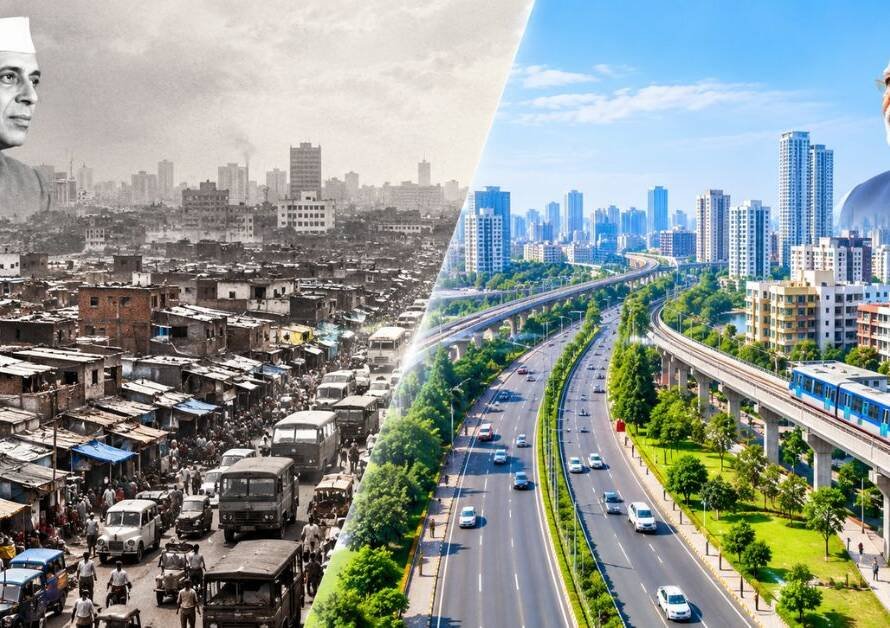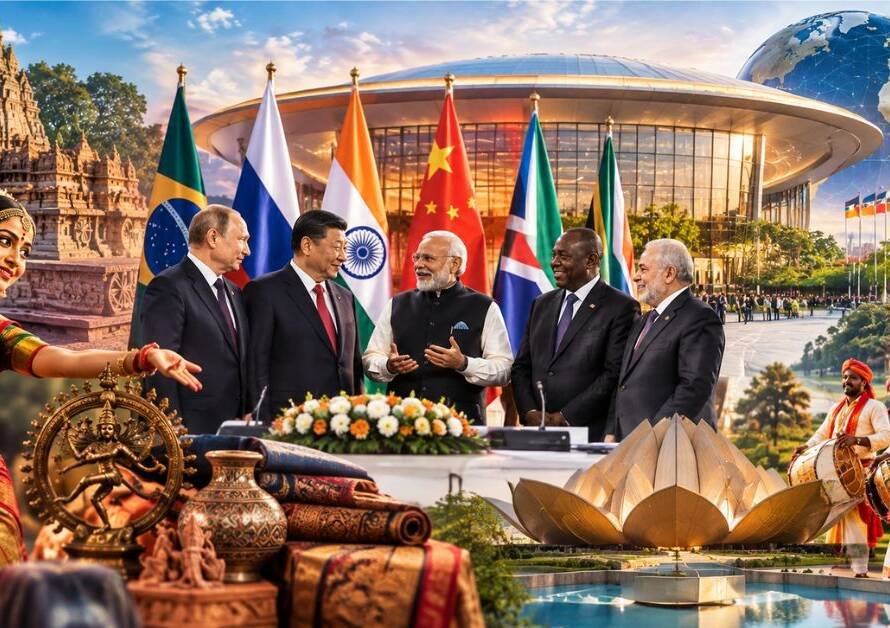
- This analysis offers a deep dive into the epoch-making transformations currently sweeping through modern India’s political, cultural, and strategic landscapes. The article outlines evidence demonstrating how, during the post-independence decades, India’s policy-making apparatus was plagued by unilateral idealism, appeasement, and strategic vacillation, which resulted in monumental historical and cultural setbacks for the majority community. From the horrors of Partition to the institutional nurturing of separatism in Jammu and Kashmir, the old regime repeatedly compromised national sovereignty for vote-bank politics.
- Today, Prime Minister Narendra Modi’s leadership is increasingly viewed as a convergence of ‘Chanakya and Vidura’ for the modern era—an administration that honors established external symbols while systematically purifying the system from within. By restoring due honor to national icons like Sardar Patel, Netaji Subhash Chandra Bose, and Lal Bahadur Shastri, the government is dismantling the Macaulay education system and the 70-year-old narrative of self-loathing peddled by the previous regime.
- This discourse clarifies why it is imperative for the majority community to awaken ideologically and place absolute trust in the current leadership to realize the mission of making India a culturally resilient, aware, and integrated nation by 2047 (the centenary of India’s independence).
Introduction: The Emergence of a Modern Chanakya and Vidura
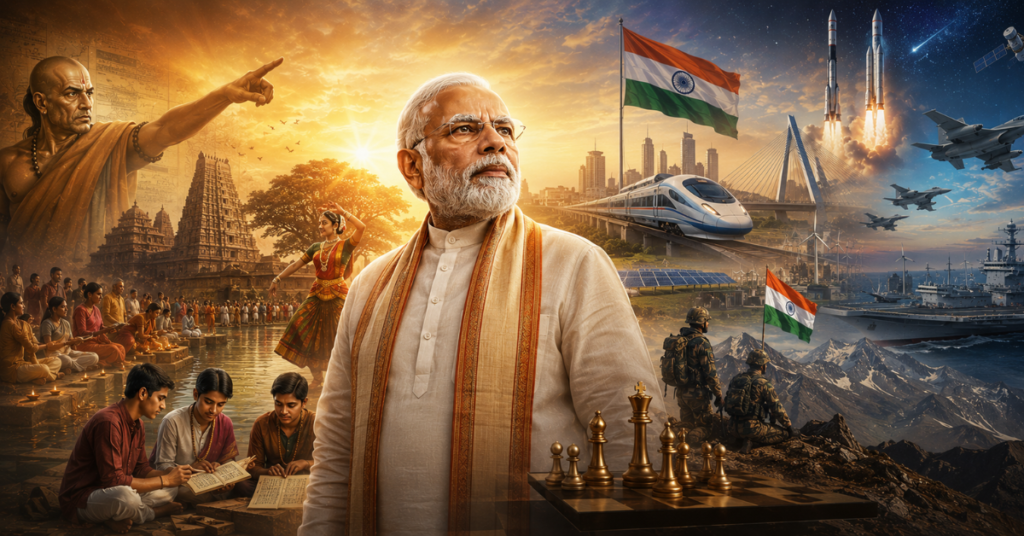
- For the past seven decades, a specific ideological ecosystem dominated India’s politics and governance, systematically suppressing the nation’s core ethos and cultural consciousness. In this context, Narendra Modi’s ascent to the pinnacle of Indian politics is not a routine political event; it signifies a massive geopolitical and Civilizational Correction. He can be seen as a blend of a modern-day Chanakya and Vidura, reclaiming India’s lost identity through policy acumen, diplomatic agility, and absolute political realism.
- Just as the historical Chanakya united a fragmented India to establish the Mauryan Empire by reading the psychology of the masses and fueling a public revolution, the current leadership excels at awakening the collective consciousness of the nation.
- This brand of politics is not pursued merely to retain power; it is dedicated to reinstating India’s foundational cultural roots and forging an unassailable cultural nation. To comprehend this journey, we must systematically analyze past wounds, historical blunders, and current strategic masterstrokes.
1. Historical Tragedies: Surrender Under the Guise of Idealism
During the final phases of the freedom struggle and the initial decades that followed, India’s leadership was trapped in a framework of unilateral idealism that wagered national security, territorial integrity, and the interests of the majority community. The decisions made behind the false masks of non-violence and secularism cost the nation its geography and the blood of millions of innocent citizens.
The primary strategic and historical blunders of this era include:
- The Brutal Reality of Partition: The 1947 partition of the country was not just a boundary line drawn on paper; it triggered the displacement and devastation of millions of families. This deeply flawed partition, executed under the shield of passive non-violence, led to the slaughter of millions of Hindus and Sikhs across the western and eastern wings.
- Atrocities Unleashed on Women: The systemic atrocities, abductions, and inhuman violence inflicted upon Hindu and Sikh mothers and sisters during Partition remain the darkest chapters of our history. The top leadership of the time failed catastrophically to halt these horrors or secure the minorities left behind in Pakistan.
- Cultural and Religious Asymmetry: A deeply discriminatory ecosystem was institutionalized within the country. In the name of communal harmony, the recitation of texts from other faiths was normalized within public platforms and hundreds of historical temples, yet no initiative was ever taken to introduce the teachings of the Srimad Bhagavad Gita or the Upanishads in minority religious institutions or madrasas. This distorted version of secularism survived solely on the baseline tolerance of the majority.
- Artificial Demographic Management for Vote Banks: Post-1951, the ruling Congress party adopted a specific strategy to secure long-term political power. A substantial segment of the population that could have logically moved during Partition was incentivized to stay back, serving as a future political vote bank. Subsequently, the politics of appeasement was institutionalized as mainstream state policy.
2. Strategic and Diplomatic Subversion: From Symbolic Politics to Civilizational Correction
- The hallmark of the current leadership is its ability to co-opt rather than directly dismiss the established symbols of the old regime, leveraging those very platforms to awaken the true consciousness of the nation. The leadership recognizes that purging the deeply entrenched Nehruvian and Macaulayist mindsets requires high-level Strategic Subversion.
Under this doctrine, several epoch-making corrections have been executed over the last few years:
- Elevating Sardar Patel alongside Mahatma Gandhi: While the current leadership maintains public reverence for Gandhian symbols, it has aggressively restored the legacy of the nation’s true unifier, Sardar Vallabhbhai Patel, on the ground. The construction of the ‘Statue of Unity’ in Gujarat is not merely a monument; it is a permanent reminder to the nation that the true hero who consolidated over 500 princely states was Sardar Patel, and not the leaders who failed to avert the tragedies of Partition.
- Restoring the Valor of Netaji Subhash Chandra Bose: The narrative surrounding national events like Independence Day and Republic Day has been completely re-engineered. Netaji’s contributions have been institutionalized through a dedicated museum at the Red Fort and the installation of his grand statue at Kartavya Path. This sends an unambiguous message: India’s independence was won not just through symbolic gestures or peace pacts, but through the armed revolution and supreme sacrifices of the Azad Hind Fauj.
- The Resurgence of Lal Bahadur Shastri’s Nationalism: Breaking the old monopoly of celebrating October 2nd as the legacy of a single leader, the current government placed the integrity and resolve of Prime Minister Lal Bahadur Shastri back into the national consciousness. By reviving the slogan “Jai Jawan, Jai Kisan,” a renewed sense of security and self-reliance was injected into the country.
- Dismantling Macaulay’s Mental Serfdom: For 70 years, India survived on the educational structures of Macaulay and the ‘ideological doles’ distributed by the old establishment, which conditioned Indians to feel apologetic about their own history, culture, and heritage. The current leadership has shattered this mental serfdom, reinstating indigenous pride through the visions of ‘Viksit Bharat’ and the ‘Panch Pran’ (Five Pledges).
3. Demolishing the Old Order and Establishing Cultural Nationalism
The modern Chanakya understands exactly how adversarial forces and global networks deploy demographic and political chess pieces to weaken India. Recognizing the vote-bank calculus of opposition factions and the appeasement playbook running since 1951, the leadership has systematically turned their own game against them to execute major policy overhauls.
Decisive milestones in this direction include:
- The Permanent Abrogation of Article 370: Article 370, which kept Jammu and Kashmir conditionally segregated from the union and facilitated institutionalized radicalization, was neutralized in a single stroke. By fully integrating Kashmir, the decades-old secessionist industry was dismantled permanently.
- Cultural Milestones: The construction of the grand Shri Ram Janmabhoomi Mandir in Ayodhya, along with the rejuvenation of Kashi Vishwanath Dham and Mahakal Lok, are not mere religious activities. They represent the triumphs of India’s civilizational soul, which had been suppressed for centuries by invaders and modern rulers alike. These steps have already closed more than half the distance toward reclaiming India’s core identity.
Mission 2047 and the Duty of an Awakened Society
This political ascetic and modern-day Chanakya is not operating on a short-term electoral agenda. The vision extends far beyond winning consecutive elections, operating on a long-term horizon that standard political pundits fail to grasp. The entire roadmap is anchored toward Mission 2047—the centenary year of India’s independence.
- The Duty of the Electorate and Society: The current leadership does not require unsolicited political advice; it requires the unshakeable support and valuable votes of the nation’s citizens. They are fully capable of managing the complex strategic calculations and systemic reforms.
- The Awakening of the 60 Percent: If even 60 percent of Hindu society unites, discards its self-loathing, and rises above internal caste fragmentations, the next 20 years leading up to 2047 will secure a highly prosperous, safe, and glorious era for India on the global stage.
Therefore, do not succumb to the misleading propaganda or structured toolkits of hostile ecosystems in this civilizational struggle. Maintain absolute faith in the strategic foresight of your Prime Minister. It is our civic duty to transmit this message to every patriot and like-minded citizen.
- History is witness that whenever the majority community slipped into complacency, the nation lost both its territory and its culture. The time to awaken is now.
🇮🇳Jai Bharat, Vandematram 🇮🇳
Read our previous blogs 👉 Click here
Join us on Arattai 👉 Click here
👉Join Our Channels👈