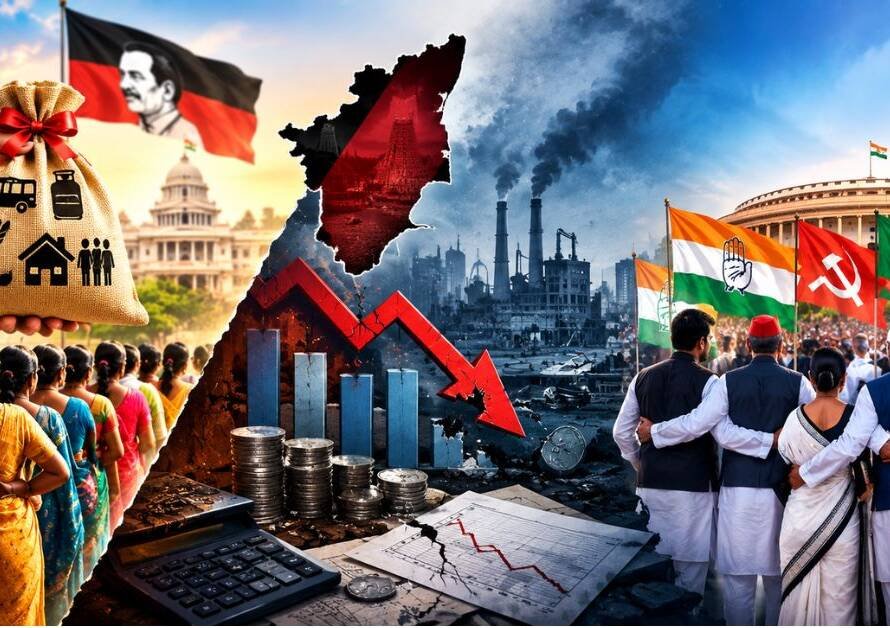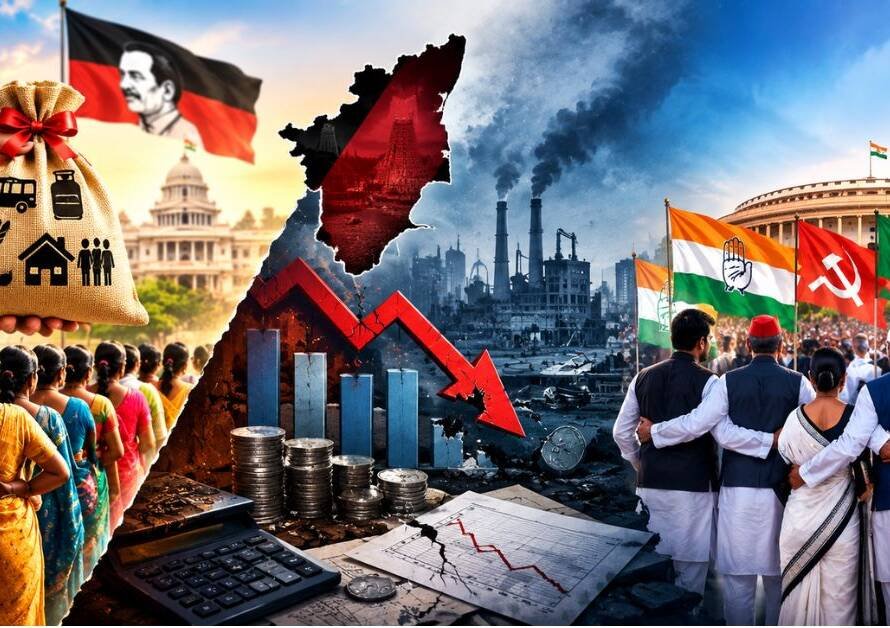
Summary
- This analysis presents a comprehensive, data-driven, and analytical evaluation of India’s economic, social, and strategic landscape before and after 2014.
- It outlines how institutional corruption, policy paralysis, and appeasement pushed India into the ranks of the ‘Fragile Five’ (the world’s five most vulnerable economies) prior to 2014.
- The transparent collection of tax revenues and a complete crackdown on systemic leakages under the current administration stand as the primary drivers that transformed India into the world’s 5th largest and fastest-growing major economy.
- This discourse highlights the structural and economic reforms that rescued the nation from potential insolvency and steered it toward self-reliance.
India’s Historic Transformation from the ‘Fragile Five’ to the ‘Top Five’ Economies
1. The Darkness Before 2014: Dynastic Loot, Policy Paralysis, and Neighboring Crises
Had there not been a decisive and historic shift in economic and administrative policies in 2014, India would likely be facing the severe economic insolvency and internal chaos currently witnessed in several neighboring countries. The pre-2014 landscape was plagued by these critical vulnerabilities:
- An Era of Institutional Exploitation and Scams: The previous governance model witnessed massive irregularities in the allocation of valuable national resources. Mega scams involving 2G spectrum, coal block allocations, and the Commonwealth Games caused severe damage to the national exchequer.
- The Stigma of the ‘Fragile Five’: Driven by fiscal mismanagement and total policy paralysis, global financial institutions categorized India among the world’s five most at-risk economies. Inflation hovered in double digits, and the fiscal deficit was entirely out of control.
- Security and Internal Stability Crisis: A string of serial terror attacks across major metropolitan hubs, coupled with internal unrest, shattered public safety. Rather than enforcing stringent counter-measures, the political landscape of appeasement routinely constrained the operational capabilities of security agencies.
2. Economic Revitalization: Plugging the Leakages and Resurrecting the Fiscal Cycle
Post-2014, the nationalist government prioritized sealing systemic leakages and enforcing transparent financial management to revive the nation’s economic health:
- Dismantling the Parallel Economy of Middlemen: Through the powerful combination of Direct Benefit Transfer (DBT), digital identity frameworks, and Jan Dhan bank accounts (the JAM Trinity), 100% of welfare funds began reaching beneficiaries’ accounts directly. This effectively uprooted a decades-old network of middlemen.
- A Historic Leap from ‘Fragile Five’ to ‘Top Five’: The immense revenue saved by eliminating scams and leakages was redirected from corporate bailouts into massive capital expenditure for national development. Consequently, India surpassed the UK to become the world’s 5th largest economy.
3. Taxation and Public Welfare: A Transparent Social Security Net
Taxes levied on petrol, diesel, and other commodities do not represent an arbitrary burden; rather, they form the bedrock of a robust social security net designed to elevate the living standards of the underprivileged and middle-class families:
- Balancing Food Security and Minimum Support Price (MSP): The government procures food grains from farmers at commercial MSP rates and distributes them to the poor through the Public Distribution System (PDS) at heavily subsidized rates. The financial deficit created by this massive subsidy is balanced directly by tax revenues.
- Accessible Healthcare and Education: Tax revenues seamlessly fund the world’s largest free vaccination drives and fuel initiatives like ‘Ayushman Bharat’ (PM-JAY), which provides free, cashless healthcare of up to ₹5 lakh per year to millions of underprivileged citizens.
- Rural Empowerment: Direct financial aid to small farmers through ‘PM-KISAN’, the construction of concrete homes under ‘PM Awas Yojana’, and grassroots sanitation infrastructure via the ‘Swachh Bharat Mission’ stand as prime examples of massive public capital expenditure.
4. Modern Infrastructure and Uncompromising Strategic Sovereignty
Building a self-reliant and powerful nation demands a futuristic infrastructure and a world-class military apparatus, both of which require heavy, uninterrupted budgetary allocations:
- Constructing World-Class Infrastructure: The rapid rollout of modern expressways, national highways, new airports, urban metro networks, and advanced trains like ‘Vande Bharat’ is essential to slashing India’s logistics costs and boosting economic efficiency.
- Strengthening Strategic and Military Autonomy: Tax revenues directly fund the procurement and indigenous manufacturing of state-of-the-art fighter jets, advanced main battle tanks, impenetrable missile defense systems (like the S-400), and indigenous aircraft carriers (like INS Vikrant). Concurrently, the long-delayed ‘One Rank One Pension’ (OROP) scheme was implemented to ensure financial security for veterans.
5. The Irony of Political Rhetoric: Spreading Misinformation on Reforms
The greatest irony within this entire economic discourse is that the very factions responsible for debilitating the national economy for decades are now orchestrating false narratives regarding the “burden of taxes”:
- Attempts to Disrupt Industrial Investment: Constantly maligning Indian industrialists—who generate millions of local jobs, construct vital infrastructure, and drive national self-reliance—is a calculated strategy to damage the domestic industrial investment climate.
- Sovereign, Citizen-Centric Policies: Modern economic policies are formulated with the sole objective of securing the future of India’s 1.4 billion citizens and safeguarding national sovereignty, rather than filling individual or familial coffers.
Learning from the current economic crises, inflation, and instability seen in neighboring countries, every responsible citizen must realize that paying taxes is more than a legal obligation—it is the vital engine driving nation-building, border security, infrastructure modernization, and the socioeconomic survival of the underprivileged. Without transparent and systematic tax collection, a nation risks slipping back into the dark eras of corruption and financial dependency. A progressive society must remain as deeply committed to its national duties as it is to its constitutional rights.
🇮🇳 Jai Bharat, Vandematram 🇮🇳
Read our previous blogs 👉 Click here
Join us on Arattai 👉 Click here
👉Join Our Channels👈