Summary
- The sharp international backlash against India’s Foreign Contribution (Regulation) Amendment Bill—exemplified by U.S. Congressman Riley Moore framing the legislation as an “attack on Christians”—is a classic case of an anti-India ecosystem crying foul.
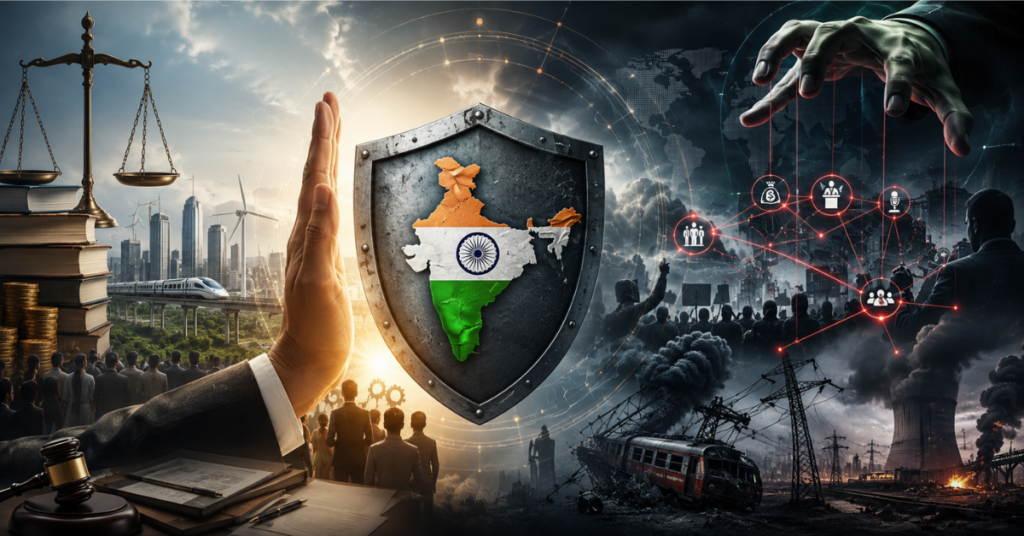
- This narrative is not driven by genuine concerns over civil liberties or religious freedom, but by desperation: tightened legislative oversight, real-time audits, and strict accountability directly choke unmonitored financial pipelines.
- For decades, these unchecked channels were abused by foreign entities, missionary networks, radical outfits, and domestic proxies to fund illegal conversions, engineer street protests, block critical infrastructure, and launch proxy influence operations.
- By enforcing robust financial transparency and shutting down the weaponized civil society pipeline that triggers civic disturbances, India is exercising its absolute sovereign right to protect its internal security, democratic integrity, and economic trajectory from external subversion.
Exposing the Anti-India Pipeline and Infrastructure Sabotage
1. Fact vs. Misinformation: The FCRA Landscape
Public posts and international statements regarding India’s FCRA regulations rely on misleading assertions designed to manufacture global outrage and pressure New Delhi.
- Gross Misrepresentation of FCRA Provisions: Claims that the FCRA legislation allows state takeovers of churches or faith-based charitable bodies are completely unfounded. The Bill creates a Designated Authority strictly to manage assets built using foreign contributions when an organization’s FCRA certificate lapses, is surrendered, or is canceled.
- Explicit Protection for Worship Places: The law explicitly mandates that if a foreign-funded asset under government supervision includes a place of worship, the Designated Authority must preserve its religious character.
- The Real Target of Scrutiny: The legislation mandates transparency and requires foreign capital to be utilized strictly for declared, lawful purposes. It restricts untracked sub-granting, sets usage thresholds, and prevents the unauthorized diversion of funds into non-declared activities—such as inducement-based religious conversions or anti-development political lobbying.
- Profiles of Political Intermediaries: U.S. lawmakers targeting the bill—such as Representative Riley Moore, a practicing Catholic who is not a formal member of major U.S. Catholic groups like Opus Dei, USCCB, the Napa Institute, or the Knights of Columbus—are frequently approached by transnational advocacy groups to publish scripted narratives.
2. Mechanics of Foreign Influence: The Panicked Ecosystem
Exposing the coordinated pushback against India’s financial compliance laws requires dissecting the specific pressure vectors that rely on unmonitored financial channels.
- Foreign Lobbies & Western Agencies: Western policy networks and intelligence proxies systematically utilize non-governmental organizations (NGOs) as soft-power tools. Enhanced financial tracking dismantles their ability to quietly fund influence operations or dictate internal policy outcomes in developing nations.
- Transnational Missionary Networks: Unchecked foreign capital was routinely deployed to fund large-scale conversion campaigns in tribal belts and strategic border regions. FCRA compliance measures—such as banning sub-granting, enforcing direct bank transfers via designated accounts, and tracking end-use—paralyze these unauthorized operations.
- Extremist & Radical Outfits: Unregulated foreign capital entering through shell trusts, charities, and cultural foundations has historically subsidized radicalization, fundamentalist institutions, and terror-linked networks. Auditing foreign capital at its source disrupts these illegal funding streams.
- Anti-National Domestic Proxies: Within India, an interconnected network of urban activists, legal advocacy NGOs, and agitators used foreign money to launch legal battles, stage manufactured street protests, and draft anti-majority legislative proposals.
3. Weaponization of Civil Society: Civic Disturbances & Security Risks
The strategic convertibility of local grievances into long-term national security liabilities represents a core tactic of foreign-funded subversion.
- Weaponization of Civil Society: By converting local grievances into prolonged legal battles and street protests, foreign-funded networks attempt to paralyze industrial progression and weaken national sovereignty. Civil society organizations—designed to act as societal buffers—are repurposed into instruments of asymmetric economic warfare.
- Manufactured Civic Disturbances: Unregulated funds are strategically funneled to organize sustained blockades, violent standoffs, and mass civil unrest. These engineered confrontations are designed to trigger severe public order crises, stretch state police forces thin, and force law enforcement into volatile situations that can be weaponized in international media.
- Critical Security Vulnerabilities:
- Border & Maritime Threats: Agitations surrounding border infrastructure, coastal deep-water ports, and defense-adjacent installations expose sensitive strategic sectors to external surveillance and sabotage.
- Internal Destabilization: Pumping funds into peripheral and socio-economically vulnerable zones alters local dynamics and creates internal friction points that external actors can exploit at will.
·
4. Case Studies: Sabotage of Strategic Infrastructure
The systematic targeting of key Indian infrastructure projects demonstrates how foreign capital has been weaponized under the guise of advocacy to cripple national growth.
- Kudankulam Nuclear Power Plant Blockade: During the commissioning phase in Tamil Nadu, widespread protests paralyzed operations. MHA investigations revealed that foreign money routed through local church-backed NGOs under the FCRA was illicitly diverted to fund the prolonged agitations, leading to the cancellation of multiple NGO licenses.
- Sterlite Copper Plant Closure (Thoothukudi): Sustained street protests against the Vedanta-owned Sterlite Copper plant culminated in violent clashes in 2018 and the permanent closure of a facility that supplied over 35–40% of India’s copper demand. Subsequent probes targeted NGOs like The Other Media for misusing foreign contributions from European donor networks to finance local agitations, transforming India from a copper exporter to a net importer.
- Vizhinjam Deep-Water International Seaport Protests: As construction approached critical milestones in Kerala, prolonged port-blockades were orchestrated by local ecclesiastical networks, claiming coastal erosion concerns. Foreign-funded entities provided logistical and legal support to stall a mega-transshipment hub designed to rival ports in Colombo and Singapore.
- Greenpeace India’s Anti-Energy Campaigns: Intelligence Bureau (IB) reports highlighted that Greenpeace India, funded heavily by foreign entities like Greenpeace International, organized targeted agitations against coal mining sites (e.g., Mahan coal block) and power plants. The economic loss caused by these delayed projects was estimated to cost India 2–3% of its annual GDP growth, leading to the cancellation of Greenpeace India’s FCRA registration.
- Oxfam India’s Industry-Targeted Agitations: MHA audit findings revealed that Oxfam India mobilized foreign funds to run negative campaigns against the Assam tea industry—threatening vital agricultural exports—and funded campaigns aimed at paralyzing domestic coal operations, leading to non-renewal of its FCRA registration.
5. Sovereign Self-Defense and Economic Independence
Every sovereign nation maintains the inherent legal right and constitutional duty to protect its security, economic trajectory, and social harmony from external subversion.
- Choking Illicit Pipelines: The fierce outrage from the anti-India ecosystem is a defensive reaction to losing its financial lifelines. With strict end-use controls, mandatory audits, and digital tracking, organizations can no longer receive foreign funds for healthcare or education and divert them into unauthorized activities.
- National Security Mandate: No democratic country permits unchecked, unaccountable foreign capital to freely enter its borders to alter local demographics, radicalize youth, or sabotage national development.
- Institutionalizing Integrity: Enforcing strict financial compliance under the FCRA is not an attack on minority rights or civil liberties—it is an indispensable step toward securing national sovereignty, internal security, and economic independence.
🇮🇳 Jai Bharat, Vandematram 🇮🇳
Read our previous blogs 👉 Click here
Join us on Arattai 👉 Click here
👉Join Our Channels👈