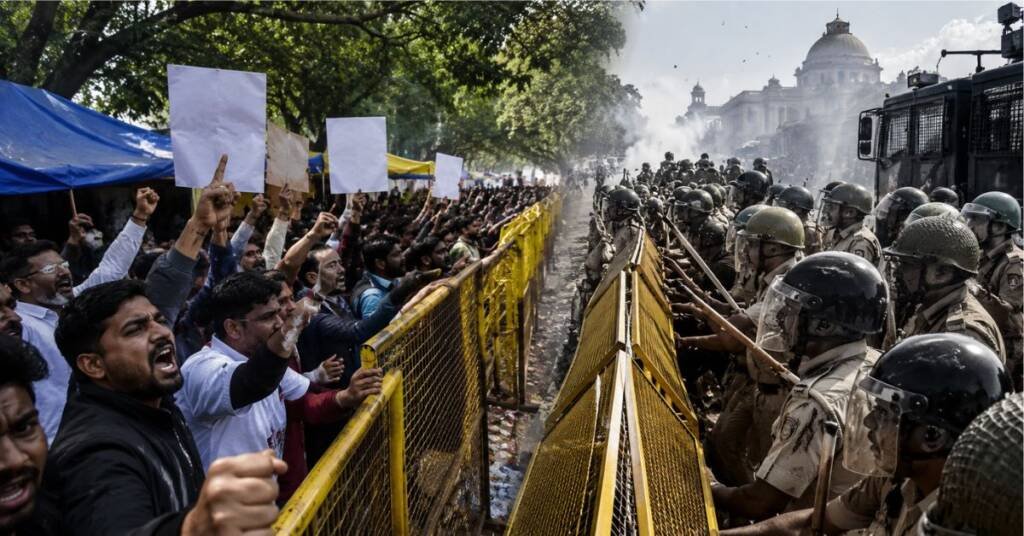
Summary
- This comprehensive narrative provides a high-level strategic and operational analysis of the intelligence, security, and administrative frameworks utilized during modern political containment operations, such as the strategic management of the Jantar Mantar agitation.
- It details how the state shifts from tactical containment on the street to deep-network intelligence mapping behind closed doors.
- By deconstructing the roles of the Home Minister, National Security Advisor, intelligence directors, and paramilitary chiefs, the text outlines the mechanics of financial tracing, surveillance data analysis, and legal enforcement deployed to dismantle engineered disruptions without resorting to kinetic escalation.
Political Reactions and Public Response
1. The High-Level Security Command: Synthesis of Strategic Operations
When top-tier national security leadership gathers following a major public containment event like the Jantar Mantar agitation, the focus moves beyond immediate crowd control. Meetings involving the Home Minister, National Security Advisor, Intelligence Bureau Director, and paramilitary leadership represent the shift from tactical law enforcement to strategic statecraft.
- Unified Command Integration: High-level security briefings integrate real-time intelligence from domestic agencies, paramilitary units, and local law enforcement. This ensures that localized street disruptions at key agitation sites are evaluated within the broader context of national security and regional stability.
- Transition from Tactical to Strategic: While front-line police forces manage physical perimeters at sites like Jantar Mantar, the central command focuses on long-term implications. The objective shifts from dispersing crowds to identifying the institutional, financial, and political architectures that enabled the mobilization.
- Formulating the Proactive Counter-Strategy: The post-event operational phase relies on preemptive intelligence. Security chiefs analyze patterns from the agitation to refine future protocols, ensuring the state remains ahead of engineered political disruptions.
2. Advanced Surveillance Analytics and Digital Face Identification
Modern crowd management during central agitations relies heavily on continuous technological surveillance. The clearing or redirection of a physical protest site initiates a data-driven identification process using high-resolution visual records gathered during the operation.
- Biometric and Facial Recognition Processing: High-definition drone footage, static long-lens photography, and embedded camera feeds from the Jantar Mantar perimeter are fed into central databases. Facial recognition systems process thousands of individual profiles to cross-reference identities against known offender registries.
- Mapping the Instigator Network: Surveillance analysis distinguishes between passive participants and active instigators. By tracking movement vectors, hand signals, and coordination behaviors within the crowd, intelligence analysts isolate key operatives responsible for provoking law enforcement.
- Digital Footprint and Communication Tracing: Geofencing data and localized network logs around the agitation hub are analyzed to determine communication patterns during the event. This mapping reveals how directions were transmitted to crowd sub-groups in real time.
3. Financial Mapping and Logistical Deconstruction
Large-scale political agitations requiring inter-state transport, lodging, and supply lines rely on complex financial pipelines. Post-containment operations prioritize tracing these financial networks to neutralize future disruption capabilities.
- Tracing Non-Transparent Funding Channels: Financial intelligence units track monetary flows linked to transport organizers, local coordinators, and proxy organizations involved in bringing protesters to Jantar Mantar. Unusual banking transactions, digital wallet transfers, and informal cash distribution channels are systematically audited.
- Logistical Chain Interdiction: Security agencies examine the logistics underlying crowd assembly. Identifying bus charters, bulk railway bookings, and coordinated shelter arrangements exposes the organizational nodes facilitating the movement.
- Exposing Foreign and External Linkages: When domestic disruptions align with broader geopolitical narratives, intelligence agencies analyze external communication channels and foreign funding pipelines to ensure international actors do not exploit internal democratic processes.
4. Legal Encirclement and Institutional Accountability
To prevent recurring cycles of manufactured street chaos, the state utilizes established legal frameworks to enforce accountability against instigators, coordinators, and financial backers of high-visibility agitations.
- Evidence-Based Prosecution: Leveraging high-resolution video footage, financial paper trails, and digital communication logs, law enforcement builds solid legal cases. This data-driven approach minimizes reliance on oral testimony and ensures high conviction rates in judicial proceedings.
- Targeting the Organizational Hierarchy: Legal action extends beyond low-level participants to target the strategic directors of the disruption. Charges are framed around conspiracy, destruction of public property, and threats to national security.
- Financial Recovery and Asset Attachment: Utilizing statutory provisions regarding damage to public infrastructure, administrative bodies initiate recovery proceedings against organizing bodies, attaching assets to compensate for public losses incurred during engineered agitations.
5. Long-Term Civilizational and Strategic Deterrence
The overarching goal of high-level containment statecraft at sites like Jantar Mantar is the establishment of long-term strategic deterrence. By demonstrating that engineered disruptions lead to systematic legal and financial consequences, the state preserves constitutional order.
- Neutralizing the “Victimhood” Strategy: By maintaining strict operational discipline and avoiding kinetic escalation during the agitation, the state deprives organizers of violent footage. Subsequent legal actions proceed through formal judicial channels, neutralizing attempts to weaponize state responses.
- Strengthening Institutional Resilience: Every successfully contained operation refines the security apparatus’s standard operating procedures. The integration of technology, intelligence, and administrative discipline ensures state institutions remain resilient against asymmetric pressure.
- Preserving Sovereignty and Governance Stability: Ultimately, the proactive containment doctrine ensures that policy decisions and legislative processes remain driven by constitutional mechanisms rather than street-level coercion, safeguarding the democratic framework of the republic.
🇮🇳Jai Bharat, Vandematram 🇮🇳
Read our previous blogs 👉 Click here
Join us on Arattai 👉 Click here
👉Join Our Channels👈