Summary
- This detailed analysis presents an in-depth evaluation of the largest ‘business reverse swing’ in the history of global geopolitics, diplomatic balancing, and modern trade.
- Amidst wars, sanctions, and severe supply chain disruptions that left developed Western nations reeling under an energy crisis, India—leveraging its unparalleled refining capacity, strategic diplomacy, and Public-Private Partnership (PPP) framework—accomplished the unprecedented feat of exporting petrol to an energy superpower like Russia.
- This article highlights the refining efficiency of Jamnagar and Vadinar, the historical parallel of the diamond trade shifting from Antwerp to Surat, the changing tide of global investments (Japan, Apple, Tesla), and the critical need to extend this economic relief to domestic consumers.
From the ‘King of Crude’ to the Customer: The Story of India’s Energy Diplomacy Model
1. The Greatest ‘Reverse Swing’ in Global Energy Trade
The India-Russia energy dynamic stands as the most vibrant and real-world example of how quickly the equations of global trade can shift amidst geopolitical crises.
- Drone Attacks and Russia’s Refining Crisis: Ukrainian drone strikes inflicted heavy damage on several major oil refineries and processing plants within Russia. Consequently, while Russia possessed an abundance of crude oil underground and in tankers, the facilities required to convert it into petrol and diesel were reduced to smoke.
- Emergence of a Domestic Crisis: During the summer, long queues formed at fuel pumps in major Russian cities, including Moscow, driving prices to record highs. Despite having raw production, this acute shortage of refined fuel emerged as a massive challenge for Russia.
- An Unprecedented Supply Chain Shift: The nation that until yesterday claimed the title of the world’s ‘Crude King’ had to knock on India’s door to satisfy its domestic market demands. Russia loaded its tankers with crude oil and dispatched them to the coasts of Gujarat. For the first time in history, a crude oil-producing giant became dependent on another country for petrol shipments.
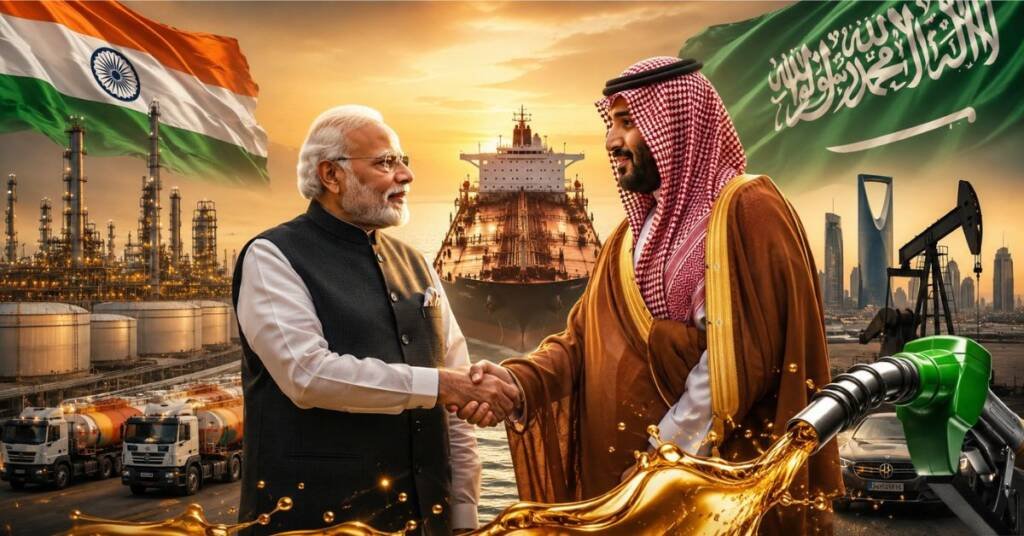
- Selling a Needle to the Blacksmith: This can be considered the boldest move in the commercial world. India not only purchased crude oil from Russia at discounted rates but also processed that very crude in its own refineries to export it back to Russia as ‘Made in India’ petrol. This marks an extraordinary ‘reverse swing’ in the history of global commerce, rewriting traditional import-export doctrines.
2. Indian Refining Hubs: The Global Dominance of Jamnagar and Vadinar
India’s success is neither an accidental occurrence nor a stroke of luck; it is the direct outcome of a state-of-the-art industrial infrastructure and refining capacity built over the last three decades.
- Global Edge in Cost and Speed: The cost of processing a barrel of crude oil in India is 25% to 35% lower than in Russia and European nations. This low operational cost, combined with exceptionally fast turnaround times, makes the Indian refining sector the most competitive in the world.
- The Industrial Miracle of Jamnagar: Reliance Industries’ facility in Jamnagar, Gujarat, is the world’s largest single-location refining complex, capable of processing over 1.4 million barrels of crude per day. Its complexity and efficiency remain unmatched globally, possessing the capability to convert even the heaviest and lowest-grade crude into high-quality fuel.
- The Role of Vadinar and Nayara: Alongside Jamnagar, Nayara Energy’s facility in Vadinar played an active role in this massive operation. Together, these two hubs tipped the scales of global oil diplomacy heavily in India’s favor.
- Logistial Optimization and Time Savings: Shipping operations are designed such that the moment a tanker arrives at the port, its crude is unloaded, and ‘Made in India’ petrol is immediately loaded onto the same vessel for its return journey without wasting a single day. This efficient management ensures ships do not return empty, yielding massive savings in both transit costs and time.
3. From Surat’s Diamonds to Jamnagar’s Oil: The Indian Business Mindset
This global dominance did not emerge overnight. It is an extension of the same commercial foresight and entrepreneurship that once dismantled some of the world’s largest trade monopolies.
- The Historical Shift from Antwerp to Surat: There was a time when the city of Antwerp in Belgium was the undisputed capital of the diamond trade, maintained by a rigid monopoly. Gujarati traders arriving from Surat leveraged their relentless hard work, precise cutting skills, and superior polishing capabilities to produce world-class diamonds at a fraction of the cost.
- Commanding the Global Market: Today, 9 out of every 10 diamonds in the world are cut and polished in Surat, and India directly controls nearly 60% of this global trade. This proves that Indian entrepreneurs possess the inherent acumen to dismantle any global monopoly.
- Semiconductors and the Future Roadmap: The very strategy that worked for diamonds yesterday is visible in the crude oil and fuel trade today. The next major frontier for the Indian business mindset is semiconductor and electronics manufacturing. With semiconductor fabs rapidly coming up in areas like Dholera and Sanand in Gujarat, and the entry of giants like Micron and Tata, India is systematically advancing toward becoming a global hub in this strategic sector.
4. Geopolitical Stability and Rising Global Investment
Ground realities have completely debunked the assertions of global rating agencies and certain Western analysts who historically categorized South Asia as an unstable, conflict-prone, and high-risk region.
- Massive Japanese Investment: Contrary to critical narratives, Japan has signed investment agreements worth approximately ₹10 lakh crore across India’s infrastructure, bullet train projects, and industrial corridors. This deployment of capital serves as a solid validation of India’s political stability and policy continuity on the global stage.
- Apple’s Manufacturing Revolution: Apple, the world’s most valuable tech company, is now manufacturing a substantial and vital share of its flagship iPhones in India for global export. India has successfully transitioned from being merely a consumer market to a primary global manufacturing base.
- The Stance of Tesla and Other Giants: EV pioneer Tesla is actively scouting land and aligning with government policies to establish its mega-manufacturing facility in the country. ‘Rising India’ is no longer just a tagline; it has become an indispensable and reliable anchor in the global supply chain.
5. Diplomatic Balance, the PPP Model, and the Necessity of Domestic Relief
Behind this entire operational narrative stands India’s independent, fearless foreign policy backed by a highly resilient Public-Private Partnership (PPP) architecture.
- Smart Diplomacy and National Interest: When the conflict in Ukraine broke out and Europe faced an energy crisis, policymakers in Delhi refused to compromise India’s energy security despite heavy pressure from Western nations. India made it explicitly clear that the welfare of its citizens remains paramount.
- Balancing Public and Private Sectors: Public Sector Undertakings (PSUs) like IOC, BPCL, and HPCL functioned as the nation’s domestic backbone, while private entities like Reliance and Nayara provided the agility, quick decision-making, and global competitiveness. This equilibrium is the true formula behind India’s growth.
- 1947 to 2026: A Historic Shift: In 1947, at the dawn of independence, India was a nation awaiting foreign ships to bring PL-480 wheat just to feed its population. Today, in the year 2026, the world’s largest oil producer anchors its vessels at Indian ports, waiting to receive petrol refined on Indian soil. This represents an epochal transformation engineered over eight decades.
- Economic Justice for Domestic Consumers: With the nation reaping such massive economic windfalls from global trade and optimized refining margins, a logical share of this profit must directly reach the pockets and kitchens of the common citizen. Backed by these strategic gains in the international market, a direct price reduction of at least ₹10 per liter on petrol and diesel should be passed on domestically. True self-reliance (Aatmanirbhar Bharat) will achieve its ultimate purpose only when corporate prosperity and a strong national exchequer directly translate into enhanced purchasing power and a better standard of living for India’s 1.4 billion citizens.
India’s art of converting global crises into commercial opportunities is absolute proof of its rising economic and diplomatic maturity. While the world remained entangled in factionalism and sanctions amidst the Russia-Ukraine conflict, India established itself as an indispensable global player through sharp business acumen, technological superiority, and decisive leadership—all without entering any geopolitical confrontation. This triad of technology, business sense, and a Nation-First diplomacy will write the template for India’s global prominence in the times to come.
🇮🇳Jai Bharat, Vandematram 🇮🇳
Read our previous blogs 👉 Click here
Join us on Arattai 👉 Click here
👉Join Our Channels👈