Executive Summary
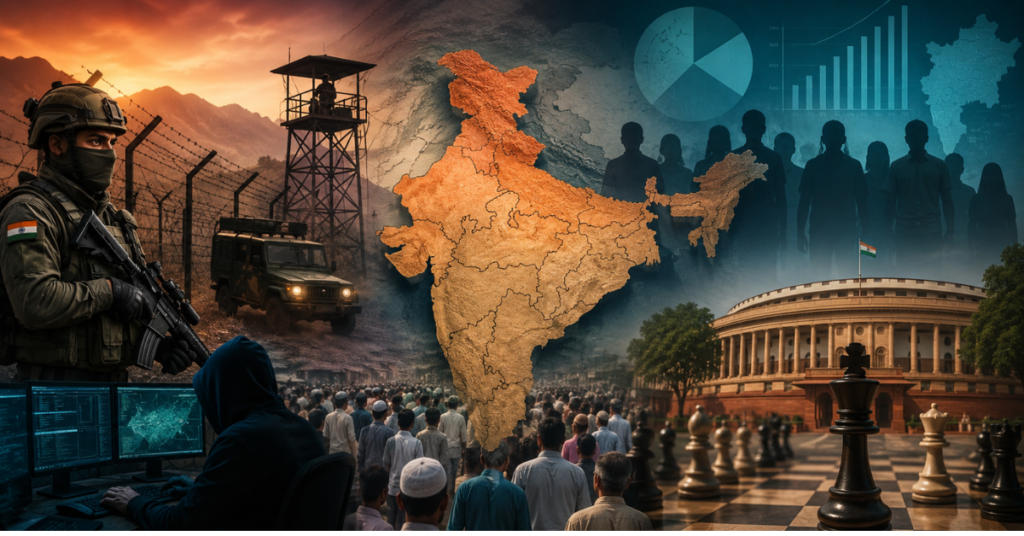
- This integrated political and social analysis examines the complex, multi-layered forces currently impacting India’s internal stability.
- It identifies a convergence of challenges: the long-term demographic shifts linked to missionary activity in tribal belts—historically addressed by the 1956 Niyogi Committee and continuing into 2026—and modern institutional battles, such as the controversy surrounding the 2026 UGC Equity Regulations.
- The analysis asserts that these are not isolated incidents but part of a broader struggle between nationalist forces aiming for civilizational revival and entrenched networks seeking to maintain dominance through identity-based polarization.
- By documenting the failure of divisive electoral tactics like the “Caste Census” card and the emergence of institutional traps, the article highlights the growing civic consciousness of the Indian public in safeguarding the nation’s future.
Demographic Change, and Political Conspiracy
Part 1: Christian Missionaries, Foreign Funding, and the Demographic Crisis
The 1956 ‘Niyogi Committee Report,’ which probed the activities of missionary organizations in Madhya Pradesh (which then included Chhattisgarh), remains a foundational document for understanding regional demographic tensions. Seventy years later, the warnings contained therein regarding the transformation of tribal identity are more relevant than ever.
The Mechanism of Cultural Erosion
The primary strategy employed by these organizations has been to detach indigenous tribal populations from their ancestral traditions:
- Fabricated Narratives: A decades-long academic campaign has promoted the “Aryan Invasion” theory, aiming to convince tribal communities that they are not part of the broader Sanatan civilization but rather a distinct, exploited group. This seeks to isolate them from mainstream Indian society.
- The Religion Trap: For centuries, tribals in regions like Jashpur, Surguja, and Bastar have practiced rituals consistent with Hindu traditions (e.g., reverence for ancestors, local festivals). The colonial-era classification of “Tribal Religion” in the 1931 Census was a tactical move to legally categorize them as non-Hindu, facilitating the missionary conversion model.
The Five-Tiered Apparatus of Conversion
The Niyogi Report identified a systematic five-pronged approach that remains active in 2026:
- Economic Dependence: Establishing cooperative societies and loan schemes to create permanent indebtedness among rural tribal families.
- Educational Indoctrination: Using a vast network of missionary schools to instill a sense of cultural inferiority, teaching children to view their ancestral traditions as “primitive” or “superstitious.”
- Evangelistic Expansion: Utilizing ‘Christian Ashrams’ and local pastors to aggressively target community gatherings.
- Medical Exploitation: Using mission hospitals to create “faith-healing assemblies,” where vulnerable patients are told their physical cures are the result of conversion.
- Philanthropic Targeting: Running orphanages and women’s shelters as conduits for community infiltration.
Chhattisgarh (2026): The Ground Reality
Despite significant strides in development, sensitive districts face persistent demographic challenges:
- Foreign Funding (FCRA) Networks: Data suggests that over 146 NGOs in the state receive foreign funds, with a significant concentration of missionary-linked entities operating in the tribal heartlands of Jashpur, Ambikapur, Raigarh, and Bastar.
- The “De-Listing” Demand: Local tribal organizations have begun a movement demanding that those who convert and abandon their ancestral traditions should no longer be eligible for Scheduled Tribe (ST) reservation benefits, as they have fundamentally changed their social and cultural identity.
Part 2: The Politics of Noise—Appeasement and Structural Apathy
The current demographic and security instability in certain pockets is the cumulative result of decades of “strategic apathy.”
- The Vote-Bank Shield: For years, political parties prioritized electoral math over national security, allowing extremist and separatist networks to grow under the legal cover of “minority rights.”
- Naxalism as an Industry: Naxalism was long portrayed as a “natural consequence of poverty,” intentionally ignoring its violent anti-national agenda. This allowed an “Urban Naxal” network to flourish within academic, policy-making, and judicial circles, providing an intellectual defense for those who sought to destabilize the state.
- Governance by Crisis: A recurring theme has been the use of “managed unrest.” By keeping specific regions in a state of perpetual fear—be it through riots, Naxal violence, or communal tension—the political class could justify the diversion of massive funds toward “crisis management” and security, creating a lucrative cycle of corruption under the guise of relief.
Part 3: The Failed “Caste Census” and the “UGC Trap (2026)”
As India’s internal security has tightened—marked by the landmark declaration of Naxal-free zones in early 2026—traditional disruption tactics have evolved.
The Failure of Social Fragmentation
The opposition’s attempt to fracture the Hindu vote through a “Caste Census” campaign largely collapsed during the 2024–2025 electoral cycle. Communities increasingly realized that the “Double-Engine” development model offered tangible empowerment, effectively neutralizing the politics of grievance.
The “UGC Trap (2026)” and Institutional Discord
Following the failure of the caste-based narrative, a new crisis was engineered within higher education to alienate the General Category (Swarnas and Brahmins):
- The 2026 Equity Regulations: Notified in January 2026, these regulations were challenged for their vague definitions of “caste-based discrimination.” Critics argued they were designed to create a one-sided system where students or faculty from the general category could be targeted without due process, effectively functioning as a “campus-based SC/ST Act.”
- Institutional Chaos: The Supreme Court eventually placed these regulations in abeyance, but not before they caused mass protests across several universities. The goal was to force a wedge between the nationalist government and its traditional base, painting the state as “anti-intellectual” or “discriminatory.”
- The Threat of Instability: By creating an environment of “caste surveillance” in universities, the architects of this trap hoped to stifle the unprecedented progress of the last 12 years and push India back toward a state of fragmented identity politics.
Part 4: The Rise of Conscious Citizenship and the Future
The most critical miscalculation by the “Thugbandhan” (opportunistic alliance) is their failure to recognize the intellectual maturity of the modern Indian electorate.
- A New Era of Awareness: The Indian youth and the professional class are no longer fooled by historical distortions or the “victim card” narrative. They recognize that the fostering of extremism and the erosion of national security were the primary tools used by previous regimes to maintain a stranglehold on power.
- The Silent Revolution: Through ballot boxes and public discourse, citizens are engaged in a “silent revolution,” actively rejecting the ecosystem of cronyism and divisive politics. This is not a short-term trend but a civilizational shift toward reclaiming India’s rightful place as a global leader.
- The Path Toward Vishvaguru: The current support for nationalist governance is driven by a long-term vision—the renaissance of India’s 2,000-year-old culture, economic sovereignty, and strategic autonomy. The goal is a nation that is not just prosperous, but one that leads the world in ethics, technology, and cultural values.
- From the remote, forest-covered districts of Chhattisgarh where demographic integrity is being fought for, to the prestigious university halls where institutional equity is being redefined, a clear pattern emerges: the old guard of political manipulation is crumbling.
- The resolve of the Indian citizen to stand with a nationalist, progressive state has transformed from a mere electoral preference into a foundational commitment.
- Through vigilance, unwavering internal security, and a deep, conscious connection to our roots, India is effectively neutralizing these multi-dimensional threats, paving the way for a secure and invincible future.
🇮🇳Jai Bharat, Vandematram 🇮🇳
Read our previous blogs 👉 Click here
Join us on Arattai 👉 Click here
👉Join Our Channels👈