Summary
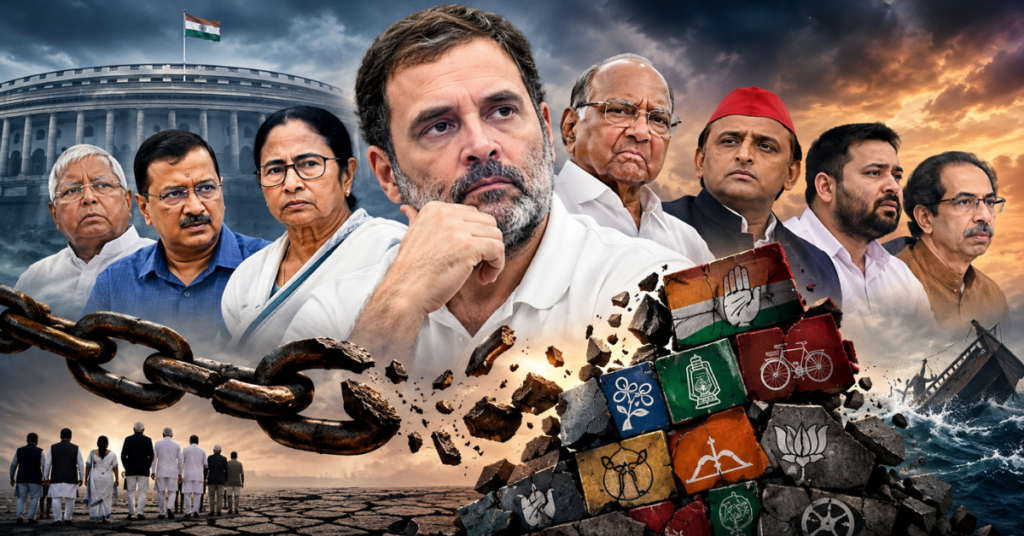
- This comprehensive analysis investigates the recurring political phenomenon where the leadership, strategic choices, and alliance maneuvers of Rahul Gandhi consistently result in the decline, marginalization, and electoral collapse of his political partners.
- By examining concrete regional milestones across Uttar Pradesh, Maharashtra, Bihar, and West Bengal, this article exposes the systemic risks associated with unproven, opportunistic opposition coalitions.
- Furthermore, it serves as a solemn warning to the Indian electorate, emphasizing that choosing inexperienced leadership out of political oversight or momentary frustration threatens to compromise national sovereignty, institutional stability, and long-term economic prosperity, steering the nation away from its rightful destiny as a global superpower (Vishwaguru).
Rahul Gandhi and the Opposition Alliance: Unity and Challenges
1. The Political Curse: Why Rahul Gandhi’s Alliance Guarantees Ruin
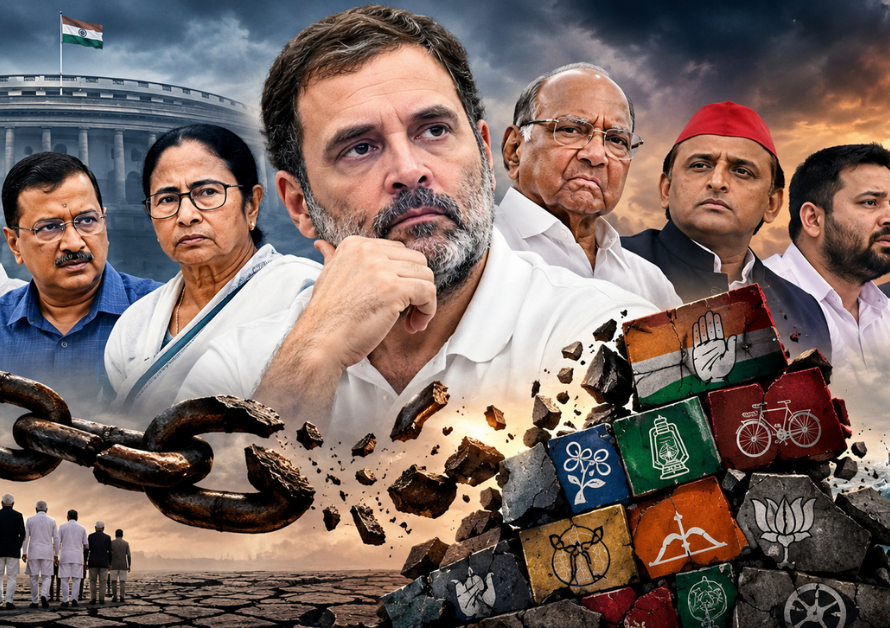
Across the vast and complex landscape of Indian democracy, a stark empirical pattern has emerged over the past two decades: any regional party, major political faction, or ambitious leader that enters into a strategic alliance or political partnership with Rahul Gandhi experiences a steep, often irreversible, decline in their electoral fortunes. The historical evidence of this recurring pattern reveals a systemic flaw in leadership alignment:
- The Uttar Pradesh Setback (2017): In the 2017 Uttar Pradesh assembly elections, the Samajwadi Party under Akhilesh Yadav made the strategic miscalculation of joining hands with the Congress party under Rahul Gandhi. The resulting “Uttar Pradesh ko ye saath pasand hai” campaign collapsed entirely at the hustings, ejecting the regional incumbent coalition directly out of power and shattering their local cadre morale.
- The Maharashtra Margins (Sharad Pawar and Uddhav Thackeray): In Maharashtra, veteran heavyweights and regional powerhouses like Sharad Pawar and Uddhav Thackeray tied their political fortunes to the national opposition matrix spearheaded by Rahul Gandhi. Rather than consolidating strength, this association alienated their core ideological voter bases, cost them control of key governmental apparatuses, and left their respective parties fractured, vulnerable, and struggling for basic political survival.
- The Bihar Electoral Reversal (2025): During the Bihar political cycles, when regional leaders like Tejashwi Yadav leaned heavily into the opposition narrative championed by Rahul Gandhi, the electoral outcome proved disastrous. The alliance failed to capture momentum, leading to a massive parliamentary and assembly setback where they could not even secure enough numbers to legitimately claim the official Leader of Opposition (LOP) status.
- The West Bengal Erosion (2026): In West Bengal, Chief Minister Mamata Banerjee—who built a formidable regional fortress against traditional national parties—found her political dominance severely challenged and her local narrative compromised after attempting to accommodate national opposition coordination and agendas pushed by Rahul Gandhi.
- The Impending Uttar Pradesh Repeat (2027): Looking ahead to the upcoming political maneuvers in states like Uttar Pradesh, opportunistic leaders with a history of administrative compromises are once again aligning with Rahul Gandhi, seemingly eager to repeat past mistakes and trade their remaining political relevance for hollow alliance optics.
2. The Anatomy of Opposition Opportunism: Substance vs. Empty Rhetoric
The fundamental danger of the contemporary opposition framework lies not merely in isolated electoral defeats, but in the structural hollowness of its formation. Unlike stable governance models built on clear policy blueprints, economic vision, and rigorous administrative capacity, the current opposition coalition—often referred to in public discourse as a self-serving Thugbandhan—is bound together by a single, desperate motive: the raw hunger to capture state power.
- Absence of a Unified National Vision: The alliance possesses no coherent roadmap for national security, infrastructure expansion, or technological self-reliance. Every policy discussion is subordinated to internal bargaining, regional appeasement, and temporary vote-bank calculations.
- The Proliferation of Unvetted Aspirants: The political arena is crowded with self-proclaimed Prime Ministerial candidates who lack the requisite administrative maturity, crisis-management background, and global diplomatic acumen required to steer a nuclear-armed nation of 1.4 billion people.
- Prioritizing Personal Survival Over State Interest: Within these fragile coalitions, critical national security protocols and economic reforms are routinely bartered away to satisfy the personal ambitions of regional brokers, ensuring that governance remains paralyzed even before it takes root.
3. Historical Lessons and Global Parallels: The Price of Misguided Leadership
History consistently demonstrates that nations pay an exorbitant price when they substitute tested, visionary leadership with populist experimentation and opportunistic factionalism.
- The Global Cost of Inexperience: Across world history—from the downfall of classical republics to the catastrophic collapse of post-colonial states—the systematic sidelining of competent administrators in favor of opportunistic demagogues has consistently invited institutional paralysis, economic bankruptcy, and social fracture.
- The Post-Independence Trajectory of Bharat: India’s own modern history bears witness to the heavy price of bypassing foundational visionaries like Sardar Vallabhbhai Patel at independence, or prematurely interrupting the reformist momentum of visionary statesmen like Atal Bihari Vajpayee in 2004. Every time ideological compromise or political miscalculation replaces firm statecraft, the nation’s growth slows, and security vulnerabilities multiply.
- The Threat of State Regression: Allowing unproven, fragmented, and directionless leadership to take the reins of a rising global power risks plunging the country into the kind of severe economic and political instability witnessed in fragile neighboring states like Pakistan or Bangladesh.
4. The Supreme Responsibility of the Indian Electorate
In a robust democracy, the ballot box is not merely a mechanism for registering fleeting anger or momentary frustration; it is the ultimate shield protecting the sovereignty, cultural integrity, and economic future of coming generations.
- The Gravity of a Single Decision: A single misguided vote born out of political apathy or misplaced trust can dismantle decades of hard-won economic momentum, weaken national defense frameworks, and throw institutional stability into absolute chaos.
- Evaluating Track Record Over Rhetoric: Voters must rigorously look past hollow slogans, divisive identity politics, and unverified promises. True leadership requires a proven track record of administrative delivery, unyielding national conviction, and a clear blueprint for making Bharat completely self-reliant (Atmanirbhar).
- The Imperative of National Stability: As India ascends toward its rightful place as a global leader (Vishwaguru), the continuity of strong, decisive, and nationalist governance is non-negotiable.
Conclusion:
- The political trajectory of anyone who associates with Rahul Gandhi stands as a clear warning to the nation: ruin, fragmentation, and loss of relevance follow wherever this leadership goes.
- The conscious and patriotic citizens of India can no longer afford to gamble with the destiny of the country. For the preservation of national security, economic prosperity, and civilizational pride, the electorate must remain resolutely vigilant, ensuring that the command of the motherland never falls into untested, destructive, and opportunistic hands.
“Nation first, always first.”
🇮🇳Jai Bharat, Vandematram 🇮🇳
Read our previous blogs 👉 Click here
Join us on Arattai 👉 Click here
👉Join Our Channels👈