Summary
- In light of recent political statements and social media campaigns, this detailed analysis examines the legal status, organizational structure, financial management, and social impact of the Rashtriya Swayamsevak Sangh (RSS).
- This narrative exposes how India’s ‘anti-national ecosystem’—in its desperation to salvage its identity and agendas—propagates technical and ideological confusion surrounding the Sangh.
- Furthermore, it highlights how the ongoing resurgence of Sanatana Dharma across the country is gradually rendering this adversarial ecosystem obsolete.
Introduction to the Rashtriya Swayamsevak Sangh (RSS) and Its Founding Purpose
1. Anxiety within the Ecosystem: The Real Reason Behind Attacks on the Sangh
The recent surge in ideological and technical attacks against the Sangh stems not from genuine legal curiosity, but from a deep-seated political crisis and a battle for existential survival:
- The Ultimate Existential Crisis: India’s anti-national and self-proclaimed liberal ecosystem perceives the Rashtriya Swayamsevak Sangh as the single greatest threat to its existence, global agendas, and divisive domestic designs. Due to the Sangh’s nationwide reach and robust nationalist network, the ecosystem’s polarizing strategies consistently fall flat.
- The Resurgence of Sanatana Dharma: The unprecedented cultural and spiritual renaissance of Sanatana Dharma currently sweeping across India has shaken the very foundations of this anti-national apparatus. As society returns to its cultural roots, it is becoming nearly impossible for this ideological ecosystem to retain relevance or survive within the Indian discourse. Consequently, in a desperate bid to preserve its fading influence, it resorts to maligning the Sangh through every available means.
2. A Detailed Analysis of Legal Status and Constitutional Protections
The technical ambiguities frequently manufactured in public discourse and political debates regarding the registration and legal existence of the Sangh are entirely groundless under Indian law:
- Constitutional Rights (Article 19): Article $19(1)(c)$ of the Constitution of India guarantees all citizens the fundamental right to autonomously form associations, unions, or cooperative societies without state interference or the mandate of prior government permission. The Sangh functions entirely within the ambit of this democratic and constitutional right.
- The Reality of the Societies Registration Act: The Indian legal framework contains no central or mandatory legislation dictating that every social, cultural, religious, or ideological group must register under the Societies Registration Act, 1860. Registration is entirely voluntary and is primarily required for organizations that engage in commercial profit or seek government grants.
- ‘Body of Individuals’ (BOI): In legal terminology and Indian jurisprudence, the RSS is recognized as a ‘Body of Individuals’ (BOI). Various higher courts across the country, including the Patna High Court (1994), have repeatedly clarified that being unregistered does not render an organization ‘illegal’ or ‘unlawful.’ As long as an organization does not engage in activities prejudicial to national sovereignty or statutory laws, its operations remain completely lawful.
- Legal Registration of Affiliated Entities: While the core entity (RSS) remains an informal body of individuals, all its affiliated wing organizations (such as Sewa Bharati, Vidya Bharati, etc.) and various trusts that hold movable or immovable property or operate bank accounts are formally registered under respective state Trust Acts and Societies Acts, remaining fully accountable before the law.
3. Financial Management, Transparency, and the System of ‘Guru Dakshina’
Questions raised regarding the Sangh’s financial self-reliance, sources of funding, and audits are clearly answered by Indian income tax laws and the organization’s internal operational methodology:
- The Principle of Mutuality: Under Section $2(31)$ of the Income Tax Act, a ‘Body of Individuals’ (BOI) is treated as a ‘person’ for assessment purposes. However, the established legal “Principle of Mutuality” applies to the Sangh. According to this principle, if a group’s members collect funds strictly among themselves—using them not for external commercial profit but solely for the internal development of members or collective social welfare—such amounts do not fall under the category of ‘Taxable Income.’
- The Internal Source of ‘Guru Dakshina’: The Sangh maintains no mechanism to accept donations or financial contributions from external individuals, corporate houses, commercial entities, or foreign sources. Every year on Vyasa Purnima, during the ‘Guru Dakshina’ program, only regular and active volunteers (swayamsevaks) offer completely confidential and voluntary contributions, keeping the sacred saffron flag (Bhagwa Dhwaj) as their witness. These funds are utilized for running daily operations (shakhas), managing full-time workers’ travels, and organizational expansion.
- Regular Audits and Tax Returns (ITR): All registered trusts operating under the control or inspiration of the Sangh (such as those managing schools, hospitals, welfare centers, or office buildings) have their balance sheets audited annually by certified Chartered Accountants (CAs). These trusts systematically file their Income Tax Returns (ITR) with the Income Tax Department, ensuring total financial transparency.
- Distance from Foreign Funding (FCRA) and Government Subsidies: To preserve its sovereignty, ideological purity, and absolute independence, the Sangh does not accept any financial grants from the state or any subsidies derived from taxpayers’ money. Additionally, it completely refrains from seeking or accepting direct funds from foreign entities or non-resident sources under the Foreign Contribution Regulation Act (FCRA), reflecting its complete self-reliance.
4. Organizational Structure and the Unique Methodology of Character Building
The organizational dynamics of the Sangh differ fundamentally from standard political or social organizations worldwide. Its structure is not top-down but grows organically from the grassroots upward:
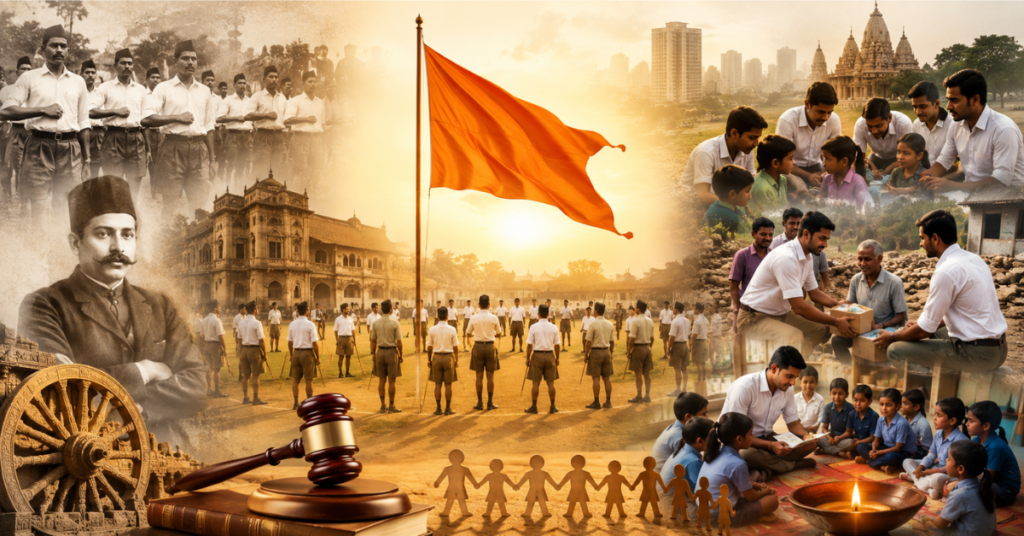
- The ‘Shakha’ – The Cornerstone of the Organization: The focal point of the Sangh’s entire operational framework is the daily shakha, an hour-long assembly held every day in an open ground or public space. Through physical exercises, sports, Surya Namaskar, drills (samata), patriotic songs, and discussions on contemporary issues, it fosters discipline, national consciousness, and a sense of collective responsibility among volunteers.
- Voluntary Association Without Membership Fees: Unlike most large international organizations that require formal written membership forms, annual fees, receipt books, and identification cards, the Sangh features no formal paperwork or record books for membership. Anyone who regularly attends shakha activities is recognized as a swayamsevak. This association is entirely voluntary, carrying no legal or social coercion upon joining or leaving.
- The Pracharak System (Full-Time Dedication): The organizational backbone of the Sangh comprises its Pracharaks. These are volunteers who choose to remain unmarried and dedicate their entire lives to the service of the nation and society without receiving any salary, honorarium, or material gain. They own no personal property; their basic necessities (food, clothing, travel expenses) are taken care of by the society and the broader Sangh family.
- Democratic Decision-Making (Akhil Bharatiya Pratinidhi Sabha): Although the Sarsanghchalak (Chief) holds the position of supreme guide and custodian, policy and executive decisions are made through a thoroughly democratic process. The Akhil Bharatiya Pratinidhi Sabha is the highest decision-making body of the Sangh, where elected representatives from every province (Prant) and department (Vibhag) meet annually to formulate policies, execute internal appointments, and pass resolutions of national importance.
5. Social Harmony and the Nationwide Expansion of Grassroots Welfare
The impact of the Sangh extends far beyond intellectual discourses or ideological debates; it plays a monumental role in strengthening the social fabric of the country and integrating the marginalized into the mainstream:
- The Practical Eradication of Casteism: Historically, caste divisions and notions of hierarchy have been significant internal vulnerabilities within Indian society. To address this permanently, the Sangh adopted a practical model of ‘Social Harmony’ (Samajik Samrasata). On the shakha grounds, all volunteers assemble in an identical uniform (ganavesh), where no one is questioned about their caste, sub-caste, class, or economic background. They perform physical labor together and dine from shared meals (sahabhoj), naturally dismantling deep-seated biases.
- Vidya Bharati and Vanvasi Kalyan Ashram: Operated by Sangh volunteers, Vidya Bharati has grown into the nation’s largest non-governmental educational network, delivering modern education rooted in Indian ethos to remote villages, urban slums, and small towns. Concurrently, through the Vanvasi Kalyan Ashram, thousands of single-teacher schools (Ekal Vidyalayas), sports centers, hostels, and development projects are run in remote tribal belts, integrating indigenous communities into the national mainstream while safeguarding them from predatory conversions and preserving their cultural heritage.
- First Responders in Disaster Management: The service wing of the Sangh (Sewa Bharati) consistently emerges as one of the country’s most reliable and rapid-response organizations during crises. Be it cyclones, train accidents, devastating floods, earthquakes, or pandemics, volunteers routinely risk their lives to distribute relief materials, set up medical camps, prepare food packets, and rescue people from debris without a shred of religious or social discrimination.
6. Historical Perspective and Democratic Commitment
Due to political dynamics, various misconceptions and half-truths are often circulated regarding the Sangh’s history and its role in national movements. However, historical documents firmly validate its patriotic legacy:
- Active Role in the Freedom Struggle: The founder of the Sangh, Dr. Keshav Baliram Hedgewar, was himself a staunch freedom fighter who participated actively in Congress-led movements and faced rigorous imprisonment twice under British rule. Hundreds of Sangh volunteers actively participated in the nation’s independence movements both individually and collectively, notably rising against British oppression during the Salt Satyagraha of 1930 and the Quit India Movement of 1942.
- The Struggle Against the Emergency (1975): The gravest assault on democracy in independent India occurred during the 1975 Emergency. At that time, the ruling regime abused its power to impose a ban on the Sangh. Despite this, Sangh volunteers led the underground resistance, organized satyagrahas, distributed clandestine pamphlets against press censorship, and over 100,000 volunteers endured subhuman torture in prisons—ultimately forcing the restoration of democracy in the country.
- National Security and Cooperation with the Armed Forces: During the Sino-Indian War of 1962 and the Indo-Pakistani War of 1965, Sangh volunteers provided exemplary support to local administrations by managing internal security, controlling traffic, donating blood for the wounded, and maintaining logistics supply lines for the military. Impressed by this patriotic and disciplined civil action, the then Prime Minister, Pandit Jawaharlal Nehru, extended a historic invitation to 3,000 RSS volunteers to participate in full uniform during the 1963 Republic Day Parade.
India Marches Toward Victory in the Narrative War
- The endless array of allegations and labels leveled against the Rashtriya Swayamsevak Sangh ultimately reflects the profound frustration of a defeated ecosystem.
- Throughout its century-long journey, the Sangh has performed monumental work in shaping the character of Indian society, reviving cultural pride, and embedding the principle of “Nation First” into the public consciousness.
- Now that the majority of the nation has awakened and Sanatana Dharma is experiencing a grand resurgence, the falsehoods propagated by this anti-national apparatus are crumbling.
- The only objective way to truly understand this phenomenon is to step away from rumors, neutrally observe its constructive endeavors, and personally experience the reality by visiting a local shakha.
🇮🇳Jai Bharat, Vandematram 🇮🇳
Read our previous blogs 👉 Click here
Join us on Arattai 👉 Click here
👉Join Our Channels👈