Summary
- The installation of Maharishi Sushruta’s bronze bust at the historic Playfair Hall of the Royal College of Surgeons of Edinburgh (RCSEd) marks a monumental shift in the global historiography of science.
- This narrative explores the clinical, historical, and civilizational dimensions of this event, dismantling Eurocentric medical history.
- By analyzing the precise surgical innovations found in the Sushruta Samhita and contrasting them with India’s modern cultural resurgence, this piece exposes a striking irony: while Sanatana Dharma and its scientific heritage are celebrated in global parliaments and premier Western institutions, they face intense political and media hostility from a domestic elite within India itself.
The Scientific Significance of the Sushruta Samhita
1. The Edinburgh Consecration: A Watershed in Medical History
The Royal College of Surgeons of Edinburgh (RCSEd), founded in 1505, stands as one of the oldest, most rigorous, and prestigious surgical fraternities in the world. It is an institution built on the rigid tenets of empirical science and clinical proof. For such an establishment to permanently install a bronze bust of Maharishi Sushruta in its historic Playfair Auditorium is not an act of diplomatic courtesy; it is an objective, institutional bow to the fountainhead of surgical science.
- Breaking the Eurocentric Monopoly: For generations, global medical curricula have taught that surgery began with the Greeks or developed exclusively during the European Renaissance. The Edinburgh consecration shatters this bias, formally acknowledging that the foundational pillars of operative surgery were raised in Kashi (Varanasi) along the banks of the Ganga over 2,500 years ago.
- The Paradigm of Vindication: This event marks a transition from defensive apologetics to confident global ownership. It forces the international community to recognize that ancient India was not merely a land of abstract spiritualism, but a civilization of acute observation, structural logic, and profound empirical mastery.
2. The Clinical Genius of the Sushruta Samhita
To understand why the highest echelons of Western medicine honor Sushruta, one must look beyond reverence and delve into the astonishingly precise, clinical realities detailed in his seminal compendium, the Sushruta Samhita. He approached the human body not with mysticism, but with the cold, calculating eye of a master technician.
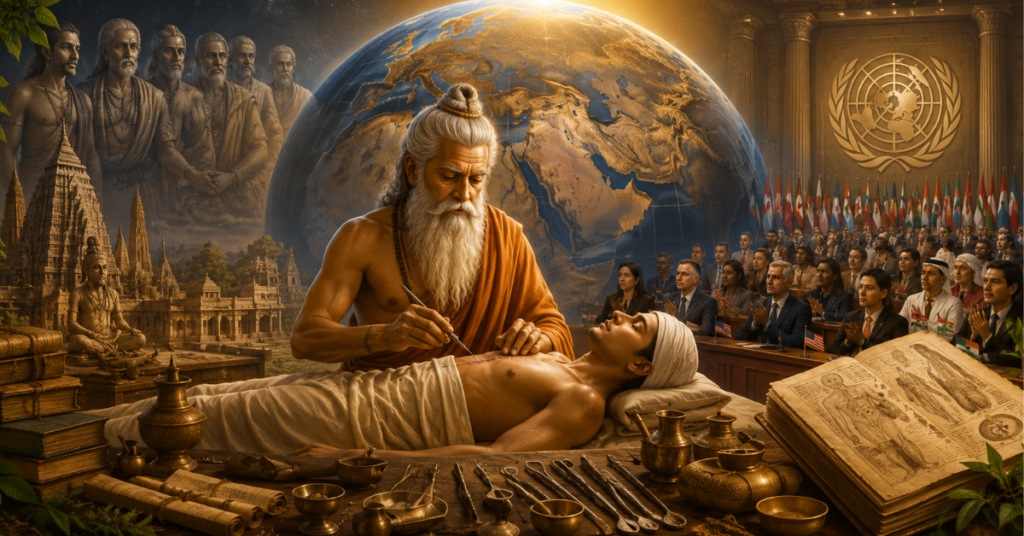
- The Father of Plastic Surgery (Rhinoplasty): Long before Western medicine understood the mechanics of tissue transfer or skin grafting, Sushruta was routinely reconstructing severed noses and ears. His method of lifting a flap of skin from the forehead or cheek, keeping it attached to its blood supply, and rotating it to reconstruct the nose is practiced today as the “Indian Flap” in modern plastic surgery textbooks.
- Ingenious Anatomical Dissection: In an era devoid of refrigeration, chemical preservatives, or advanced imaging, Sushruta devised a brilliant method to study human anatomy. Bodies were placed in cages and immersed in the slow current of a river for seven days. As natural decomposition softened the outermost layers, Sushruta used brushes made of grass and fibers to systematically scrape away tissue layer by layer, accurately documenting deep muscles, blood vessels, ligaments, and internal organs.
- Biomimetic Surgical Instruments: The Sushruta Samhita catalogs over 120 surgical instruments (Yantras and Shastras). Demonstrating a deep understanding of ergonomics and mechanical advantage, Sushruta designed these tools based on the jaws, beaks, and claws of animals and birds (e.g., the Simhamukha or lion-faced forceps). Modern artery forceps, speculums, and scalpels retain the exact structural geometry conceived by Sushruta millennia ago.
3. The Deep Irony: Global Reverence vs. Domestic Hostility
The honoring of Maharishi Sushruta in Edinburgh highlights a profound and painful paradox regarding how India’s civilizational identity—Sanatana Dharma—is treated at home versus abroad.
Global Celebration: Today, Sanatana Dharma, its philosophies, its scientific contributions, and its festivals are respected across the globe. From the British Parliament to the United States Congress and the halls of Westminster, global leaders and democratic institutions openly celebrate and pay tribute to India’s heritage without hesitation.
In sharp contrast, the situation within India presents a distinct anomaly:
- The Domestic Ruckus: The tragic irony is that if a similar unapologetic celebration of Sanatana Dharma or its rishis takes place within the Indian Parliament, it triggers an immediate political and media ruckus. A vast, entrenched network of domestic politicians, pseudo-secular critics, and media houses instantly label the celebration of India’s own roots as “regressive,” “majoritarian,” or “a threat to democracy.”
- The Prophets of Self-Contempt: It remains a historical aberration that a civilization’s heritage is embraced by foreign superpowers, yet remains an object of political targeting and mockery by a loud segment of the political opposition within its own birthplace.
4. Decolonizing the Indian Intellect
The deepest tragedy of the colonial occupation of India was not merely the drain of material wealth, but the systemic dismantling of national self-esteem. The education systems imposed upon India were deliberately designed to create an alienated elite that viewed its own heritage as backward, superstitious, and unscientific.
- The Burden of Self-Contempt: For decades post-independence, a Euro-mimetic intellectual ecosystem dominated India’s academic institutions. To speak of ancient Indian science was labeled as regressive. Our own children were taught to look exclusively to the West for inspiration, completely oblivious to the fact that their ancestors had pioneered the very sciences they were importing.
- The Turning of the Tide: When a premier British institution honors an ancient Indian sage, it deals a fatal blow to this inherited colonial hangover. It strips the domestic “pseudo-liberal” critics of their armor. When the West validates what Indian sages preserved for millennia, the narrative shifts from “mythology” to “historical fact,” triggering a massive psychological liberation across the nation.
5. The Convergence of Hard Power and Civilizational Pride
Global recognition does not occur in a vacuum. The world does not respect a civilization that is economically fragile, politically fractured, or militarily timid. The sudden global acceptance of India’s ancient scientific heritage is intimately tied to India’s current geopolitical and economic ascent.
- The Language of Strength: Over the last decade, India has transformed from one of the “Fragile Five” economies to the world’s fourth-largest economic powerhouse. When a nation demonstrates hard power—whether through the flawless execution of ISRO’s space missions, the indigenization of defense manufacturing, or the unilateral deployment of life-saving medical aid via Vaccine Maitri—the world stops viewing its history as an ancient relic. It begins viewing its history as a blueprint for civilizational resilience.
- The Hypocrisy of the Corrupt: This global resurgence stands in sharp contrast to the internal “Narrative War” being waged by vested political interests within India. While an honest, relentless leadership works to elevate India’s stature internationally, domestic detractors—who looted the nation’s resources for decades—cry foul, claiming that India’s institutions are failing. Yet, their global disinformation campaign is thoroughly exposed when world-class scientific bodies like the RCSEd choose this exact moment to immortalize India’s ancient icons in bronze.
The Blueprint for a Resurgent Bharat
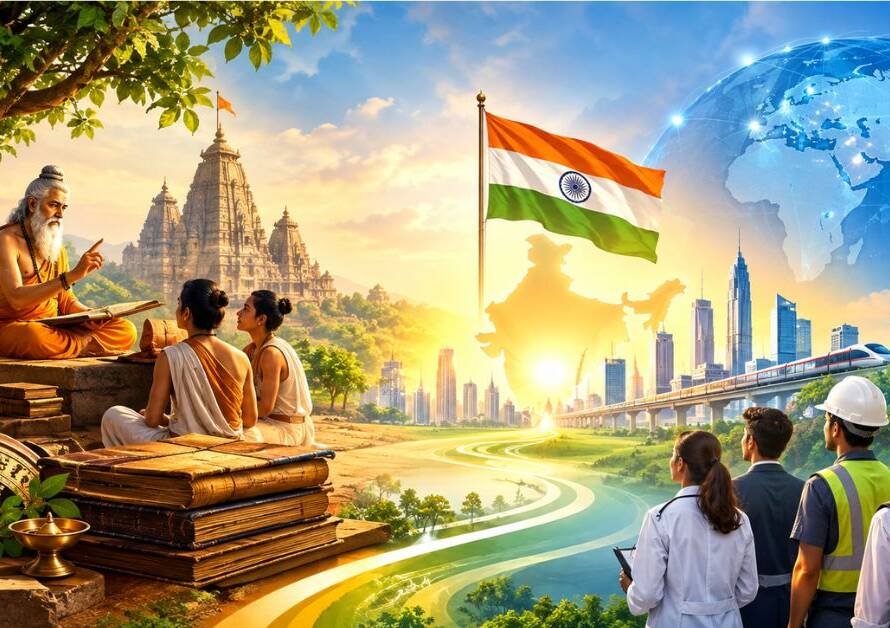
- The image of Maharishi Sushruta standing tall in the heart of Edinburgh is a profound message to the youth of modern India. It serves as an undeniable reminder that our civilizational roots are inherently logical, deeply empirical, and profoundly scientific.
- We are not required to choose between ancient heritage and modern advancement. The two are parts of the same continuous stream. The same civilizational DNA that mapped human anatomy 2,500 years ago is today engineering interplanetary missions and leading global digital revolutions.
- The long night of cultural amnesia is drawing to an end. As the global community is forced to re-center the history of science around its true originators, India reclaims not just its past, but its rightful seat at the head of global innovation.
- Our culture is our science, our history is our strength, and our heritage is our ultimate pride.
🇮🇳Jai Bharat, Vandematram 🇮🇳
Read our previous blogs 👉 Click here
Join us on Arattai 👉 Click here
👉Join Our Channels👈