Summary
- This analytical post highlights a major shift in contemporary geopolitical strategy, focusing on western security architecture and its relationship with Turkey.
- Using the statements of former U.S. Director of National Intelligence (DNI) Tulsi Gabbard as a foundation, this analysis examines the growing contradictions within NATO, the state-sponsored support provided to ideological movements like the Muslim Brotherhood and Hamas, and the global shift away from legacy diplomatic compromises toward aggressive Counter-Terrorism Realism.
Tulsi Gabbard’s Warning and the New Direction of Western Security Alliances
1. Introduction: The End of Diplomatic Ambiguity
- For decades, international diplomacy operated on the assumption that certain strategic compromises were necessary to maintain global stability. Turkey, situated as a vital geographical bridge between Europe and Asia, was always considered an indispensable, albeit volatile, ally.
- However, this paradigm is shifting. Prominent global voices on national security are calling for an immediate re-evaluation of long-standing alliances based on clear counter-terrorism principles rather than obsolete compromises.
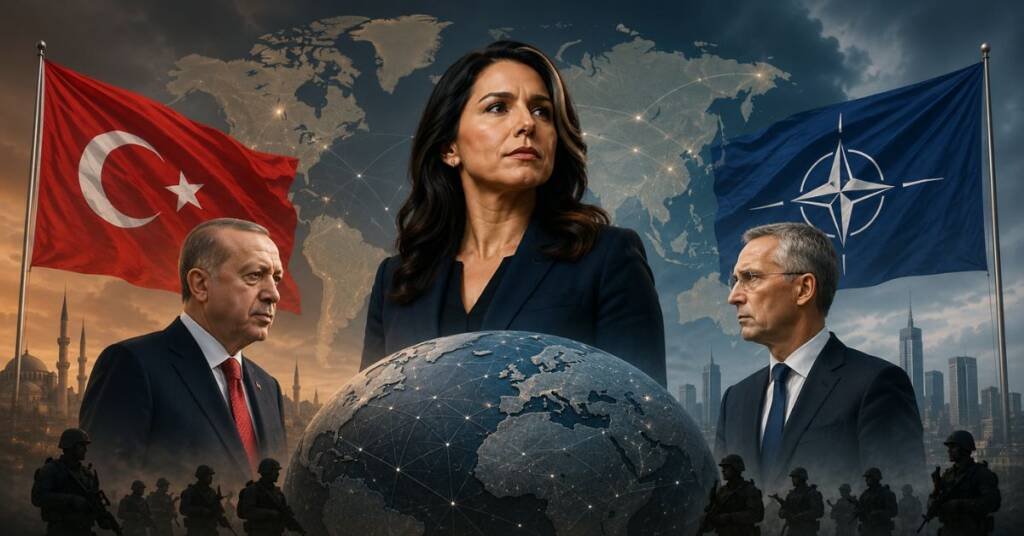
- A clear reflection of this new school of thought is captured in the aggressive declaration by former U.S. Director of National Intelligence Tulsi Gabbard:
- “It is time to designate Turkey a state sponsor of terror, remove it from NATO, stop the Muslim Brotherhood, and defeat Hamas.”
- This statement is not merely a sharp critique; it is a direct challenge to the global security framework established after the Cold War. By linking Turkey’s name with blacklisted terrorist organizations and the Muslim Brotherhood, this approach challenges the foundational assumptions of Western foreign policy and demands a total restructuring of regional partnerships.
2. The NATO Paradox: Integration vs. Adversarial Alignment
The demand to remove Turkey from the North Atlantic Treaty Organization (NATO) targets one of the greatest contradictions in modern international security. Turkey possesses the second-largest standing army within the alliance, guarding NATO’s highly critical southeastern front. Despite this, its geopolitical activities have consistently run counter to the core security interests of its Western allies.
- Strategic Tension Within the Alliance: NATO was founded on mutual trust, shared democratic principles, and a unified defense posture against common adversaries. When a member state maintains active and operational relationships with forces that other members consider hostile, the entire treaty framework is compromised.
- The Problem of Institutional Deadlock: Since NATO operates on a consensus model, any single member with an adversarial or ideologically misaligned stance can stall collective actions, disrupt critical military access, or complicate the process of admitting new members.
- A Massive Risk to Intelligence: In the international intelligence community, sharing sensitive data relies on the trust that information will not leak to non-state actors or adversarial nations. When a member country is accused of harboring operatives of banned organizations or maintaining loose borders, it becomes a major threat to the entire global intelligence system.
3. The Ideological Network: State Patronage and the Support Ecosystem
A critical aspect of this analysis is that terrorist organizations do not operate in a vacuum. Expansionist, radical ideologies—such as jihadic and khilafat movements expanding globally—cannot operate long-term, gather modern weapons, or run global public relations (PR) networks without state support, safe harbors, and financial aid.
- The Muslim Brotherhood as an Ideological Infrastructure: This narrative directly links the broad political machinery of the Muslim Brotherhood to active militant groups like Hamas. It argues that treating these groups as separate and independent factions ignores the unified ideological network fueling radicalism across societies worldwide.
- Safe Havens and Diplomatic Immunity: For years, top leadership and commanders of various militant factions have lived openly in certain regional countries. They utilize foreign funds and local diplomatic infrastructure to direct their operations. Providing political legitimacy or safe harbor to such elements is equivalent to direct participation in their campaigns.
- Dismantling the Financial Architecture: The total eradication of terrorism cannot be achieved solely through victories on the battlefield. It requires a top-down approach that chokes off the banking networks, shell companies, and state-funded charity organizations that funnel illicit money to armed groups.
4. The Mask of Political and Economic Greed
When intelligence officials abandon traditional diplomatic jargon and speak openly, they expose a deep systemic vulnerability: the triumph of short-term economic gains and transactional politics over long-term civilizational security.
- The Transactional Illusion: Many democratic governments operate on the capitalistic assumption that any country or entity can be integrated into the global community by offering economic incentives (trade agreements, infrastructure investments, or military contracts). This assumes that economic interests will always outweigh ideological fanaticism—an illusion that history continuously disproves.
- The “Management” Mindset: Instead of seeking permanent and fundamental solutions to expansionist ideologies, global superpowers often prefer to keep the problem in a state of mere “management.” This keeps defense deals lucrative, yields temporary geopolitical leverage, and avoids immediate disruptions to the global supply chain.
- The Shield of Political Correctness: By weaponizing the vocabulary of multiculturalism and institutional transparency, expansionist networks successfully insulate themselves from criticism. Under the guise of maintaining domestic social harmony, genuine national security concerns are frequently suppressed, allowing radical structures to grow unchecked at the grassroots level.
5. Why Ideological Warfare is More Dangerous Than Conventional Warfare
Conventional conflicts have clear borders, identifiable soldiers, and a definitive end. In contrast, expansionist ideological movements operate silently and deceptively, posing a far greater threat to humanity than any traditional civil-military war.
- The Erosion of Local Cultures: Unlike a military invasion that triggers immediate national resistance, ideological expansion occurs slowly across generations. It quietly alters demographics, education systems, and local legal frameworks until the original pluralistic culture and peace of a region are entirely destroyed from within.
- Invisible Combat Elements: When a threat operates as a network rather than an organized state army, there is no single capital to capture and no single face to sign a treaty with. It utilizes the very laws, protections, and freedoms of democratic societies to hollow them out from the inside.
- The Irony of Global Inaction: Dozens of highly organized factions—including Hamas, ISIS, al-Qaeda, and their international affiliates—are united across the globe to damage global peace, harmony, and overall humanity. The ultimate irony of the modern era is that the global community appears largely unconcerned about this unified network. Blinded by corporate profits, geopolitical interests, and the shackles of political correctness, global leadership remains paralyzed and has completely failed to build a collective defense mechanism on a war footing to face this civilizational threat.
6. The Emergence of Uncompromising Realism
Historically, major Western powers resorted to diplomatic ambiguity to handle problematic allies, overlooking their internal radicalization or proxy operations in exchange for access to strategic airbases or containment of regional adversaries.
This analysis marks a clean break from that traditional diplomacy, advocating instead for the doctrine of Uncompromising Realism:
- Prioritizing Absolute Security Over Legacy Treaties: Proponents of this doctrine argue that old diplomatic agreements from the 20th century are obsolete if they compromise core national security interests today.
- Using Hard and Direct Language: By using direct terms like “State Sponsor of Terror,” this approach seeks to eliminate the diplomatic euphemisms that often obscure the complicity of certain countries in regional instability.
- A Trend Toward Selective Coalitions: As large international institutions struggle with internal divisions, the global security architecture may now move away from large, inefficient organizations toward smaller, ideologically aligned coalitions of trusted partners.
7. Strategic Implications for Global Geopolitics
If the principles outlined in this analysis were fully implemented into international policies, the consequences would reshape the global map across several critical sectors:
- Restructuring the Middle Eastern Balance of Power: Expelling a major regional power from the Western security umbrella would accelerate the rise of independent regional blocs, forcing neighboring countries to renegotiate their bilateral defense frameworks.
- The Transformation of NATO’s Mission: Expelling an old member would set a new precedent within NATO. The organization would transform from a geographical alliance into an ideological pact enforced by strict and mandatory rules regarding counter-terrorism and intelligence security.
- A Global Crackdown on Sovereign Enablers: Shifting the focus away from non-state actors toward the sovereign nations that harbor them sends a clear message to other countries: providing material or institutional support to extremist factions will result in severe economic, political, and intelligence sanctions.
8. The Roadmap to Unified Global Action
- The current state of global affairs leaves no room for passive diplomacy. A permanent solution requires abandoning political greed and moving toward absolute strategic realism on a war footing.
- Democratic nations must develop the structural resilience and courage to penalize state sponsors of radicalism financially and politically, even if it means absorbing short-term economic losses or breaking critical supply lines. The true end of terrorism does not happen on a conventional battlefield; it happens by dismantling the funding networks, foreign-funded radical literature, and unauthorized institutional systems that misguide populations at the grassroots level.
- Global alliances must be redrawn not based on geographical proximity or transactional trade balances, but on an absolute commitment to human rights, pluralism, and global harmony—prioritizing humanity above political correctness.
🇮🇳 Jai Bharat, Vandematram 🇮🇳
Read our previous blogs 👉 Click here
Join us on Arattai 👉 Click here
👉Join Our Channels👈