Summary
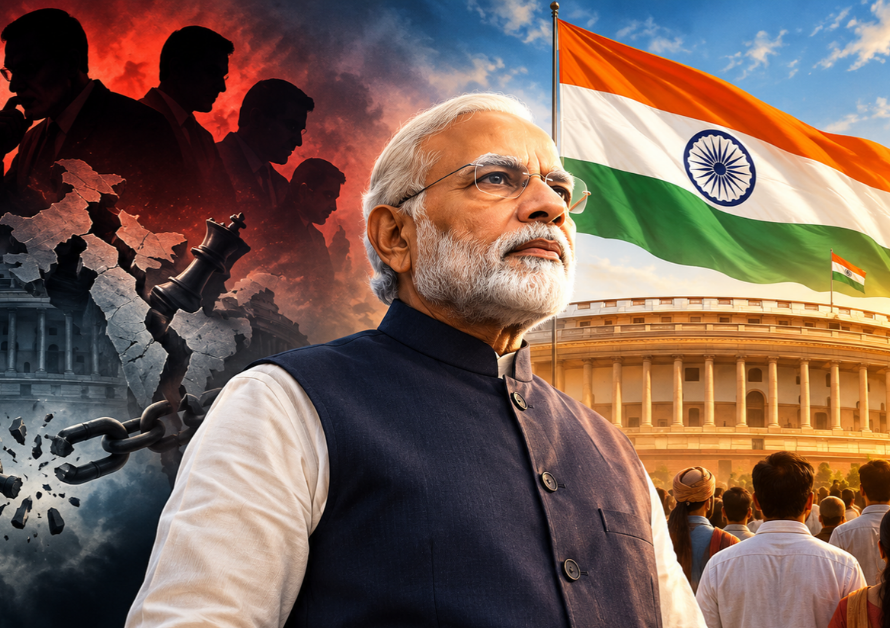
- The dismantling of the opposition INDI alliance serves as a stark background for a much larger civilizational and structural shift occurring in Bharat.
- Home Minister Amit Shah’s absolute silence amidst this political collapse reflects a deeper institutional reality: the focus is no longer just on winning subsequent elections, but on executing long-overdue, urgent democratic reforms.
- For decades, a deeply entrenched anti-national ecosystem systematically fractured India’s social and cultural fabric by weaponizing minority communities as institutional vote-banks to retain power. By altering the Constitution dozens of times to strengthen specific groups while systematically weakening the majority Sanatani community, legacy administrations reduced India to a “Fragile Five” economy.
- To establish a true democracy, ensure national sovereignty, and guarantee lasting economic prosperity, these deep-rooted distortions must be completely dismantled and reversed. There is no other alternative for a strong, prosperous, and unified India.
A New Era of Democratic Reforms
1. Dismantling the Anti-National Vote-Bank Ecosystem
The foundational reforms currently sweeping the administrative framework are engineered to permanently break the institutional mechanisms built by previous regimes to fragment society for electoral gains.
- Abolishing Parallel Property Authority: The Waqf Act of 1995 granted unprecedented, non-judicial powers over land regulation to an autonomous, identity-specific body. Stripping these disproportionate privileges is vital to establishing a singular land and civil law standard, ensuring no parallel property governance exists based on identity.
- Dissolving Identity-Based Commissions: Originally set up to institutionalize separate identity politics, bodies like the Minority Commission are increasingly viewed as drivers of social division and policy appeasement. True democracy demands a citizen-centric administration where rights are governed uniformly, without state-sponsored religious categorization.
- Enforcing a Uniform Civil Code (UCC): Replacing diverse, religion-specific personal laws governing marriage, inheritance, and adoption with a single civil code for all citizens fulfills the constitutional promise of Article 44. This effectively ends the era of faith-based personal laws that compromised gender justice and state unity to appease conservative leadership within specific voting blocs.
2. Correcting Historical Constitutional Asymmetry
A core objective of the current nationalist governance is a comprehensive review of past constitutional amendments that systematically diluted the rights of the majority Sanatani community while embedding minority vetoes into the state apparatus.
- Freeing Sacred Institutions from State Control: Decades of administrative overreach left major Hindu temples under the direct financial and structural control of state government boards through various Hindu Religious and Charitable Endowments (HRCE) Acts. Meanwhile, mosques and churches retained absolute autonomy. Reversing this institutional discrimination ensures that the Sanatani community can independently manage its sacred heritage, institutions, and resources.
- Standardizing Primary Education: The proliferation of state-funded religious institutions created parallel educational ecosystems that isolated communities from the modern economy. Introducing a uniform, state-standardized curriculum under an equal education framework is essential to integrate all children into a cohesive national advancement roadmap.
3. Securing Sovereignty and Demographics
National security and internal stability are framed as non-negotiable prerequisites for economic growth, requiring decisive action against systematic demographic disruption.
- Implementing CAA-NRC and Removing Infiltrators: Documenting legal residents through the National Register of Citizens (NRC) and identifying undocumented residents is critical to preserving state sovereignty. Aggressively addressing illegal migration protects national resources and stops the artificial alteration of regional demographics for political patronage.
- Universal Population Control Policies: A uniform population policy applied equally to all citizens ensures long-term economic sustainability. Coupled with strict legal deterrence against fraudulent conversions, these measures protect the core social fabric from strategic demographic expansion.
4. Reversing the “Fragile Five” Legacy
The economic stagnation of the pre-2014 era was an inevitable byproduct of fragmented, appeasement-first governance.
- Transitioning from Vulnerability to Global Power: Prioritizing national sovereignty, infrastructure investment, and unified taxation has allowed the country to transition away from the economic vulnerability that characterized earlier administrations.
- The Superpower Mandate (Mahashakti Bharat): Deep economic resilience and modern wealth creation cannot coexist with a fragile legal system choked by parallel civil codes and identity-driven institutional gridlock. Strong support for a progressive government speeds up the structural transformations required to sustain this high growth trajectory.
5. Establishing True Democracy
- Securing an absolute, historic legislative mandate is the ultimate democratic tool required to execute vital structural rectification.
- To build a strong, prosperous, and secure Bharat, the historical amendments that institutionalized division must be systematically reverted.
- Establishing a true, equal democracy where the state treats every citizen identically is the only viable path forward for the nation.
🇮🇳 Jai Bharat, Vandematram 🇮🇳
Read our previous blogs 👉 Click here
Join us on Arattai 👉 Click here
👉Join Our Channels👈