Summary
- This article provides a poignant analysis of the deep-rooted institutional corruption plaguing India’s infrastructure and administrative machinery.
- Centering on the Anti-Corruption Bureau (ACB) raid at the residence of Mohan Naik, an Engineer-in-Chief of the Roads and Buildings Department, the discourse uncovers how an official monthly salary of ₹85,000 translates into an unimaginable benami empire worth over ₹100 crores.
- The piece highlights that while the current nationalist government is exerting its complete political willpower to eradicate corruption at the grassroots, this war cannot be won unless the public actively resists the “shortcut culture.”
- Rather than just typical punitive actions, this analysis presents a concrete roadmap for strict administrative reforms, including the immediate public auction of seized assets to significantly escalate the “Cost of Corruption.”
The Bitter Truth behind a ₹100-Crore Empire from a ₹85,000 Salary
1. The Incident: The Unimaginable Empire of a Salaried Official
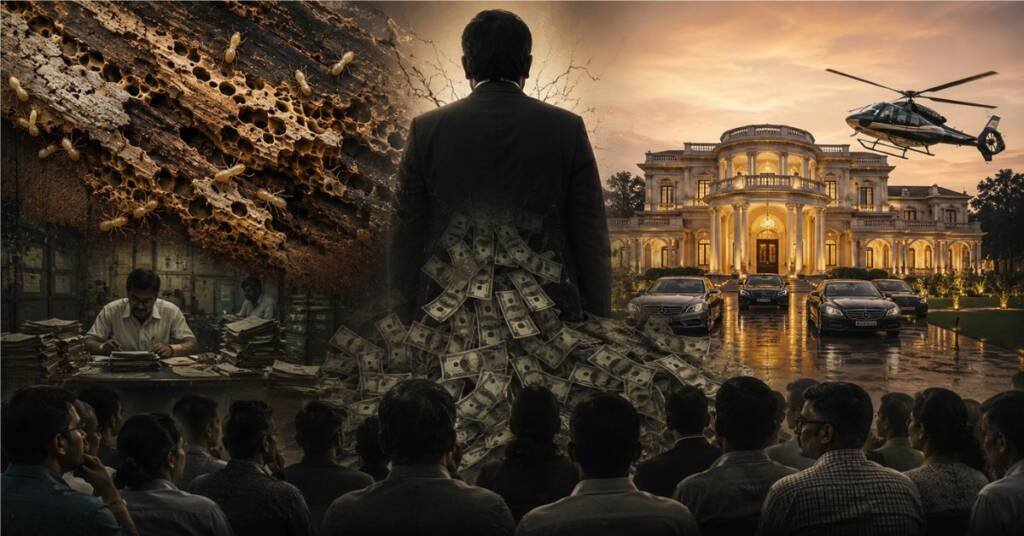
In any rule-based system, a public servant’s position is meant for social service and infrastructure development. However, when corruption becomes institutionalized, the position merely turns into a tool for personal enrichment. The raid conducted by the Anti-Corruption Bureau (ACB) on the premises of Mohan Naik represents a stark and alarming manifestation of this reality.
- The Facade of Honesty vs. Gritty Reality: By law, the government provides a respectable monthly salary of approximately ₹85,000 for this post—a sum sufficient for a middle-class family to live with dignity. Yet, the dark empire operating behind this legitimate income left even the investigating officers stunned.
- The Hoard of Disproportionate Assets: The unaccounted assets unearthed during the raids rival those of major corporate tycoons:
- A Massive Land Bank: Nearly 20 acres of agricultural and commercial land, an impossible acquisition through a lifetime of legitimate savings.
- Pure Gold: Over 5 kilograms of pure gold (in the form of biscuits and jewelry) recovered from the premises.
- Urban Real Estate Net: 7 luxury apartments scattered across prime locations, acting as standard vehicles to park black money.
- The Pinnacle of Luxury (Triplex Villa): A lavish triplex villa where the officer spent a staggering ₹2.5 crores in cash just to clear the official registration and stamp duty.
- Additional Residential Assets: Another premium house located in the posh Kukatpally area, valued at a declared price of ₹62 lakhs.
- Symbols of Indulgence: Over 60 bottles of expensive, smuggled foreign liquor were seized, epitomizing how taxpayers’ hard-earned money was being squandered on unethical luxury.
2. Infrastructure Devastation: Engineering Failure or Moral Bankruptcy?
Every monsoon, media outlets stream debates and citizens share photos of pothole-ridden roads on social media. While we routinely blame weather anomalies, the destruction of roads and bridges is rarely a natural disaster; it is a man-made administrative crime.
- The Corruption Leakage: When the government sanctions a ₹100-crore budget for a national highway or public building, that capital is legally mandated for premium materials, modern tech, and safety compliance. However, when characters like Mohan Naik sit at the helm, 30% to 50% of that budget is siphoned off as bribes and cutbacks from top to bottom.
- Compromising on Raw Materials: Once half the budget vanishes into private vaults and marble floors, the contractor is left with meager funds for actual execution. To secure their own profit margins, severe compromises are made on the asphalt layer’s thickness. Consequently, the very first rainfall seeps beneath the surface, peeling the road apart.
- Indulgence at the Citizen’s Cost: The public bears the brunt of this unholy trinity (official-contractor-politician). Ordinary citizens break their vehicles, damage their spines, and lose loved ones in fatal accidents caused by these potholes. It is profoundly painful to see citizens dying on broken roads while corrupt officials sip imported liquor on the sofas of villas built from those very tax rupees.
3. The Exploitation of Taxpayers and Systemic Betrayal
The silent and helpless victim of this corrupt chain is the Indian taxpayer. This segment acts as the engine of the national economy, yet it receives systematic mental and financial exhaustion in return.
- The Relentless Middle-Class Struggle: A salaried professional wakes up before the alarm rings, battles gridlock to reach the office, and works tirelessly. Similarly, a small trader braves the scorching heat to open their shop. These individuals pay their taxes with absolute honesty, even if it means compromising on personal comfort.
- The Death of Expectations: When paying taxes, a citizen enters into a implicit social contract with the state, expecting secure borders and safe, world-class roads. When this money funds the expansion of administrative predators instead of national growth, it is a blatant murder of that social contract.
4. Government Efforts, the Shortcut Culture, and a Maturing Bureaucracy
Amidst this grim landscape, a definitive positive aspect is that the current nationalist government is fighting on a war footing to eliminate this chronic ailment. Digital governance, Direct Benefit Transfers (DBT), and granting operational autonomy to agencies like the CBI and ACB stem from this absolute commitment. However, this state-led war remains incomplete without becoming a mass civic movement.
- The Resolve of the Nationalist Government: At the apex level, the nationalist government is heavily invested in bringing transparency to administrative channels. A strict policy of “Zero Tolerance” against corruption ensures that even highly influential officials and white-collar criminals find themselves behind bars. The state is utilizing policy interventions and digital tools to dismantle the networks of middlemen.
- Civic Responsibility and the Toxic Culture of Shortcuts: No government can eliminate corruption purely through legal force until a moral consciousness awakens within the citizenry. A self-destructive “shortcut culture” has deeply infected our society. Individuals routinely offer bribes to speed up minor tasks, avoid traffic citations, or bypass regulatory checks. This habit of seeking immediate personal convenience provides oxygen to the corrupt apparatus. As a society, we must commit to never resorting to corrupt means; citizens must uproot this shortcut mentality and exercise patience with the law.
- A Maturing Bureaucracy: India urgently requires a civil service that sheds its colonial hangover to become democratically mature and accountable. Bureaucracy must transition from discretionary powers toward entirely rule-based, automated digital platforms. When officials no longer hold the arbitrary power to halt or clear files based on personal whim, the opportunities for corruption evaporate automatically.
5. Policy and Administrative Reforms: Seizure, Auction, and Stiff Deterrence
The repetitive cycle of short-lived media headlines, a brief stint in judicial custody, and returning to enjoy benami wealth upon bail has eroded the fear of the law. If we intend to save this country from crawling in potholes, we must escalate the “Cost of Corruption” to a point where an official trembles before accepting a bribe.
- Immediate Public Auction of Seized Assets: Anti-corruption frameworks must be amended so that the moment a preliminary probe confirms disproportionate assets, the property is not just sealed, but permanently confiscated and put under Public Auction. One hundred percent of the proceeds should be instantly transferred to the Infrastructure Development Fund of the specific district where the corruption took place. The public needs to see a corrupt official’s villa being sold to build their roads.
- Time-Bound Fast-Track Trials: Currently, corruption cases drag on for decades. Special fast-track courts must be mandated to deliver a final verdict and sentencing within a strict maximum window of 6 months.
- An Accountability Law for Public Safety: If a road or bridge collapses before its designated guarantee period, liability must not stop at the contractor. Personal financial accountability must be fixed on the entire engineering chain that cleared the project, and the losses must be recovered directly from their private assets.
- For India to truly emerge as a developed, self-reliant nation, we must purge our infrastructure from this infectious disease of corruption and shortcuts.
- The honest efforts of the nationalist government will remain incomplete until reinforced by the moral resolve of the public and a mature, transparent bureaucracy.
- The time has come for the middle class to shatter its silent surrender, reject the shortcut culture entirely, and demand accountability for every single paisa paid.
🇮🇳 Jai Bharat, Vandematram 🇮🇳
Read our previous blogs 👉 Click here
Join us on Arattai 👉 Click here
👉Join Our Channels👈