Summary:
- This detailed narrative analyzes the tough administrative and legislative stance being adopted globally to tackle public property damage and violent riots.
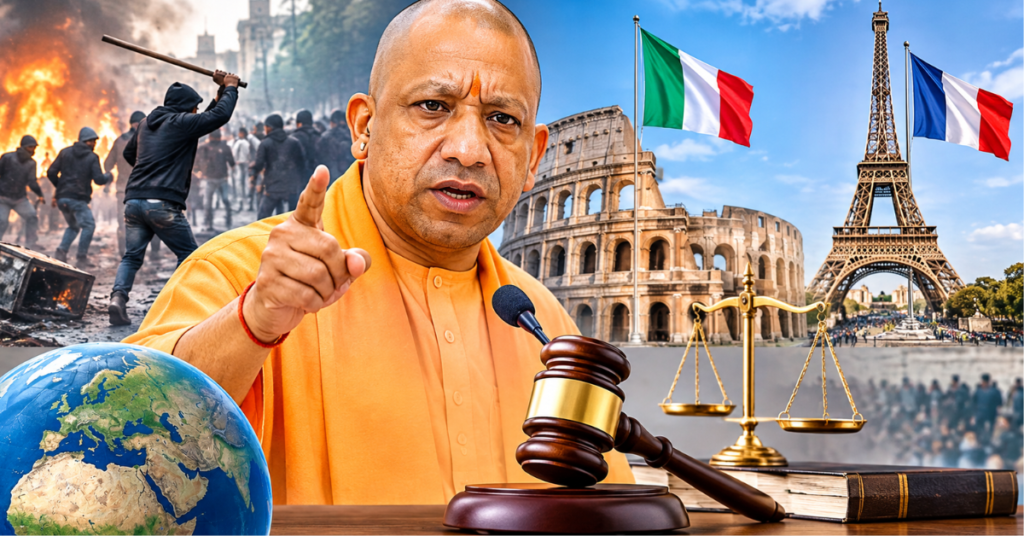
- The successful governance model pioneered in Uttar Pradesh, India, by Chief Minister Yogi Adityanath—under which public property damages are directly recovered from the rioters themselves—is now echoing across developed European nations.
- Following the implementation of strict anti-riot legislation by Italian Prime Minister Giorgia Meloni’s government, the French Senate has also backed the ‘RIOTERS PAY’ bill by a overwhelming majority.
- This model imposes heavy financial fines and compensation recovery on rioters, participating groups, and even the parents of minors who damage public and private property.
- This serves as definitive proof that while modern democracies guarantee the right to peaceful protest, enforcing financial and legal accountability for violence, arson, and vandalism has become a global imperative.
A Major Shift in Global Governance
1. The Global Resonance and Relevance of India’s ‘Yogi Model’
When the Uttar Pradesh government in India first introduced stringent administrative and legal measures to recover property damages directly from rioters, it faced intense criticism from so-called human rights advocates and the leftist ecosystem.
- Deterrence of Strict Laws and Restoring Order: The core principle of the U.P. model was crystal clear and unyielding: “If you riot and burn public property, the compensation will come out of your own pocket.” The enforcement of this stern provision led to a dramatic reduction in large-scale stone-pelting, arson, and violent disturbances, firmly re-establishing the rule of law across the state.
- Europe Adopting the Indian Framework: Western nations that once routinely lectured India on human rights are now walking the exact same path to safeguard their own internal security. Hitting rioters directly in their wallets is now becoming a global benchmark for law enforcement.
2. Italy: Giorgia Meloni Government’s Strict Anti-Riot Legislation
The right-wing government led by Italian Prime Minister Giorgia Meloni has enacted extremely tough legal provisions to reinforce law and order and crack down on violent protests:
- Heavy Financial Fines and Imprisonment: Individuals found guilty of violent riot-related offenses face severe penalties, including fines up to €20,000 (approx. ₹21 Lakhs) and imprisonment for up to 5 years.
- Crackdown on Group Violence: Direct legal action will be taken if a group of 5 or more individuals endangers public safety by throwing stones, sticks, or fireworks during demonstrations.
- Ban on Face Concealment and Vandalism: Strict punishments are mandated for concealing one’s identity (covering faces), inflicting bodily harm, or engaging in collective vandalism during protests.
- Direct Parental Liability: If a minor damages public or private property, the financial and legal liability falls directly on their parents.
- Expanded Police Powers and Military Deployment: Police powers have been expanded to allow preventive detention of high-risk youths aged 14 to 17. Additionally, 500 soldiers have been deployed in Milan to assist police and guard high-risk, sensitive locations.
3. France: The ‘RIOTERS PAY’ Bill and Historical Senate Approval
Following Italy, France has taken a landmark step toward dealing decisively with rioters, signaling a massive shift in European policy priorities:
- Strong Senate Endorsement: On October 28, 2026, the French Senate approved the ‘RIOTERS PAY’ bill with a decisive majority of 229 votes in favor to 105 against. However, it requires approval from the French National Assembly before becoming full law.
- Broad Provisions for Compensation: The proposed bill allows for recovery of up to €10,000 (approx. ₹10.5 Lakhs) in compensation for damages linked to riots and public unrest.
- Principle of Collective Financial Liability: Under this proposal, individuals who knowingly participate in a group that engages in violence or property destruction can be held collectively liable—even if they did not physically commit the damage themselves.
- Major Relief for Shopkeepers and Merchants: This legislation opens a direct legal pathway to force rioters to compensate small business owners, shopkeepers, and commercial establishments for the heavy losses caused by looting and vandalism in recent years.
- Deduction from Government Welfare Benefits: The proposal includes provisions allowing compensation amounts to be directly withheld from guilty individuals’ government welfare benefits and housing assistance.
- Concerns Raised by Critics: Opponents of the bill argue that the ‘collective liability’ clause could unfairly burden peaceful protesters with the financial cost of damages caused by others.
4. Redefining Democracy, Freedom, and Civic Accountability
These legislative actions by European nations like Italy and France highlight a fundamental evolution in modern democratic systems worldwide:
- The Line Between Protest and Anarchy: Freedom of expression and peaceful assembly remain democratic rights, but using them as a shield for arson, destroying public infrastructure, and paralyzing the economy will no longer be tolerated.
- State Sovereignty and the Rule of Law: The firm stance taken by these nations sends an unmistakable message that leniency toward rioters and agitators has come to an end. Rights of law-abiding citizens cannot be protected unless personal and financial accountability is enforced on lawbreakers.
Conclusion
- The policy shift of recovering damages from rioters—sparked by India’s ‘Yogi Model’—has become an indispensable necessity for developed nations across the globe.
- It serves as incontrovertible proof that when national interest, law and order, and public safety are prioritized, India’s decisive administrative vision emerges as a global gold standard.
🇮🇳Jai Bharat, Vandematram 🇮🇳
Read our previous blogs 👉 Click here
Join us on Arattai 👉 Click here
👉Join Our Channels👈