Summary
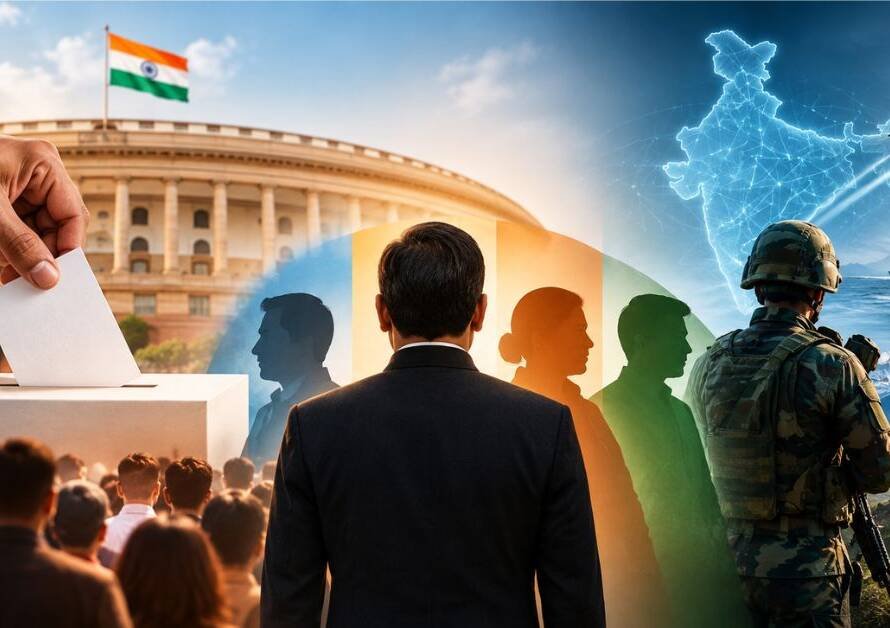
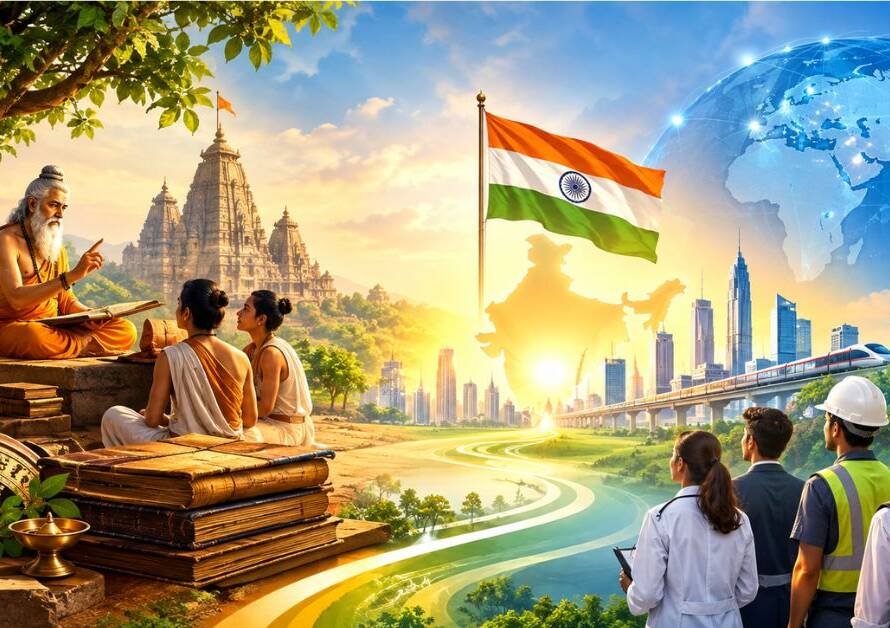
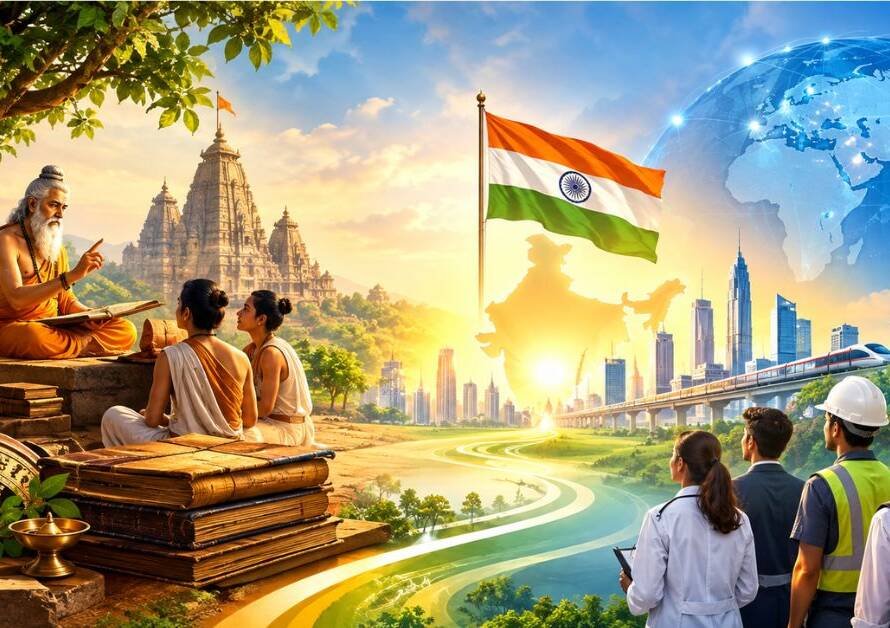
- This comprehensive analytical essay outlines India’s critical path toward its centenary in 2047.
- It evaluates the foundational macroeconomic and digital transformations of the past 12 years under a unified, decisive leadership, contrasts this potential against severe internal security, demographic, and political fault lines
It concludes with a strategic imperative for long-term political continuity and civic awakening to avert institutional decay and secure superpower status.
The Historical Journey of India’s Rise as a Superpower
1. The Foundational Decade: Structural Remodeling (2014–2026)
The trajectory of modern India shifted fundamentally over the last 12 years, moving away from an era defined by administrative paralysis, systemic leakage, and ad-hoc policymaking. The current framework has established a rule-based, high-velocity state architecture designed to support a multi-trillion-dollar economy.
- The Digital Public Infrastructure (DPI) Revolution: The deployment of the India Stack—encompassing Aadhaar, the Unified Payments Interface (UPI), and DigiLocker—has formalized a historically shadow economy. By routing welfare directly via Direct Benefit Transfer (DBT), the state eliminated intermediaries, plugged massive fiscal leakages, and established financial inclusion as a baseline utility.
- The Physical and Logistics Overhaul: India has aggressively dismantled its legacy infrastructure deficits. The rapid expansion of national highway networks, operationalization of Dedicated Freight Corridors (DFCs), modernization of ports, and the creation of regional airport webs have structurally lowered the cost of logistics, making domestic manufacturing globally competitive.
- Transition from Patronage to Rule-Based Governance: The systemic clean-up of banking sectors through the Insolvency and Bankruptcy Code (IBC), transparent spectrum and resource auctions, and digitizing tax compliance have severely curbed corporate cronyism, enforcing fiscal discipline across both public and private sectors.
2. The Macroeconomic Potential: The Road to a $30 Trillion Economy
As India marches toward the centenary of its independence in 2047, its economic destination is envisioned as Viksit Bharat—a fully developed, high-income superpower. The realization of this potential relies on converting its current momentum into compounding long-term growth.
- Global Supply Chain Re-alignment (China+1): Capitalizing on geopolitical shifts, India is leveraging targeted Production Linked Incentive (PLI) schemes to anchor vital global value chains. The nation is actively transitioning from a consumer of electronics, pharmaceuticals, and defense equipment to a high-volume global exporter.
- Frontier Technology Anchoring: The economic future is heavily tied to moving up the technological value chain. Significant capital and policy focus are directed toward semiconductor design and fabrication, Artificial Intelligence execution, commercial space exploration, and green hydrogen production to ensure energetic and technological sovereignty.
- Urbanization as a Wealth Generator: The ongoing migration of hundreds of millions of citizens into Tier-2 and Tier-3 smart cities acts as a massive productivity multiplier. Properly managed urban centers transform underemployed agricultural labor into high-output manufacturing and service professionals.
3. The Asymmetric Threat: Subversion, Traitors, and Political Destabilization
The primary barriers to India achieving its superpower status are not external military adversaries, but deeply entrenched internal networks working to undermine the state’s foundations. The current political leadership faces a continuous challenge from coordinated anti-national interest groups.
- Narrative Warfare and Manufactured Friction: Organized internal factions and subversive elements frequently exploit legitimate democratic processes to execute legal blockades, artificial environmental protests, and coordinated misinformation campaigns. These actions are designed to stall critical infrastructure projects, deter foreign direct investment, and paralyze executive governance.
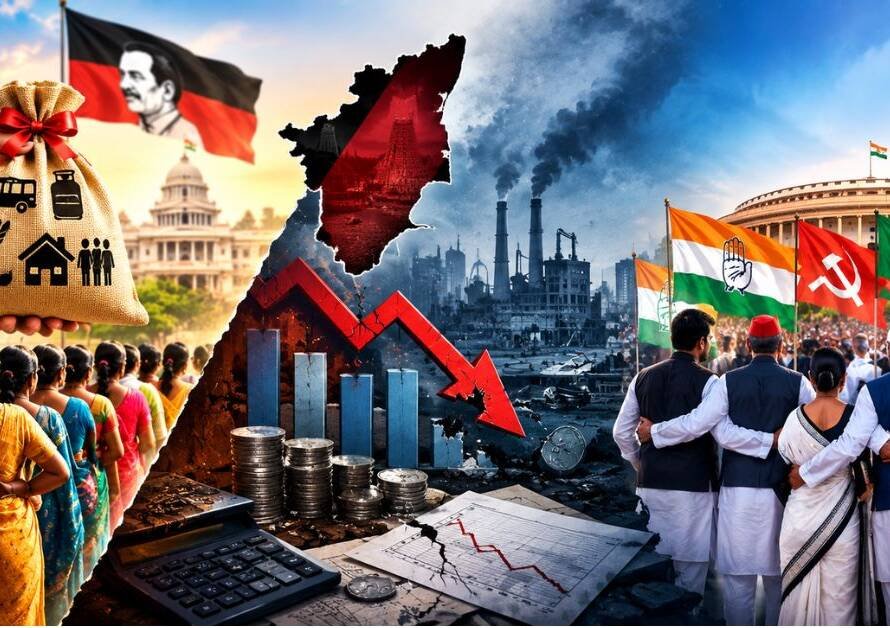
- The Threat of Legacy Coalitions (Thugbandhan): A return to fragmented, short-term political alliances presents a severe systemic risk. These political formations traditionally operate without a long-term national development blueprint, relying instead on structural corruption, systemic scams, and competitive appeasement politics. Such mechanisms dilute state resources, weaken institutional integrity, and compromise national interests for immediate electoral survival and personal financial enrichment.
- The Risk of State Decay: Analysts warn that if a unified, strategic governance model is replaced by unstable political syndicates, the nation risks losing its hard-won momentum. Without a decisive central authority focused on national security and growth, the institutional framework could rapidly deteriorate, potentially mirroring the economic collapse, systemic instability, and failed-state dynamics observed in parts of the immediate South Asian neighborhood, such as Pakistan and Bangladesh.
4. The Demographic and Extremist Fault Lines
A nation’s territorial and democratic integrity is inherently tied to its demographic composition. A major existential challenge facing contemporary India is the deliberate exploitation of demographic variables by radicalized and extremist modules.
- Asymmetric Population Shifts: Security and demographic analysts point to significant imbalances in population growth rates across distinct regions and communities. In strategic border states and sensitive districts, targeted demographic expansion by extremist groups alters the baseline population ratio, leading to long-term changes in electoral constituencies and political power dynamics.
- Weaponized Radicalization: Extremist elements actively deploy radical religious ideologies to create societal polarization. These efforts aim to weaken national cohesion, disrupt economic centers through localized conflict, and systematically diminish the cultural and political footprint of the majority Hindu civilization.
- Subversion of Democratic Institutions: By altering local demographics, these extremist groups utilize democratic voting mechanisms to secure administrative control over vital regions. This presents a direct challenge to the uniform application of constitutional law and internal security management.
5. The Cultural Matrix: Civic Apathy vs. The Need for Awakening
Even the most advanced security architectures and economic policies fail if the foundational society remains indifferent to existential threats. A critical challenge identified within the nation is the deep-seated complacency within the majority Hindu population.
- The Illusion of Material Prosperity: A significant portion of the majority community remains comfortably ensconced in personal financial security, material consumerism, and private entertainment. This preoccupation creates a dangerous disconnect from the shifting geopolitical, demographic, and security realities occurring just outside their immediate spheres.
- Historical Amnesia and Inertia: The absence of a collective, long-term strategic consciousness leaves the majority society vulnerable to incremental subversion. When individual comfort is prioritized over civilizational preservation, a society loses the capacity to identify and neutralize gradual institutional and demographic decay.
- The Imperative for Active, Lawful Retaliation: To safeguard the country’s future, a fundamental cultural awakening is required. The majority society must transition from passive observers to active, organized protectors of their heritage. This involves lawful, systematic, and intellectual resistance—countering subversion through economic solidarity, political unity, cultural education, and active participation in the national security discourse.
6. The Geopolitical Matrix and Global Ambitions
The international landscape leading to 2047 will be multi-polar, highly fragmented, and structurally volatile. India’s capacity to act as a global superpower depends entirely on maintaining an unyielding internal core.
- Strategic Autonomy as a Position of Power: By refusing to become a junior partner in any rigid superpower bloc, India has established itself as an independent global pole. It engages with Western frameworks like the Quad to counter regional hegemony while sustaining critical trade and energetic links across Eurasia.
- Leadership of the Global South: India’s civilizational identity and economic scale position it uniquely to champion the interests of developing nations, providing a stable, democratic alternative to predatory economic models.
- The Indispensable Swing State: In an era of intense US-China systemic rivalry, a unified and politically stable India acts as the ultimate balancing force in the Indo-Pacific, ensuring that global maritime and trade lifelines remain open and rule-based.
7. The Patriotic Verdict: The Strategic Imperative for Continuity
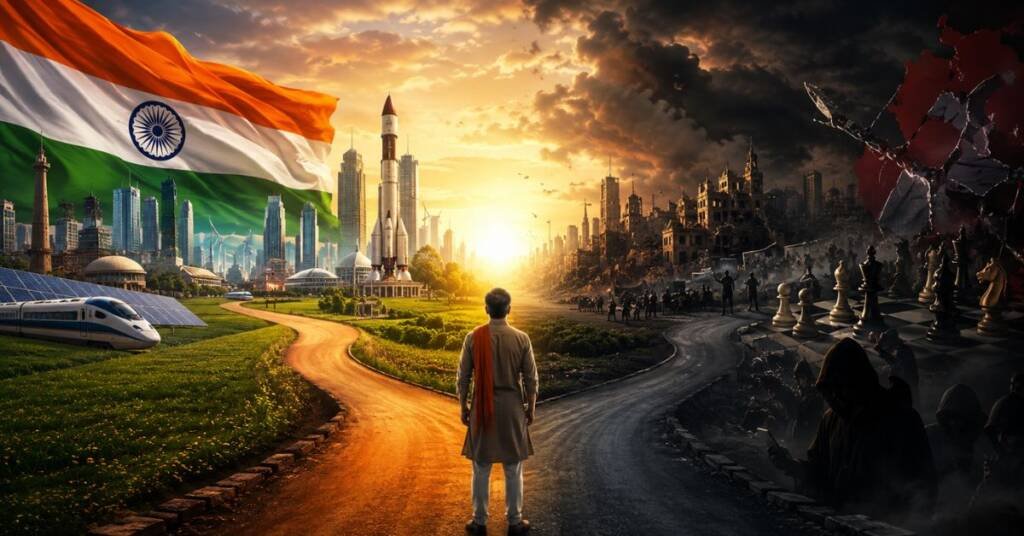
The path to 2047 presents a clear binary choice. India cannot afford the luxury of political experimentation with forces that lack a cohesive national vision.
- Sustaining the Decisive Mandate: To complete the transition from a developing economy to an unassailable global superpower, patriotic citizens must provide long-term, unwavering support to the current political model that prioritizes national sovereignty, administrative transparency, and massive infrastructure scaling.
- Neutralizing the Destabilization Matrix: A strong, centralized state is essential to defeat internal traitors, dismantle subversive syndicates, and counter weaponized demographic shifts. Security, economic growth, and civilizational pride are interdependent; none can exist without the others.
- Securing the Superpower Destiny: The coming decades will determine whether India reclaims its position as a primary engine of global wealth and human advancement, or succumbs to internal fragmentation. The responsibility rests entirely on a vigilant, awakened citizenry supporting a leadership that possesses the strategic resolve to place the nation above all else.
🇮🇳 Jai Bharat, Vandematram 🇮🇳
Read our previous blogs 👉 Click here
Join us on Arattai 👉 Click here
👉Join Our Channels👈