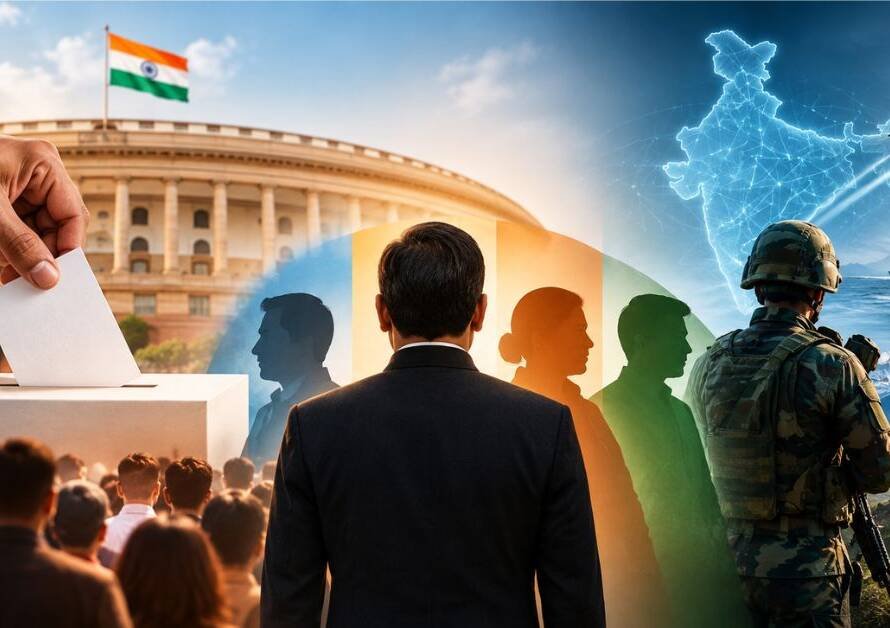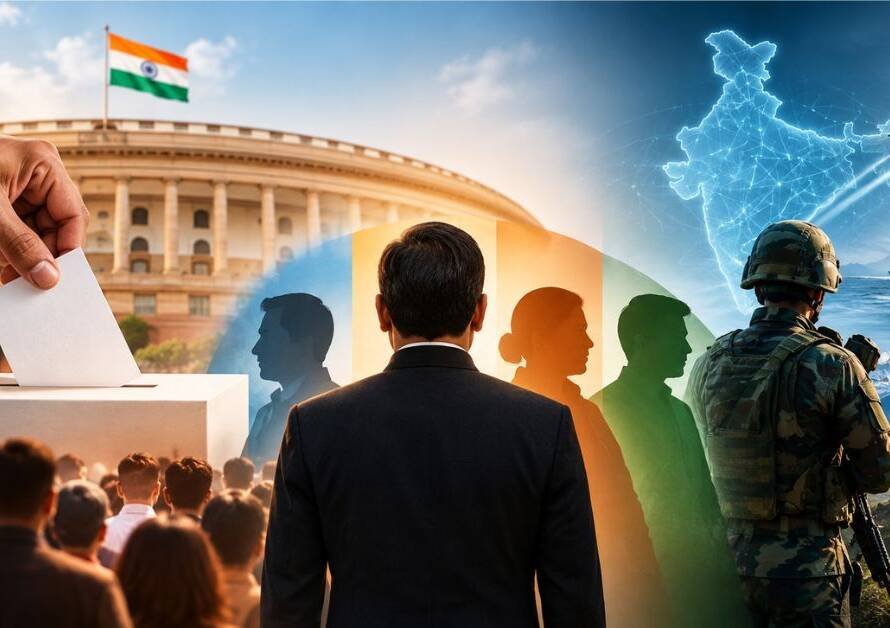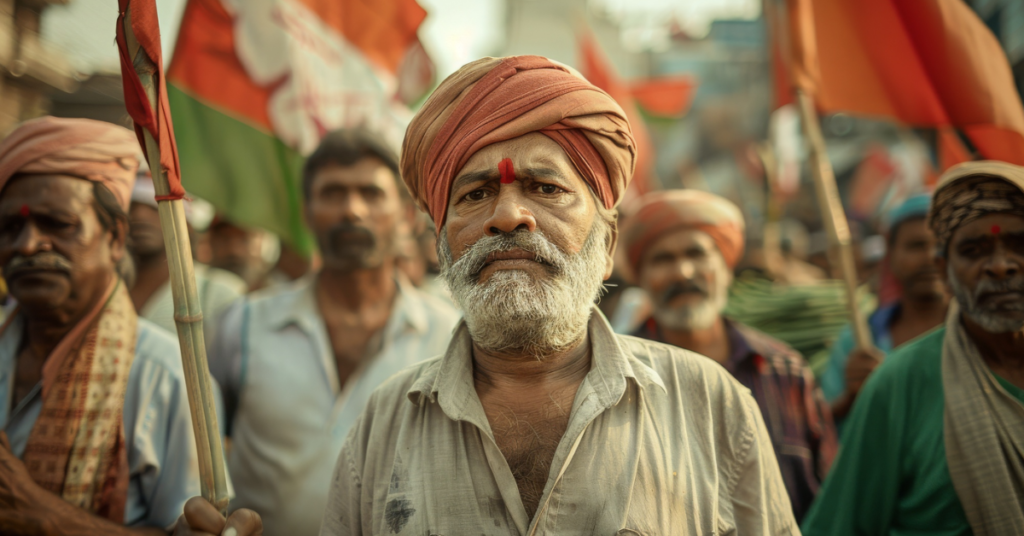
Summary
- This extensive political analysis exposes the profound ideological contradiction within the Congress Party and the I.N.D.I. Alliance.
- While these factions loudly champion slogans like “Jitni Aabadi, Utna Haq” (Rights proportional to population) and demand a nationwide “Caste Census” at public rallies, they systematically confine actual administrative and executive power to specific ‘upper-caste’ elites within their own state governments.
- Utilizing empirical and structural examples from states like Karnataka, Telangana, Himachal Pradesh, and Kerala, this article demonstrates that the opposition’s version of ‘Social Justice’ is merely an electoral toolkit designed to fragment the majority society and secure minority voting blocs. Behind closed doors, the levers of institutional power remain firmly guarded by the traditional elite.
Words vs Actions: Power Structures and Claims of Social Justice
I. Rhetoric vs. Reality: The Ground-Level Command Structure of Congress-Ruled States
The true colors of a political leadership that endlessly chants “Backward, Tribal, Dalit, and Minority” on public stages are laid bare when the time comes to actually delegate the Chief Minister’s chair or core organizational power. The balance of power across the four primary states under Congress influence completely dismantles their own public slogans:
- The Power Epicenter of Karnataka: In Karnataka, amidst the complex political equations between D.K. Shivakumar and Siddaramaiah, actual strategic command and diplomatic leverage remain heavily concentrated within the Vokkaliga community—an exceptionally influential, wealthy, and dominant upper class. The very party that campaigns on backward-class grievances routinely hands the keys of critical decision-making to this traditional elite.
- The Revival of ‘Reddy Raj’ in Telangana: The statehood movement in Telangana was largely propelled by the sheer numbers and active participation of Backward Classes (OBCs), Dalits, and Tribals. Huge promises regarding their institutional rights were made during the election campaign. Yet, the moment the government was formed, absolute executive command was handed directly to A. Revanth Reddy. The Reddy community has historically functioned as the dominant landowning and upper-caste class of the region.
- The Rajput Hegemony in Himachal Pradesh: In Himachal Pradesh, the reins of governance are held firmly by Sukhvinder Singh Sukhu, who hails from the Rajput community. The entire administrative fabric of the state revolves around a traditional upper-caste lobby, systemically keeping the state’s sizable Dalit and backward populations far away from the apex of leadership.
- The Influence of the Nair Lobby in Kerala: Even though the Congress does not currently hold the Chief Minister’s chair in Kerala, the principal face of the opposition in both the organization and the Legislative Assembly is V.D. Satheesan, a prominent member of the Nair community. This demographic occupies an undeniably elite position within Kerala’s socio-economic and cultural matrix.
II. Rahul Gandhi’s Electoral Formula: A Monolithic Toolkit for Social Division
When Rahul Gandhi declares at political rallies that “Jitni Aabadi, Utna Haq” (Whosoever holds the numbers must hold proportional representation), the underlying objective is not the holistic welfare of marginalized communities, but rather the creation of deep structural fractures within the majority population.
- A Report Card of Absolute Zero: If the Congress Party’s claims regarding backward-class representation were genuine, why does the number of OBC, SC, ST, or Muslim Chief Ministers across their current state governments stand at an absolute ‘Zero’? This stark paradox proves that the subaltern (marginalized) demographics are utilized merely as electoral ‘fuel’ to win power, while never being permitted into the ‘driver’s seat’ of governance.
- Reducing Minorities to Passive Voters: Grand narratives regarding the safety, rights, and preservation of minority communities are regularly peddled at rallies. Fear-mongering is systematically used to turn these groups into rigid voting blocs. However, when it comes to granting them actual top-tier administrative or political leadership, they vanish completely from the Congress’s “proportional representation formula.”
- The Politics of Tokenism: Staged PR exercises—such as visiting the homes of Dalits or Tribals for shared meals and holding up copies of the Constitution during public marches—are nothing more than political illusions. Behind closed doors, when ticket distribution or cabinet formations are finalized, the exact same feudal, syndicate-driven mindset takes complete control.
III. The Inherent Fear of the Coalition and the Compulsion of Appeasement
This dual-faced political model reveals a calculated strategy implemented by the Congress and its alliance partners, working with the deliberate intent to stall India’s institutional momentum.
- Assaulting Administrative Merit: These factions aggressively advocate for highly divisive, identity-based quotas within the civil and administrative services. Their goal is to weaken the nation’s core bureaucratic meritocracy. By selling the dangerous illusion to India’s youth that progress is achieved through caste rivalries rather than individual capability, they seek to distract the younger generation from critical issues like national security, infrastructure, and economic growth.
- Frustration Over Digital Transparency: The vast ecosystem of institutional corruption, middlemen, and systemic scams that thrived under legacy governance models has been entirely dismantled. Thanks to Direct Benefit Transfer (DBT) infrastructure, public funds flow directly into the bank accounts of individual citizens. This technological shift has permanently shut down the business of identity-based middlemen, triggering deep anxiety within the opposition alliance.
- Chasing an Electoral Mirage: Like a thirsty deer chasing a mirage in the desert, this entire opposition coalition is running blindly after absolute power. The alliance features dozens of self-proclaimed prime ministerial aspirants, each actively undermining the other. Repeatedly rejected by the Indian electorate, their growing desperation drives them toward narratives that actively seek to fragment society.
IV. Civilizational Integration vs. Tribalization into Caste Pockets
This hypocrisy highlights a fundamental conflict between two opposing ideas of India. One vision seeks to reduce the nation into fragmented tribal pockets defined strictly by caste, while the other is actively consolidating India as an indivisible, resurgent civilization.
- The Outdated Model of Fragmentation: The opposition requires society to remain permanently trapped in historical narratives of oppression. This ensures they can continue to run their political shops by offering retrograde incentives—such as promising employment opportunities even at sub-standard performance levels. They explicitly do not want a self-reliant, proud, and merit-driven society.
- The Rise of Cultural and Sanatani Pride: Contemporary India is returning to its foundational roots. As the nation dictates its own terms on the global stage under the principles of sovereignty and ‘Vasudhaiva Kutumbakam’, inward-looking, divisive caste narratives are rapidly losing their efficacy among the masses.
- The Changing Metric of the Electorate: Today’s citizens are digitally literate and hyper-aware. They see through the blatant contradictions of political leaders who routinely launch tirades against traditional cultural values on the internet, yet conduct their own family weddings with strict adherence to ancient Vedic rituals and actively seek the blessings of deities like Bhagwan Ganesh. The public understands that those who play the caste card at rallies are the exact same elites who keep real power insulated within their personal, high-caste networks.
V. An Exposed Facade
- Rahul Gandhi’s slogan of “Jitni Aabadi, Utna Haq” collapses entirely when placed next to the actual list of Chief Ministers governing his own states. This political deception can no longer be concealed.
- Modern voters are no longer influenced by orchestrated social media speeches or theatrical campaign slogans; instead, they form their judgments based on tangible executive decisions and the real administrative architecture of governments. The opposition’s caste card has been completely and irrevocably exposed.
🇮🇳 Jai Bharat, Vandematram 🇮🇳
Read our previous blogs 👉 Click here
Join us on Arattai 👉 Click here
👉Join Our Channels👈