Summary
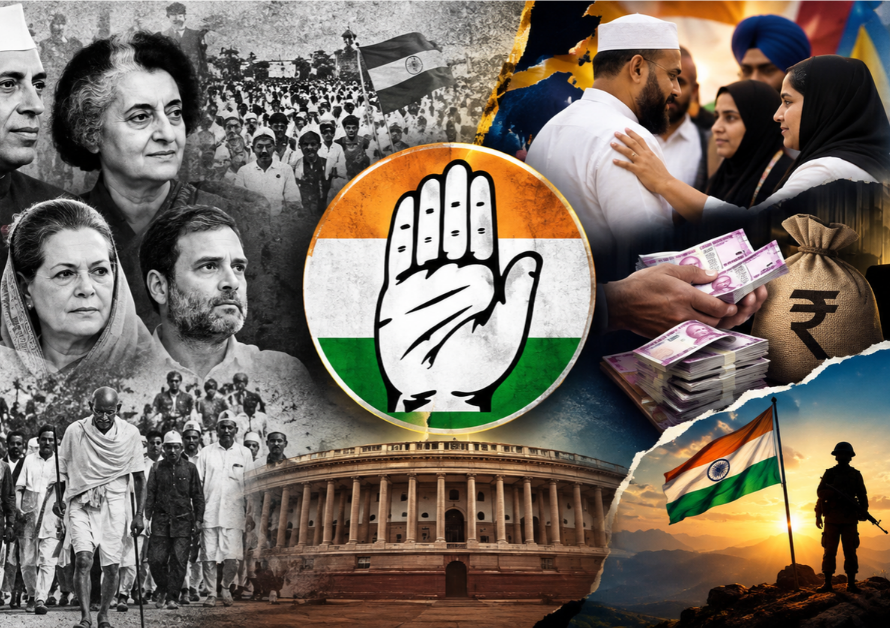
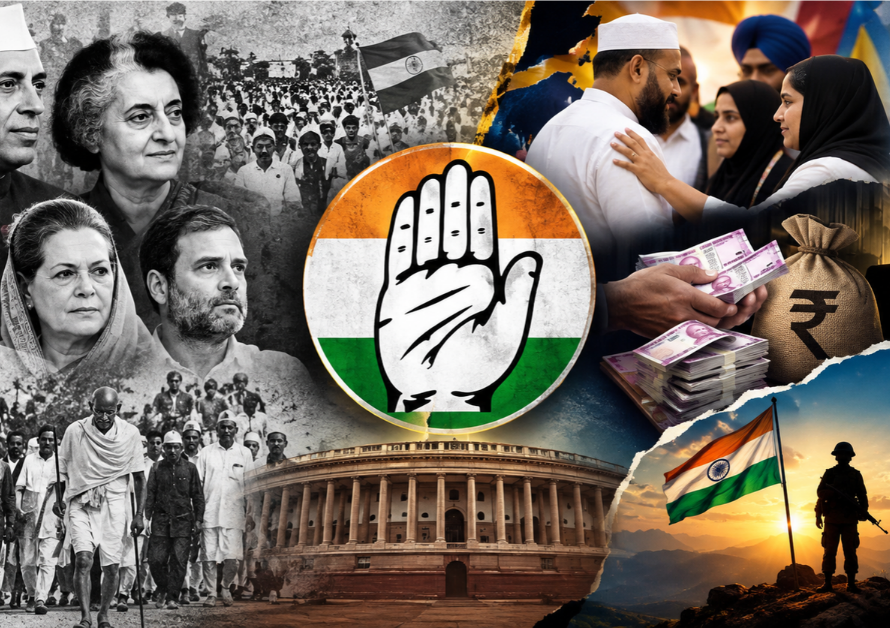
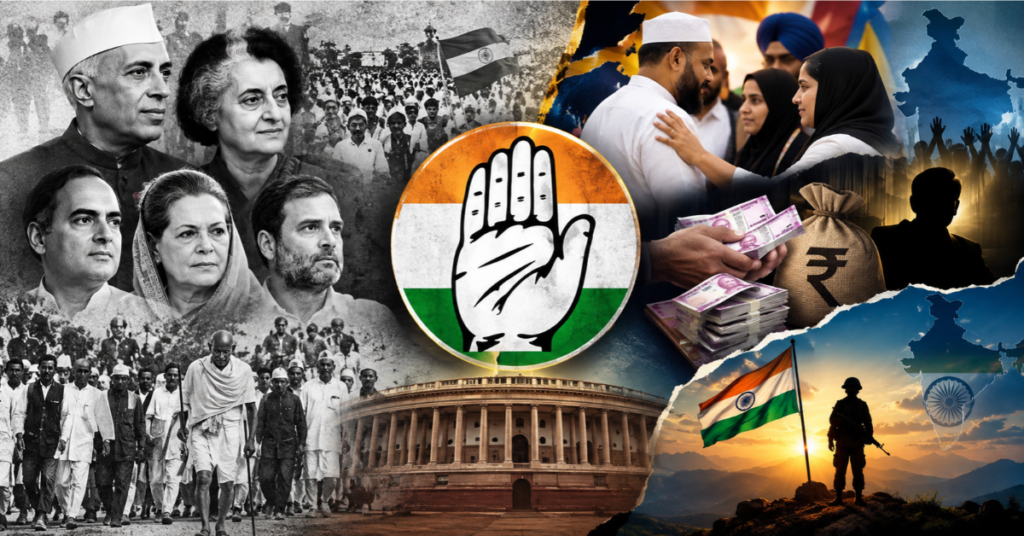
- Post-independence political history in India presents a complex web of policy decisions, security strategies, legislative frameworks, and administrative choices.
- Analyzing these historical records reveals how political strategies driven by minority appeasement, structural corruption, and central control compromised national security, created legal asymmetries, diluted native heritage, and hindered economic progress over seven decades.
- However, a transformative shift in governance arrived with the nationalist administration taking charge in 2014, anchoring its policies firmly on a “Nation First” doctrine, absolute zero tolerance for terrorism, and a decisive resolve to root out systemic corruption and anti-national elements.
Congress and India’s Political History: Promises, Policies, and Controversies
1. National Security and Strategic Concessions
Political decisions regarding national defense and anti-terror operations frequently prioritized immediate political survival and personal considerations over long-term strategic security.
- The Hostage Exchange Precedents (1989–1991): During the Rubaiya Sayeed kidnapping in December 1989, the central administration released 13 high-profile terrorists in exchange for the daughter of the Union Home Minister. This precedent was repeated in August 1991 with the release of 7 jailed terrorists during the kidnapping of Nahida Soz, and again in September 1990 with the release of 21 terrorists during the abduction of Tasadduq.
- Institutionalizing Soft Counter-Terror Policies: Yielding to insurgent demands sent a clear message to cross-border terrorist networks that the Indian state could be coerced through hostaging and political pressure. This institutional weakness emboldened militant factions across Jammu & Kashmir, leading to decades of heightened insurgency.
- Foreign Policy and Proxy Warfare Inaction: Rather than establishing strong military deterrence, official responses to cross-border proxy warfare were often restricted to diplomatic appeals and international protests, leaving border communities vulnerable.
- Surrender of Diplomatic Leverage (1972): The post-1971 war negotiations culminated in the Shimla Agreement, where 93,000 Pakistani prisoners of war were returned without securing a permanent resolution to the Kashmir dispute or guaranteeing the release of Indian POWs.
2. Legislative Asymmetry and Religious Appeasement
Legislative frameworks were repeatedly crafted to grant unilateral benefits and legal autonomy to specific groups, creating deep social and legal inequalities across Indian society.
- State Control of Majority Temples: Through various state-level Religious and Charitable Endowments (HRCE) Acts, government agencies assumed direct control over wealthy Hindu temples, taking over their financial revenue and administration. Conversely, places of worship belonging to minority communities were granted complete independence and protection from state intervention.
- The Waqf Act of 1995 and Unchecked Land Claims: The passage of the Waqf Act in 1995 granted Waqf boards extraordinary authority to declare public or private property as Waqf real estate with minimal judicial review. This established an asymmetrical property regime that disadvantaged non-minority landholders.
- The Places of Worship Act (1991): By enacting the Worship Act in 1991, the legislature froze the religious character of places of worship as they existed on August 15, 1947. Opponents argue this blocked judicial remedies for historic sites that had been encroached upon or altered during medieval rule.
- Overriding Judicial Rights (Shah Bano Case, 1986): Following the Supreme Court’s ruling granting maintenance rights to a destitute woman in the Shah Bano case, the government enacted the Muslim Women (Protection of Rights on Divorce) Act, 1986. This overturned a progressive judicial verdict to appease conservative religious leaders for electoral gains.
- Constitutional Restrictions on Religious Education: Under Article 28 of the Constitution, state-funded majority institutions face strict limitations regarding religious instruction, whereas Article 30 guarantees minorities the right to set up and run their own religious and educational institutions with state support.
3. Economic Mismanagement and Resource Exploitation
Economic growth was severely constrained for decades by a combination of restrictive state controls, bureaucratic hurdles, and massive financial corruption scandals.
- Systemic Financial Scandals (2004–2014): Governance during the UPA era was marked by massive financial irregularities that drained public resources:
- 2008: The 2G Spectrum Scam resulted in an estimated loss of ₹1.76 lakh crore.
- 2009: The Satyam Corporate Scam involved fraud totaling ₹14,000 crore.
- 2010: The Commonwealth Games Scam swallowed ₹70,000 crore, alongside the Sahara Housing Bond Scam of ₹24,000 crore.
- 2012: The Coal Block Allocation Scam led to an estimated loss of ₹1.86 lakh crore, coupled with the Waqf Board Land Scam of ₹1.5–2 lakh crore.
- 2013: The Sharda Chit Fund Scam caused losses of ₹10,000 crore, while the NSEL Scam impacted investors to the tune of ₹5,600 crore.
- Diverting Capital from Core Infrastructure: Financial losses on this scale diverted critical capital away from defense modernization, healthcare infrastructure, industrial manufacturing, and agricultural upgrades.
- The License Raj Era: Early economic policies strangled private enterprise through high tax rates, excessive licensing requirements, and bureaucratic red tape, suppressing entrepreneurship and delaying industrialization.
4. Cultural Disconnect and Historical Distortions
Educational and cultural policies were systematically used to redefine national history, downplaying indigenous heritage while glorifying foreign invaders.
- Educational Control (1947–1977): For thirty years after independence, the Ministry of Education was continuously led by figures such as Maulana Azad, Humayun Kabir, M.C. Chagla, Fakhruddin Ali Ahmed, and Nurul Hasan.
- Rewriting Textbooks: Under these tenures, national curricula produced by NCERT downplayed indigenous Indian empires like the Cholas, Vijayanagara Empire, Ahoms, Marathas, and Rajputs, while devoting extensive coverage to medieval invaders and Mughal rulers.
- Denying Indigenous Heritage (Ram Setu Affidavit, 2007): The legal submission of an affidavit in court claiming that there was no historical or scriptural evidence of Lord Ram or the Ram Setu highlighted a broader institutional skepticism toward native traditions.
- Neglect of Indigenous Systems: Classical Indian achievements in science, mathematics, literature, and philosophy were minimized in school textbooks, disconnecting generations from their cultural roots.
5. Constitutional Subversion and Federal Centralization
Despite claims of upholding democratic values, executive power was repeatedly used to bypass constitutional processes and undermine regional federalism.
- Misuse of Article 356 (President’s Rule): Central governments frequently dismissed democratically elected state governments for political reasons, invoking President’s Rule 84 times under Congress Prime Ministers:
- Jawaharlal Nehru: 7 times
- Indira Gandhi: 49 times
- Rajiv Gandhi: 6 times
- P.V. Narasimha Rao: 11 times
- Manmohan Singh: 11 times
- The Internal Emergency (1975–1977): The imposition of Emergency suspended fundamental rights, jailed opposition leaders, silenced free media, and introduced fundamental changes to the Constitution’s Preamble without public consensus.
6. The Paradigm Shift: Governance Since 2014
Marking a stark departure from decades of compromise, appeasement, and systemic decay, the governance model implemented since 2014 by the nationalist administration has brought a much-needed and welcome transformation to the country.
- Nation First Policy: Replacing vote-bank politics and identity pandering, national interest has been established as the supreme guiding benchmark for all domestic and foreign policies.
- Zero Tolerance for Terrorism: Counter-terrorism policies have shifted from passive diplomatic reactions to proactive, decisive military doctrines, demonstrating that threats against India’s sovereignty will be met with immediate and overwhelming force.
- Dismantling Exploitative Networks: The present administration has actively targeted and dismantled the internal networks and institutional elements that exploited state resources and undermined national integrity for decades, paving the way for a secure, empowered, and self-reliant India.
🇮🇳Jai Bharat, Vandematram 🇮🇳
Read our previous blogs 👉 Click here
Join us on Arattai 👉 Click here
👉Join Our Channels👈