Summary
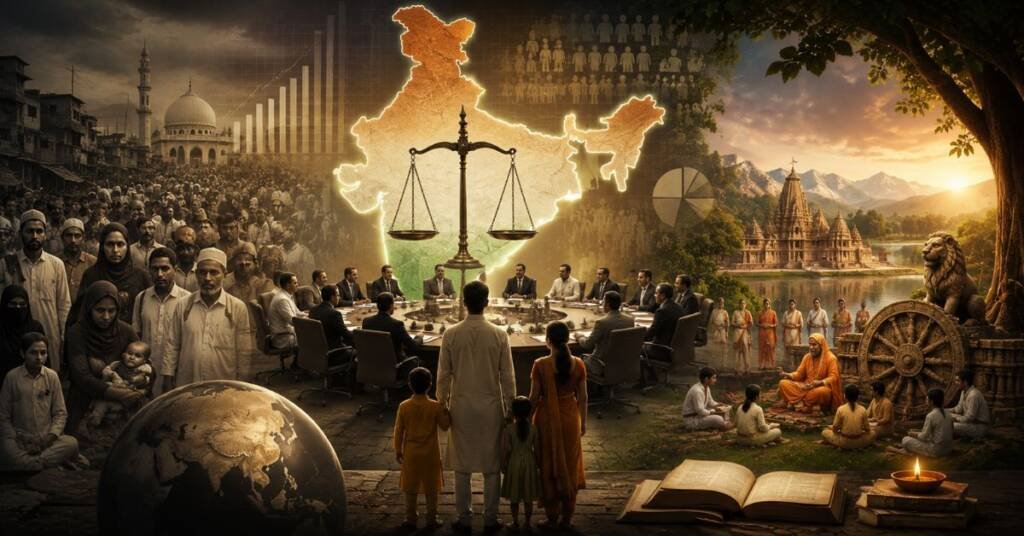
- This comprehensive analysis evaluates the intersection of historical precedents, demographic shifts, constitutional frameworks, and civilizational survival by synthesizing global developments with India’s past and present realities.
- Examining the tragic violence of Partition in 1947 alongside modern cases like Gambia’s 2015 Islamic declaration, the report assesses the empirical limits of secularism when demographic majorities shift and political power transitions.
- It analyzes the contrast between minority rights advocacy and majority-driven state policy, the constitutional mechanics of Article 19, and the modern challenges posed by narrative manipulation, digital mobocracy, and political subversion.
- The analysis concludes with an actionable roadmap for maintaining democratic integrity, national security, and civilizational continuity grounded in realism, institutional vigilance, and historical awareness.
Assessing the Limits of Secularism and the Lessons for India
1. The Lessons of History: Partition, Power Shifts, and Civilizational Trauma
Understanding the relationship between state power, demographic dominance, and civilizational security requires examining pivotal historical turning points, most notably the Partition of India in 1947.
- The Reality of Partition (15 August 1947): The transfer of power and the creation of Pakistan demonstrated how rapidly the protection of minorities can collapse when political authority is reshaped along religious lines. In Lahore and across territories that became Pakistan, the sudden shift in power was accompanied by large-scale violence, forced displacement, and the massacre of hundreds of thousands of Hindus and Sikhs. Millions were forced to flee overnight, abandoning their ancestral properties, wealth, and heritage simply to survive.
- The Vulnerability of Passive Optimism: Historical events highlight that civilizational security cannot be maintained through passive idealism or assuming that institutional guarantees are permanent. When a society ignores historical precedents and structural realities, it risks repeating past vulnerabilities within its own homeland.
- The Imperative for Vigilance: Preserving the security, culture, and democratic framework of future generations requires an active, conscious, and realistic citizenship. Ensuring that history does not repeat itself demands institutional strength, legal firmness, and a collective commitment to national interest.
2. Global Precedents & Demographic Realities: The Case of Gambia and Secularism
The structural shift from a secular state framework to a religiously defined regime upon demographic tipping points represents a critical area of geopolitical study.
- The Gambia Case Study: In December 2015, Gambia’s then-President Yahya Jammeh declared the nation an “Islamic Republic,” citing its ~95% Muslim demographic. While this declaration was motivated partly by political survival and alignment with Middle Eastern financial backers, and was later reversed under President Adama Barrow in 2017, it underscored a recurring geopolitical dynamic: when demographic consolidation reaches a threshold, secular frameworks are frequently treated as dispensable transitional phases.
- The Asymmetry of Secular Obligations: Across multiple regions in the Middle East, North Africa, and parts of South Asia, historical patterns show that secularism is vigorously championed by minority populations as a defensive guarantee for equal rights. However, once demographic dominance is achieved, state structures are frequently revised to institute religious law (Sharia), systematically narrowing the civic, religious, and legal space for non-majority populations.
- The Limits of One-Way Secularism: A primary vulnerability of open, democratic societies is the tendency of the majority population to treat secularism as a permanent, one-sided obligation, while ignoring broader demographic and geopolitical trends.
3. Synthesizing the Internal Threat: Protests, Subversion, and the Decline into Mobocracy
The vulnerability of a nation to demographic and ideological shifts is accelerated when internal mechanisms of law and order break down under the guise of free expression.
- Exploitation of Democratic Rights: In open democracies, bad-faith agitators and subversives utilize the guarantees of free speech under Article 19(1)(a) to promote anti-social agendas, defame national security forces, and damage public property under the banner of dissent.
- The Kangana Ranaut Row and Public Decorum: The controversy surrounding MP Kangana Ranaut’s “Generation Gutter” remarks highlighted a growing trend where organized agitators (such as the “Cockroach Janta Party” during NEET protests) use profanity, vulgar social media content, and direct abuse against constitutional authorities. While political opponents weaponized her choice of words to target an entire demographic, her core critique exposed an environment where uncivil, disruptive behavior is protected while the state is vilified.
- Selective Outrage and Double Standards: The public square frequently displays stark double standards. When public representatives face personal attacks, property destruction, or gendered abuse, mainstream coverage is often muted. Conversely, firm pushback against anarchic behavior is instantly labeled as an assault on democracy, creating an asymmetric environment that favors bad-faith actors.
4. The Constitutional Balance: Creative Liberty vs. National Sovereignty
To prevent a constitutional democracy from devolving into an unstructured mobocracy, free expression must remain tethered to responsibility and national integrity.
- Constructive Dissent vs. Calculated Agitation: True freedom of expression under Article 19(1)(a) is vital when it is intellectually honest, creative, and aimed at societal advancement. However, when speech is weaponized to manufacture false narratives without evidence, degrade national security forces, or insult cultural traditions, it exceeds democratic bounds.
- The Mandate of Article 19(2): The Indian Constitution explicitly mandates “reasonable restrictions” under Article 19(2) to protect sovereignty, national security, public order, and decency. Allowing unchecked rhetoric and unverified accusations to pass without legal accountability undermines the rule of law.
- The Slide Toward Mobocracy: When emotional volume and algorithmic outrage supersede empirical facts, public discourse degrades. In a mobocracy, organized pressure groups dictate outcomes through intimidation rather than constitutional processes.
5. Fact-Based Problem Identification
Synthesizing historical lessons, demographic realities, and domestic political dynamics reveals three core challenges:
- Historical Amnesia and Strategic Blindness: A significant portion of society remains disconnected from historical lessons and long-term demographic shifts, viewing national stability as guaranteed rather than something requiring active vigilance.
- Degradation of Civic Protests: Protests increasingly rely on shock value, vulgarity, and the targeting of constitutional heads rather than constructive, evidence-based critique.
- Institutional Exploitation for Political Disruption: Political ecosystems routinely leverage narrative misdirection and selective outrage to stall administrative reforms, exploit social fault lines, and weaken government stability.
6. Comprehensive Roadmap for National Resilience and Resolution
Securing democratic longevity, legal order, and civilizational continuity requires a clear, policy-driven response across multiple domains:
- Historical Awareness and Cultural Preservation: Educational and civic frameworks must foster a realistic understanding of historical events and demographic dynamics. Protecting civilizational heritage and legal structures requires proactive vigilance and national unity.
- Enforcing Legal and Empirical Accountability: Expressions that threaten public order, incite communal disharmony, or rely on fabricated narratives must face swift, non-partisan legal consequences. Assertions against state institutions must meet strict evidentiary standards under Article 19(2).
- Restoring Decorum in Public Dissent: Protesting bodies must decouple legitimate policy concerns from vulgarity, anti-national rhetoric, and public destruction, ensuring that public expression remains peaceful, constructive, and fact-based.
- Proactive Governance and Media Integrity: Government bodies must address systemic administrative grievances rapidly to neutralize bad-faith manipulation. Simultaneously, digital platforms must enforce strict community guidelines against algorithmic outrage and the spread of fake narratives.
🇮🇳Jai Bharat, Vandematram🇮🇳
Read our previous blogs 👉 Click here
Join us on Arattai 👉 Click here
👉Join Our Channels👈