Summary
- This analysis presents a comprehensive and policy-oriented study of the growing culture of disruption and chaos within the Indian parliamentary system.
- It evaluates the double standards of accountability applied to elected representatives versus ordinary citizens.
- Highlighting the financial loss, policy stagnation, and erosion of legislative dignity, this article lays out a clear roadmap for restoring parliamentary decorum through strict administrative reforms, the principle of ‘No Work, No Pay,’ and digital transparency via public performance dashboards.
Parliamentary Disruption and Public Accountability: Restoring Democracy
1. Introduction: The Growing Crisis of Democratic Institutions
- Decline of the Forum for Deliberation: The true foundation of democracy lies in debate, logic, and the pursuit of consensus. Parliament is not merely a formal institution for enacting laws or passing the government budget; it is the supreme body where the collective intellect of the nation gathers to shape the country’s direction.
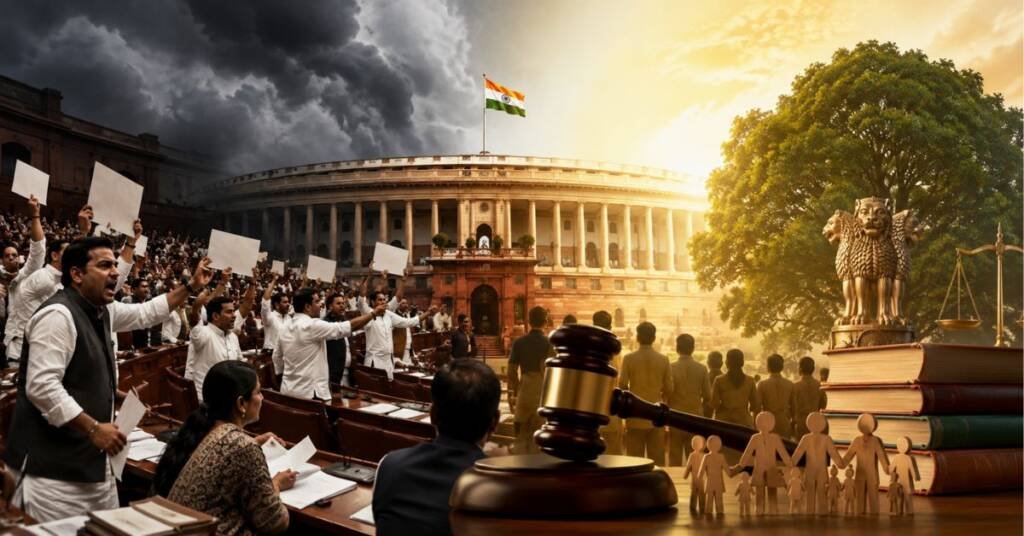
- Sessions Turning into Chaos: A deeply concerning trend is that modern parliamentary sessions, rather than serving as centers for policy analysis, rigorous study, and serious nation-building debates, are increasingly turning into arenas for strategic political showmanship, slogan-shouting, and planned disruptions.
- Neglect of the Common Citizen: When a parliamentary session falls victim to chaos, it is not just governmental legislative work that comes to a halt; the voice of the last citizen—whose rights and grievances required legislative attention—is effectively silenced.
2. Dual Standards and Moral Contradictions
- Erosion of Equality Before the Law: A just and ideal democratic society relies on the principle that rules apply equally to everyone. However, comparing the standards of conduct inside Parliament with the rules governing ordinary citizen life reveals a stark and troubling moral contradiction.
- Strictness for Citizens and Employees: Every section of society—be it a dedicated government employee, a private-sector professional, or an ordinary citizen—is bound by strict rules of duty. If an employee boycotts work or causes disruption at their workplace, they face immediate disciplinary action and salary deduction. If a citizen disrupts public order, legal penalties are applied instantly.
- Misuse of Parliamentary Privileges: Conversely, when elected representatives enter the House and systematically stall proceedings, it is often shielded under the guise of “political protest.” The original purpose of granting constitutional immunity to representatives was to allow them to speak fearlessly, not to hand them a license to obstruct the functioning of the House.
3. Financial, Administrative, and Policy Damage
- Loss of Taxpayers’ Money: Every minute of Parliament’s operation is funded by the hard-earned tax money of the nation’s poor and middle classes. When a session is adjourned without any constructive work, it represents a direct and inexcusable waste of public funds.
- Passing Bills Without Debate: When the House faces continuous disruption, the most severe consequence is that vital and far-reaching bills are rushed through without detailed discussion, parliamentary committee scrutiny, or essential amendments. This severely compromises policy quality and increases the risk of administrative errors.
- Suppression of Public Interest Issues: Zero Hour and Question Hour are the two most powerful pillars of the parliamentary system through which MPs hold the government accountable on local and pressing issues. When sessions collapse into chaos, these vital mechanisms become completely ineffective.
4. Concrete and Actionable Policy Proposals for Administrative Reforms
A. Financial Accountability (Enforcing the ‘No Work, No Pay’ Principle)
- Suspension of Salary and Allowances: The universal workplace standard of ‘No Work, No Pay’ must be made mandatory for Parliament.
- Proportional Deductions: If a member or a political group systematically disrupts the House, their salary, daily allowances, and other financial perks for the duration of the disruption should be automatically suspended.
B. Enforcement of a Strict Penal and Disciplinary Code
- Framing Clear Rules: A transparent and strict code of conduct must be enacted to penalize unparliamentary behavior, such as entering the Well of the House, tearing papers, waving placards, or breaking microphones.
- Automatic Suspension System: Such disruptive behavior should trigger an automatic suspension mechanism that operates independently of party politics or the Speaker’s personal discretion.
C. Public Performance Dashboard
- Digital Transparency: Digital tools should be leveraged to publish a live, transparent report card for every MP before the public.
- Metrics of Accountability: The dashboard should clearly display an MP’s attendance, constructive contributions to debates, policy questions asked, and the total parliamentary time lost due to disruptions.
D. Legal Scrutiny of Parliamentary Dignity and Membership
- Stringent Legal Provisions: Representatives who repeatedly and intentionally dishonor the supreme temple of democracy should face strict disciplinary and legal consequences.
- Termination of Membership: In cases of severe and persistent disruption, the Privileges Committee should be empowered to act impartially and take decisive action, up to and including the cancellation of membership.
5. Nation First, Politics Later
- Constructive Debate vs. Obstruction: The true strength of a democracy does not lie in how aggressively a party can protest, but in how logically and constructively it can engage in policy debates.
- Far-Reaching Impact of Policy-Making: Elections are a temporary political phase, but laws enacted by Parliament shape the future of generations to come. Playing games with the legislative process is, therefore, playing games with the nation’s future.
- Public Awakening as the Ultimate Solution: Meaningful reform will only happen when citizens wake up and demand accountability from their representatives beyond party lines. Parliament must function continuously, because the growth of the nation cannot afford to stop.
🇮🇳Jai Bharat, Vandematram 🇮🇳
Read our previous blogs 👉 Click here
Join us on Arattai 👉 Click here
👉Join Our Channels👈
Reads & Views: 97