Summary
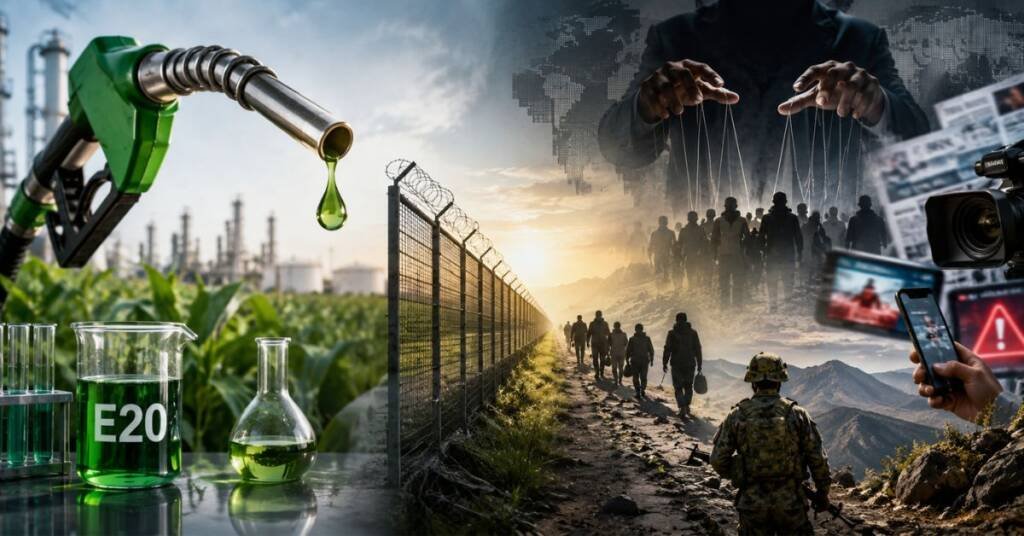
- This comprehensive investigative report exposes the dual-pronged social media propaganda currently circulating in the digital space: first, the fear-mongering surrounding E20 petrol (20% ethanol-blended fuel) in pre-2022 cars, and second, fabricated narratives regarding Chinese military incursions in the Northeast.
- Through automotive engineering facts and precise socio-political analysis, this text clarifies how standard technical upgrades and outdated internal insurgent videos are being weaponized to target national security and economic stability.
- The narrative provides a structural breakdown of modern engine resilience, social media illusions, and the political agenda aimed at disrupting upcoming parliamentary sessions to stall critical legislative bills.
Analysis of Coordinated Propaganda
Part 1: The Geopolitical Dimension—The Truth Behind False Border Incursion Claims
Whenever a parliamentary session is about to commence, sensationalist propaganda regarding national security is often activated to paralyze administrative machinery. The misleading videos currently being circulated about the northeastern borders are a direct part of this strategy.
- Identification of Uniforms and Insurgent Groups: The armed personnel being projected on social media as Chinese soldiers do not belong to the Chinese People’s Liberation Army (PLA). They are actually members of active internal insurgent groups operating in the Northeast.
- The Geographical Reality (Manipur vs. Arunachal): The viral footage has no connection to international borders. The video was filmed in the Phayang area of Manipur, not Arunachal Pradesh, and represents a localized internal security matter. The individuals pictured belong to the UNLF (United National Liberation Front).
- The Disinformation Ecosystem: If such sensitive and misleading videos are not fact-checked immediately, specific political IT cells, agenda-driven commentators, and certain digital creators establish them as international crises to manufacture unnecessary panic among the public.
Part 2: Automotive Facts—Why Your Car is Completely Safe with E20 Fuel
On the domestic front, E20 fuel (20% ethanol-blended petrol) is being branded as an “engine-killer” to target the nation’s economic and automotive infrastructure. However, automotive engineering and material science completely debunk this misinformation.
1. Fuel Composition and Global Precedent
- Plant-Based Energy: E20 is not a corrosive acid or a harmful chemical. It is a standard fuel blend comprising 80% conventional fossil petrol and 20% plant-based ethanol (ethyl alcohol), derived primarily from sugarcane molasses, maize, and surplus food grains.
- Gradual Scientific Progression: India did not adopt this system overnight. The country has successfully utilized E10 (10% ethanol) blends for over a decade. The transition to E20 is a highly regulated, gradual, and scientific upgrade.
- Global Standards: The United States regularly deploys E15, while Brazil has long mandated an E27 blend, with vehicles running successfully on E100 (100% pure ethanol) without experiencing engine failure.
2. Material Science: The Myth of Melting Fuel Pipes
- Use of Advanced Synthetics: Rumors online claim that ethanol eats through fuel lines and washers. While ethanol can degrade older, raw natural rubber, Indian automotive manufacturers phased out natural rubber decades ago.
- The Role of BS4 Compliance: Since the introduction of Bharat Stage 4 (BS4) emission standards—which rolled out ornamentally from 2010 and became mandatory nationwide by 2017—automakers have exclusively used highly advanced synthetic materials.
- Advanced Industrial Polymers: Modern fuel delivery systems utilize FKM (Fluoroelastomers) and NBR (Nitrile Butadiene Rubber). These polymers are chemically inert to alcohol blends and possess more than enough structural resilience to handle E20 fuel safely for decades.
3. Software Control: How the ECU Protects the Engine
- Closed-Loop Optimization: Any car manufactured in the last 15 years is managed by an Engine Control Unit (ECU) integrated with exhaust oxygen (O2) sensors.
- Automated Mathematical Correction: Pure petrol operates at an optimal air-fuel ratio (stoichiometry) of 14.7:1, while pure ethanol runs at roughly 9:1. Moving from an E10 to an E20 blend requires the fuel injection system to adjust by a minor margin of only 3% to 4%.
- Sufficient Correction Thresholds: Factory ECUs are programmed with a corrective tolerance range of up to ±20%. The vehicle’s software detects variations in oxygen levels and recalibrates fuel injection timing within milliseconds, eliminating structural engine strain.
4. The Octane Truth: Preventing Engine Knocking
- Combustion Stability: Contrary to viral rumors, E20 fuel actively prevents catastrophic engine knocking (premature ignition). Pure ethanol possesses a Research Octane Number (RON) of approximately 108.5. Blending 20% ethanol into regular petrol raises its overall octane rating to 95 RON, keeping combustion temperatures cooler and protecting the engine under high load.
Part 3: Understanding Actual Limits (Triggers vs. Causes)
While E20 fuel will not destroy a modern, well-maintained car, it exhibits specific chemical characteristics that vehicle owners should understand rationally without panicking.
1. The Solvency Effect on Older or Neglected Vehicles
- Ethanol functions as a powerful natural solvent. When introduced into an older car with a history of poor maintenance, it cleans out historical rust, varnish, and carbon deposits settled at the bottom of the fuel tank.
- If these dislodged particles travel down the fuel lines, they can temporarily clog the fuel filter or injectors. This is not a case of fuel destroying an engine, but rather the fuel exposing long-term vehicular neglect.
2. Moisture Absorption and Long-Term Storage
- Ethanol naturally attracts moisture (water vapor) from the air. If water accumulation reaches roughly 0.4% by volume, a phenomenon known as “phase separation” occurs, causing water to separate from the petrol and settle at the bottom of the tank.
- This is only possible if a vehicle is left completely stagnant for 4 to 6 consecutive weeks in a highly humid environment with a near-empty fuel tank. Regularly driven cars cycle through fuel too quickly for moisture to accumulate. For long-term storage, keeping the fuel tank completely full eliminates empty air space and prevents condensation entirely.
Part 4: The Broader Strategy—The Objective Behind Coordinated Chaos
When technical realities and national security data are analyzed structurally, it becomes evident that neither E20 fuel nor border conditions constitute a genuine crisis. Launching both narratives simultaneously in the digital space is a coordinated attempt to confuse ordinary citizens.
1. A Predictable Pattern of Failed Agitations
The modern disinformation machinery has repeatedly failed to incite mass disruption through institutional agitations because citizens have begun recognizing the patterns:
- The Examination Controversies: Standard administrative reviews and routine reforms in national examinations were leveraged to trigger widespread student unrest, but these narratives dissolved against logical policy corrections.
- Cultural and Legal Opposition: Coordinated efforts to undermine or delegitimize major cultural milestones, such as the Ram Mandir, were comprehensively rejected by the cultural fabric of the nation.
- Attacks on Democratic Institutions: Sensationalized claims targeting electoral processes under the guise of “EVM theft” collapsed both in courts of law and against ground realities.
- Caste-Based Polarization: Attempts to divide society along historical socio-demographic fault lines are being bypassed by voters who prioritize infrastructure, digital transparency, and national development.
2. Conspiring to Obstruct Parliamentary Legislative Business
With street-level agitations failing, the primary objective of this propaganda shifts toward disrupting parliamentary proceedings.
- Creating a Negative Atmosphere: By generating a virtual environment of internal economic crisis (the E20 scare) and external security failure (fake Chinese incursions), a pretext is established for disruptions inside Parliament.
- Stalling Crucial Bills: The core objective is to prevent meaningful debate, instigate shouting matches, and force repeated adjournments. This old playbook is specifically designed to stall and delay critical legislative bills listed for discussion and passage during the session.
Choosing Facts Over Digital Noise
- The consequences of halting long-term structural and economic reforms in favor of populist slogans are visible in the economic instability of various neighboring nations.
- It is vital for citizens to verify the truth and understand the technical aspects of any sensational video or alarming claim before sharing it.
- By choosing the clarity of scientific and administrative facts over digital noise, citizens safeguard both their personal interests and the sovereign integrity of the nation.
🇮🇳 Jai Bharat, Vandematram 🇮🇳
Read our previous blogs 👉 Click here
Join us on Arattai 👉 Click here
👉Join Our Channels👈