Summary
- This comprehensive policy discourse outlines a practical and structural roadmap to counter the demographic, cultural, and administrative crises confronting contemporary civilizational society.
- It proposes a revolutionary solution: the establishment of a free, residential Gurukul system funded and operated by the accumulated resources of major traditional temples.
- Crucially, this discourse identifies the primary administrative bottlenecks as internal rather than external—specifically pointing to vested interests, institutional greed among certain traditional managers, and the widespread inertia of passive commentators (“Gyanchands”).
Ultimately, it establishes that while a revived Gurukul system is a vital institutional pillar, the true sculptors of character and national destiny remain parents and their unbroken family values.
Foundational Family Values
I. The Contemporary Social and Demographic Crisis
Modern traditional society is currently grappling with an invisible yet severe demographic and cultural crisis. The root causes of this systemic destabilization include:
- Economic Insecurity and Declining Birthrates: The modern hyper-consumerist and excessively expensive schooling system fills poor and middle-class families with financial dread regarding child-rearing and higher education. This economic anxiety leads directly to shrinking family sizes, triggering long-term demographic imbalances.
- Cultural and Ideological Disorientation: Driven by blind Western emulation and an outdated, colonial-era curriculum designed merely to produce administrative clerks, the younger generation is becoming detached from its roots. Lacking ideological clarity and civilizational pride, youth frequently fall prey to orchestrated cultural and psychological shifts (Ideological Warfare).
- Dismantling of the Family Fabric: The fragmentation of traditional joint families and the dominance of a purely materialistic worldview have led to the systemic neglect of elders. The rising societal demand for orphanages and old-age homes serves as stark evidence that our foundational value system is in deep crisis.
II. Temple-Funded Residential Gurukuls: A Revolutionary Solution
The remedy to these multi-dimensional crises is embedded within traditional social models. By strategically channeling the vast resources of wealthy temples, the direction of society can be fundamentally re-engineered:
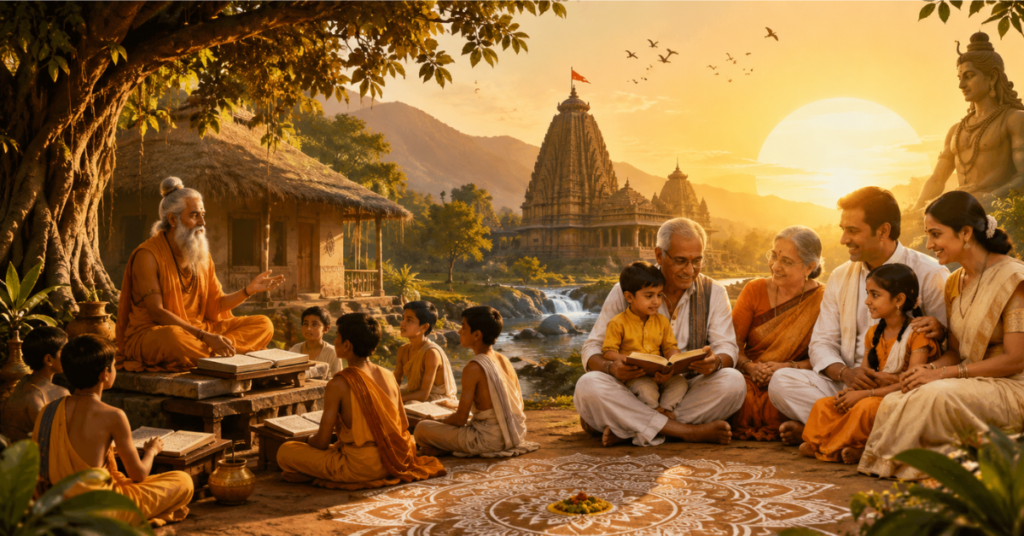
- A Free and Secure Ecosystem: If prominent regional and local temples establish large-scale, free residential Gurukuls—where the temple trusts bear the complete cost of food, clothing, housing, and integrated modern-traditional education—the greatest financial burden is lifted from middle-class and underprivileged families.
- Demographic Security Shield: When parents gain absolute confidence that their children’s educational and professional future is secure, they can build larger families free from economic panic. This naturally restores long-term demographic balance.
- Self-Reliance via Skill-Based Education: In stark contrast to the modern, hyper-competitive “rat race” and rote-memorization factories, these Gurukuls provide education tailored to each child’s inherent ‘Guna-Karma- स्वभाव’ (Core Competency).
- Whether a child’s natural aptitude lies in scientific research, commerce, agriculture, or defense, they are trained to achieve mastery, raising a new generation of entrepreneurs and leaders.
- Building a Cultural Backbone: Graduates of this residential lifestyle—both young men and women—emerge equipped with classical knowledge, martial arts, self-defense, and unassailable logical reasoning. They remain immune to ideological manipulation, laying the foundation for a healthy, addiction-free, and robust society.
III. Administrative Challenges: Passive Commentators vs. Active Achievers
The greatest obstacle to executing this visionary model is not external hostility, but internal systemic decay. The discourse identifies critical internal friction points:
- The Prevalence of the “Gyanchand” Mindset: Modern society suffers from an overabundance of passive commentators (“Gyanchands”) who lament problems for hours on social media and give grand speeches from public stages. Conversely, there is a severe drought of active achievers (“Karamchands”) willing to work selflessly on the ground. Society discusses crises endlessly but evades dedicating time and physical labor toward executable solutions.
- Vested Interests and Institutional Greed: The managers, trustees, and administrators of several affluent temples frequently prioritize personal financial interests and institutional control over broader societal welfare. Devotional offerings and wealth are too often diverted toward personal luxury or narrow administrative circles rather than driving civilizational resurgence.
Strategic Administrative Solutions:
- Decentralized Parallel Governance: The religious and ritualistic rights (pujas, sacraments) must remain exclusively with traditional priests. However, the management of temple funds and large-scale social projects (like the Gurukuls) must be handed over to an independent Governing Body composed of enlightened, selfless, retired professionals—such as former military officers, scientists, and administrative leaders.
- Proof of Concept: Rather than waiting for the entire macro-system to change overnight, capable and conscious citizens must unite to launch 2 to 3 model Gurukuls in partnership with selected transparent trusts. Once society witnesses the unprecedented tangible results, public pressure will naturally compel other temples to reform their administrative structures.
- Absolute Financial Transparency (Public Audit): Implementing advanced digital and technological tools to track every single penny of donations must be mandatory. When donors clearly see their contributions directly financing national and cultural rebuilding, the influx of financial support will scale exponentially.
IV. The Family Foundation: Parents as the Primary Sculptors
No matter how ideal, robust, or well-funded an institutional Gurukul system becomes, it remains a supplementary mechanism. The primary, irreplaceable work of character building can only occur within the home:
- No Substitute for Family Values: No school or Gurukul on earth can substitute for the protective shade of parents, a mother’s maternal care, and a father’s discipline. A child spends only a few hours a day or a few months a year in an educational institution; their subconscious mind is permanently sculpted by the domestic environment.
- Conduct Over Preaching: Children do not learn what they are told; they emulate what they observe their parents doing. If elders are disrespected within the home, or if parents themselves are caught in a blind materialistic chase and unethical behavior, institutional education remains a mere academic subject, failing to transform the child’s inner conscience.
- Transforming the Home into the First Gurukul: A child who has not grown up listening to history, heritage, and the epic narratives of great ancestors on their mother’s lap will always possess a fragile ideological foundation. Parents must transition out of the passive “Gyanchand” category and, through their own personal conduct, turn their homes into the primary center of learning.
- Symbiotic Co-existence: True transformation occurs when the Gurukul and the family operate in complete alignment. Gurukuls must periodically organize orientation workshops (Sanskar Shivirs) for parents. This ensures that the foundational values a child learns at school are met with a complementary, nurturing environment when they return home.
V. Long-Term Impacts and Civilizational Resurgence
When this tri-faceted model (Temple Resources + Gurukul Education + Family Values) is executed with absolute dedication, the long-term results will completely rejuvenate society:
- The Rebirth of Classical Knowledge Systems: Classical languages are not mere instruments of speech; they are the repositories of profound scientific, philosophical, and ethical data. Through the Gurukuls, these languages will return to the mainstream, systematically reviving our Traditional Knowledge Systems.
- Dismantling the Need for Old-Age Homes: When the younger generation graduates with deep empathy, sensitivity, and a profound sense of gratitude, the idea of sending elders to old-age homes becomes culturally unthinkable. Elders will naturally reclaim their rightful, respected status as guides and anchors within families and the broader community.
- A Mentally Resilient and Self-Reliant Nation: Citizens forged under this system will not only achieve intellectual excellence but will possess the psychological fortitude required to remain entirely free from the modern epidemics of clinical depression, anxiety, and directionlessness. This remains the only enduring path to safeguard civilizational continuity and reposition India as a global beacon of sustainable prosperity.
🇮🇳 Jai Bharat, Vandematram 🇮🇳
Read our previous blogs 👉 Click here
Join us on Arattai 👉 Click here
👉Join Our Channels👈