Summary
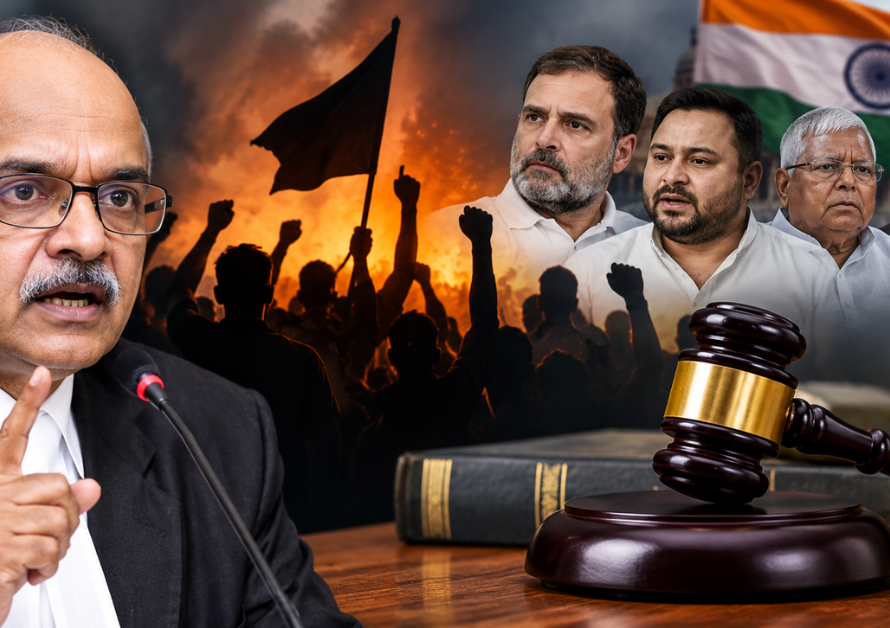
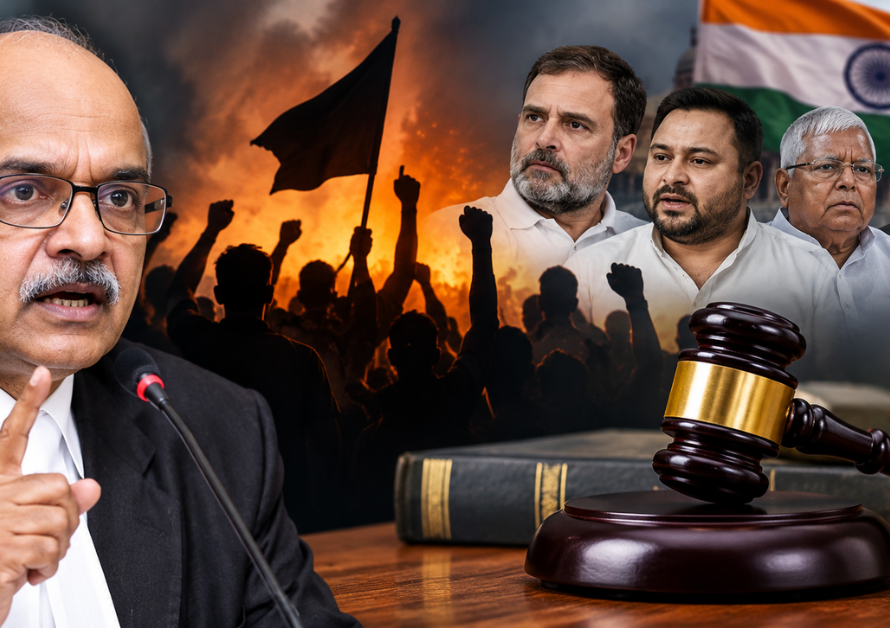
- The independence of the judiciary is an integral part of the ‘Basic Structure’ of Indian democracy. Recently, a criminal contempt petition was filed in the Supreme Court regarding political statements and attacks made on social media against the Chief Justice of India (CJI), Surya Kant.
- Filed by advocates Digant Mishra, Divyansh Bisht, Ashish Gopal Garg, and Shweta Garg, the primary objective of this petition is to curb the growing trend of political parties and leaders attempting to exert public and political pressure on judges in sub-judice matters, and to lay down clear guidelines for the same.
- The petition names the Central Government alongside major opposition parties and leaders as respondents, including the Congress party, Leader of Opposition in the Lok Sabha Rahul Gandhi, Leader of Opposition in the Rajya Sabha Mallikarjun Kharge, Trinamool Congress MP Mahua Moitra, the Kerala Congress, and Samajwadi Party President Akhilesh Yadav.
- The petitioners contend that demanding the Chief Justice’s resignation or advocating for an ‘alternative’ outside the constitutional framework is not merely contempt, but a direct assault on judicial impartiality, institutional reforms, and public trust.
The Supreme Court Contempt Petition and Constitutional Boundaries
1. Detailed Background and Primary Legal Demands of the Petition
This case highlights the growing friction between the modern digital landscape, political campaign machinery, and the constitutional protection of sub-judice judicial proceedings:
- Initiation of Criminal Contempt Action: The petitioners have moved the apex court to initiate proceedings under the Contempt of Courts Act, 1971 against political figures who posted derogatory statements aimed at lowering the authority of the judiciary and damaging the image of the Chief Justice.
- Binding Guidelines to Prevent Political Pressure: The petition requests the Supreme Court to formulate a comprehensive Standard Operating Procedure (SOP) or set of guidelines to prohibit political parties, public representatives, and social media handles from targeting judges in pending matters.
- Comprehensive List of Respondents: Alongside the administrative machinery of the Central Government, the petition impleads top leadership figures from opposition parties—including Rahul Gandhi, Mallikarjun Kharge, Mahua Moitra, Akhilesh Yadav, and organizational entities like the Kerala Congress.
2. Factual Details of Controversial Social Media Posts
The petition specifically submits social media posts made on October 12 as evidence of a coordinated attempt to pressure the judiciary:
- Objectionable Post by Kerala Congress: The petitioners highlighted an X (formerly Twitter) post by the Kerala Congress on October 12, which cited law-and-order concerns to demand that Chief Justice Surya Kant step down from his post and be replaced by another individual.
- Statements by MP Mahua Moitra: The petition cites a subsequent post made that same evening by Trinamool Congress MP Mahua Moitra, in which she stated that “if Surya Kant cannot do it, she will.”
- Allegation of an Organized Campaign: The petitioners argue that these posts were not spontaneous criticism, but rather an organized campaign designed to influence the bench in politically sensitive cases and erode public confidence in the judicial system.
3. Institutional Cleanup, Reforms, and the Political Economy of Opposition
Beyond the specific posts, the narrative submitted highlights a fundamental conflict between ongoing administrative cleanup within the judicial system and political interest groups:
- Disposal of Frivolous and Politically Motivated Cases: Under Chief Justice Surya Kant, significant focus has been placed on cleaning up the judicial system, speeding up justice delivery, and discouraging politically motivated or ill-intentioned litigation by rejecting unnecessary petitions. This approach has caused frustration among certain political networks and lawyers.
- National Interest vs. Ecosystem Opposition: Supporters argue that CJI Surya Kant is among the rare judicial heads prioritizing the country’s broader interests over partisan politics. Consequently, opposition parties and affiliated legal ecosystems—who perceive their political strategies being hindered—have targeted him alongside other constitutional entities such as the Union Government and the Election Commission of India (ECI).
- Pattern of Targeting Constitutional Institutions: The petition underscores a troubling trend where constitutional authorities acting with strict independence and transparency face coordinated public attacks whenever judicial rulings or administrative cleanups conflict with partisan objectives.
4. Constitutional Provisions: Breach of Articles 121 and 124(4)
The petition relies on specific articles of the Constitution of India and established jurisprudence to argue for the protection of judicial independence:
- Reference to Article 121 (Bar on Parliamentary Discussion): Article 121 explicitly restricts discussions in Parliament with respect to the conduct of any Judge of the Supreme Court or a High Court in the discharge of their duties (except upon a motion for impeachment). The petitioners argue that if parliamentary debate on judicial conduct is strictly regulated, unstructured public and social media attacks are inherently unacceptable.
- Article 124(4) and the Removal Process: The Constitution prescribes a rigorous and formal impeachment process under Article 124(4) for the removal of a judge. Demanding the ‘replacement’ or ‘resignation’ of the Chief Justice via social media posts bypasses and violates this constitutional framework.
- Impact on Judicial Impartiality: Subjecting judges to public trolling or political pressure during sub-judice matters undermines their ability to deliver fearless, independent judgments, posing a threat to the Rule of Law.
5. Freedom of Speech vs. Contempt of Court
This matter brings back into focus the delicate constitutional balance between freedom of speech (Article 19(1)(a)) and the law of contempt:
- Limits of Fair Criticism: Healthy analysis, academic critique, and fair commentary on judicial rulings are fully protected in a democracy. However, attributing motives to judges, demanding arbitrary resignations, or applying public pressure falls outside the boundary of fair criticism.
- Scope of the Contempt of Courts Act, 1971: Criminal contempt includes any act or publication that scandalizes, lowers the authority of any court, prejudices, or interferes with the due course of any judicial proceeding.
- Misuse of Digital Platforms: The petition emphasizes that targeting constitutional institutions on social media for short-term political gains is becoming a trend that requires immediate and clear judicial boundaries.
6. Protecting Judicial Dignity in a Democracy
- This petition represents a critical legal moment for Indian constitutional democracy. It confronts the fundamental question of whether political entities can drag the heads of constitutional institutions into political controversies to further partisan agendas.
- The Supreme Court’s eventual handling of this petition will not only address the dignity and security of the office of the Chief Justice but also set a precedent defining the precise boundary between political discourse on social media and the preservation of judicial independence.
🇮🇳Jai Bharat, Vandematram 🇮🇳
Read our previous blogs 👉 Click here
Join us on Arattai 👉 Click here
👉Join Our Channels👈