Summary
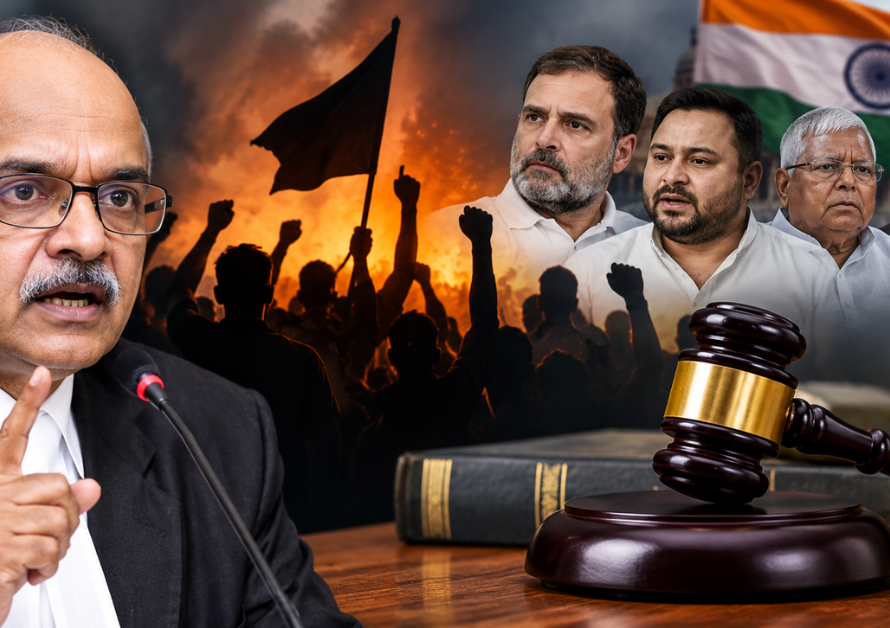
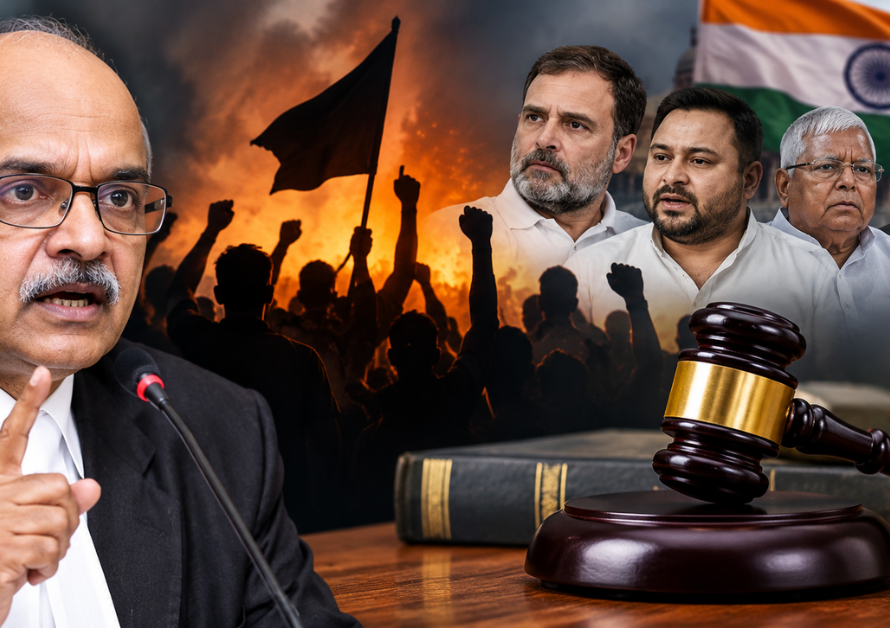
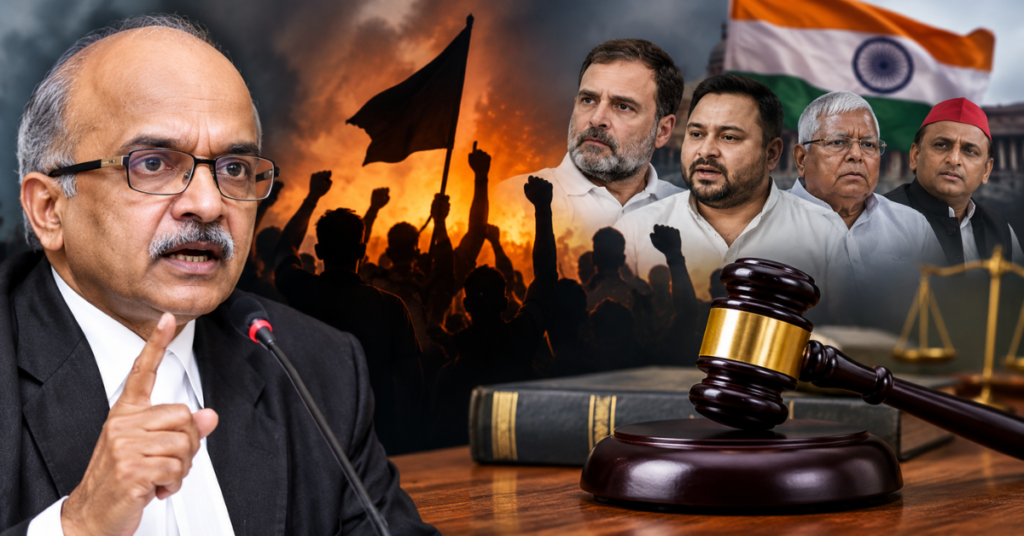
- Controversial remarks regarding “street revolution” and “a lot of bloodshed,” reportedly made by senior advocate Prashant Bhushan during an X Spaces discussion on October 11, 2026, have sparked deep ideological and legal concern across the country.
- This instance is not an isolated event; rather, it highlights a broader pattern of statements consistently issued by various opposition politicians, radical thinkers, and chaotic elements. The primary objective behind such statements appears to be inciting the public, creating violent instability akin to recent events in Nepal or Bangladesh, and endangering the democratic system.
- This detailed legal and political analysis connects Prashant Bhushan’s recent case with the divisive rhetoric of the opposition ecosystem, presenting an in-depth argument for uniform and strict legal action under various provisions of the Bharatiya Nyaya Sanhita (BNS), including Sections 152, 196, 197, 353, and 61.
Demand For Strict Legal Action Under The BNS Against Anti-National Statements From Prashant Bhushan And Opposition Leaders
1. Prashant Bhushan’s Statement On X Spaces And The Agenda Of Violent ‘Revolution’
During a public X Spaces session organized on October 11, 2026 (which also featured comedian Kunal Kamra among others), comments made by senior Supreme Court advocate Prashant Bhushan stunned intellectuals and ordinary citizens alike:
- Call for ‘Street Revolution’ and ‘Bloodshed’: During the discussion, it was asserted that under current circumstances, the only remaining path for a change of regime or system is “revolution.” Along with this came a warning that “there will be a lot of bloodshed” in this revolution, and that security forces would use firearms in the coming times.
- Disrespect for Democratic Processes: Advocating for “street revolution” and “bloodshed” to incite the public against a democratically elected government, constitutional institutions, and Election Commission procedures does not fall under peaceful protest or freedom of expression. It constitutes a direct act of spreading anarchy and inciting a crowd toward violence.
2. Not An Isolated Incident: A Systematic Pattern By The Opposition And Anti-National Elements
Prashant Bhushan’s statement appears to be part of a larger ideological ecosystem. A close observation of recent political developments reveals that statements encouraging public conflict are being made continuously by various opposition leaders and aligned elements:
- Provocative Examples from Various Leaders:
- Threats of Anarchy Similar to Nepal and Bangladesh: Several opposition figures and speakers have openly referenced recent violent upheavals in Nepal or Bangladesh, speaking of surrounding the Prime Minister’s residence or Parliament and calling for “people to take to the streets” in India on a similar pattern.
- Incitement Against Security Forces and Institutions: A narrative is constantly being built against the Election Commission, the judiciary, and police administration, claiming that institutions have become ineffective and that the only remaining option is violent agitation or taking the law into one’s own hands.
- Communal and Class Division: Regular attempts are observed on social media and public platforms by various radical figures to use language akin to civil war to incite specific sections or communities.
3. Ideological Background: Past Stance And Questions Surrounding Separatism
Alongside this recent controversy, there is strong public resentment regarding the past statements of Prashant Bhushan and his ideological associates:
- Stance on Separatism and Security Forces: Critics recall past controversies generated by statements concerning a referendum in Kashmir, the repeal of the Armed Forces Special Powers Act (AFSPA), and sympathy shown toward separatist figures (such as in the Burhan Wani case).
- Threat to National Security: Analysts argue that when an established legal figure repeatedly makes statements that hit at national security, sovereignty, and the morale of security forces, their remarks regarding “bloodshed” cannot be viewed as accidental. They appear to be part of an effort to create internal instability within the country.
4. Relevant Provisions Under The BNS: How To Enforce Legal Action
When statements move beyond political criticism to become calls for violence and regime change, the following stringent sections of the Bharatiya Nyaya Sanhita (BNS) come into effect:
A) Section 152 Of BNS (Acts Endangering Sovereignty, Unity, And Integrity Of India)
- Legal Provision: This section targets any act or speech that intentionally endangers the sovereignty, unity, or integrity of India, or incites secession or armed rebellion.
- Basis for Application: Claiming that the government should be removed through a “street revolution” accompanied by bloodshed forms a primary subject of investigation under this section.
B) Section 353 Of BNS (Statements Conducive To Public Mischief, Fear, And Rumor)
- Legal Provision: This section treats statements made with the intent to cause fear, alarm, or incitement to violence among the public as criminal offenses.
- Basis for Application: Assertions such as “security forces will open fire” and “there will be bloodshed” are sufficient to create fear and incite the public. It carries a penalty of imprisonment for up to 3 years.
C) Section 197 Of BNS (Imputations, Assertions Prejudicial To National Integration)
- Legal Provision: Applies to statements that dismiss the constitutional order and national unity to justify chaotic means.
D) Section 61 Of BNS (Criminal Conspiracy)
- Legal Provision: If an investigation reveals a shared plan among various political figures and anti-national elements via X Spaces, virtual meetings, or other platforms to spread anarchy, a collective case under Section 61 can be made.
5. Uniform Enforcement Of Law And Expectations From The Police
The credibility of the country’s judicial system depends on the law being applied equally to everyone, regardless of position, stature, or ideological influence:
- Ending Double Standards: If an ordinary citizen used such provocative language on social media, an FIR would be registered immediately. Therefore, senior lawyers, prominent leaders, or spokespersons cannot be granted immunity to call for violence under the guise of free speech.
- Demand for Forensic Investigation (@DelhiPolice): The Delhi Police should conduct a forensic examination of the original audio evidence from the X Spaces session and related meetings to determine whether a criminal conspiracy and violations of BNS sections took place. Legal action should be taken against all co-accused found guilty without yielding to pressure.
Conclusion
- The freedom of expression guaranteed by the Constitution provides the right to criticize the government, but it gives no one the right to cause “bloodshed” or overthrow the democratic system through “street revolution.”
- The time has come for the judiciary, police administration, and patriotic legal experts to unite and register solid cases under relevant BNS sections against figures like Prashant Bhushan and all such leaders, ensuring that Indian democracy remains protected from internal chaos.
🇮🇳 Jai Bharat, Vandematram 🇮🇳
Read our previous blogs 👉 Click here
Join us on Arattai 👉 Click here
👉Join Our Channels👈