Summary
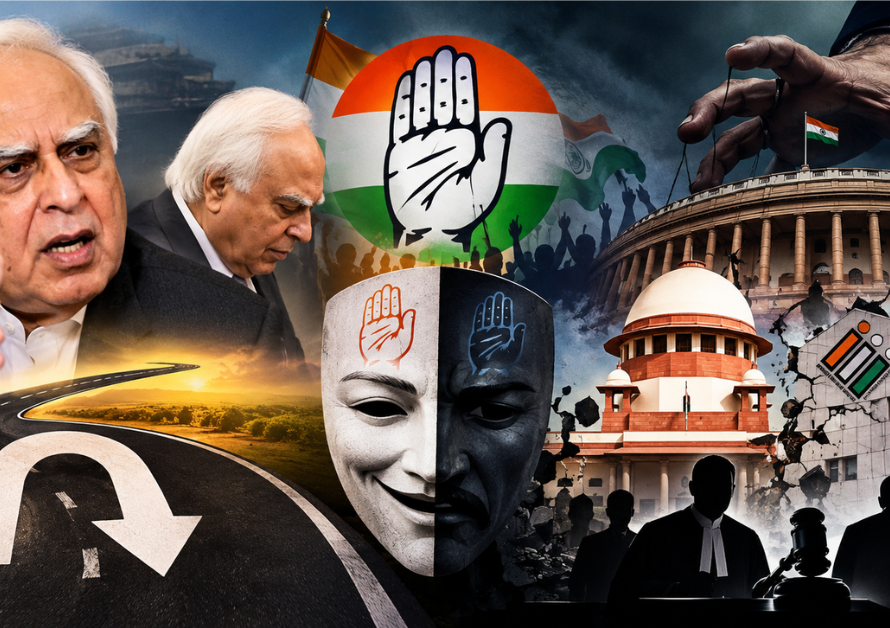
- When Kapil Sibal was the Law Minister during the United Progressive Alliance (UPA) government, he had explained three fundamental administrative and legal reasons in the Parliament of India related to the Special Summary Revision and amendment (SIR) of electoral rolls—change of residence, replication of names (duplication), and the death of a voter.
- At that time, Sibal had proved on official parliamentary records that the deletion of names from the voter list is not stripping a citizen of their democratic right, but rather an essential legal process to maintain a transparent and fair electoral system.
- The irony today is that when the Election Commission removes the names of millions of deceased, relocated, fake, or foreign voters under these very constitutional rules, Kapil Sibal himself and the entire Congress party are trying to spread confusion and anarchy in the country by terming it “vote theft.”
- From going to Rashtrapati Bhavan and weaving fabricated and false narratives to exerting pressure on the Chief Justice of India (CJI) and tarnishing the credibility of the Election Commission, this double character of the opposition alliance has been completely exposed.
- If the opposition genuinely has any constitutional grievance against the Chief Election Commissioner (CEC) or the electoral process, instead of engaging in violent politics, unbridled rhetoric, and media dramas on the streets, they should show the ideological and legal courage to bring an impeachment motion in Parliament.
- Exposing and strongly retaliating this political hypocrisy that undermines the dignity of constitutional institutions is extremely vital in the national interest.
Kapil Sibal’s U-Turn and Congress’s Double Standards
1. Kapil Sibal’s Official Arguments During the UPA Tenure and Parliamentary Records
- Reality of Parliamentary Records: While serving as the Union Law Minister in the UPA government, Kapil Sibal had officially clarified on the floor of Parliament that removing names to keep the electoral roll clean, updated, and transparent is entirely an administrative and legal process.
- First Reason (Change of Residence and Registration in a New Constituency): When a citizen leaves their original assembly constituency and begins residing in a new area, their name is legally removed from the old constituency’s list. Sibal himself had explained that this is not stealing anyone’s vote, but a constitutional mechanism to transfer voting rights to a new location.
- Second Reason (Name Replication or Duplication): If a citizen’s name remains recorded simultaneously in the voter lists of both old and new locations, it is mandatory under the rules to cancel the name from one place, because no Indian citizen can vote from two different places.
- Third Reason (Deletion of Name Post-Decease): Following the death of any voter, removing their name from the electoral roll to maintain the authenticity and credibility of the voter list is an obligatory administrative duty of the Election Commission.
- Political Convenience U-Turn: The scientific and legal arguments that Sibal himself placed before the nation in Parliament are now being opposed by him and his party purely to cash in on political opportunities and mask the fear of electoral defeat.
2. Statistics of Voter List Revision and the Truth of Rohingya-Bangladeshi Infiltration
- Truth of Transparent Data: Among the names removed during the Election Commission’s voter list purification drive, approximately 2.8 million (2.8 crore) were deceased individuals, 6.3 million (6.3 crore) were citizens who had changed their residences, and about 1 million (1 crore) were duplicate voters.
- Status of Legitimate Citizens vs. Infiltrators: Legitimate Indian citizens who changed locations got their names added to their new residential areas through standard legal procedures, safeguarding their democratic rights.
- Blow to Illegal Infiltrators: The Rohingya and illegal Bangladeshi infiltrators who had infiltrated the voter lists using fake identity papers and were completely unable to prove their Indian citizenship were purged from the electoral rolls during this purification process.
- Congress’s Propaganda at Rashtrapati Bhavan: Branding this routine and legal deletion process as “vote theft,” Congress leaders, along with other opposition parties, met the Hon’ble President, and upon exiting, Rahul Gandhi spread the false claim that the President had conceded to their point.
- Lack of Proof and Khilji/Kharge’s Confession: The reality was that the President had demanded solid evidence in support of their allegations of “vote theft.” Congress President Mallikarjun Kharge himself had to admit to the media that they were still gathering proof, which clearly shows that political confusion was spread without any foundation.
3. Pressure on the Judiciary and Violation of Constitutional Propriety
- Ignoring the Supreme Court’s Clear Stance: When Congress lacked concrete proof to present to the President, they staged a drama of seeking an appointment to meet the then Chief Justice, even though a bench headed by the Chief Justice had already dismissed a public interest litigation seeking the removal of the Chief Election Commissioner (CEC).
- Clear Refusal to Meet by the Chief Justice: Respecting the dignity, independence, and constitutional processes of the Supreme Court, the Chief Justice of India outright rejected such political meetings and attempts to exert pressure in the absence of a solid legal basis.
- Attack on the Credibility of Constitutional Institutions: Publicly questioning the credibility of the judiciary, the Election Commission, and constitutional posts instead of presenting arguments on constitutional platforms is a dangerous and irresponsible tradition for the health of democracy.
- Ideological Bankruptcy: When political parties begin to lose public support in election outcomes, they attempt to divert public attention by targeting independent constitutional institutions to conceal their failures.
4. Street-Level Violent Politics vs. The Constitutional Path of Impeachment
- Clear Provision for Parliamentary Impeachment: The Constitution of India provides a definite, transparent, and dignified pathway within Parliament for the removal of the Chief Election Commissioner (CEC) through “Impeachment.”
- Opposition Fleeing Parliamentary Processes: If Congress and its allied parties possess genuine facts or evidence against the Election Commission, they ought to bring an impeachment motion on the floor of Parliament, but due to a lack of concrete evidence, they choose street anarchy over constitutional procedures.
- Double Character of Senior Advocates: Senior legal experts like Kapil Sibal know very well that no official can be removed from a constitutional post through street protests, press conferences, or mobilizing crowds, yet they continue to provide ideological patronage to this anarchic narrative.
- A Strong Message to Elements Spreading Anarchy: It has become critically essential to bring so-called intellectuals who advocate inciting unrest, promoting violence, and running parallel systems on the streets within the strict framework of the law and deliver a strong and decisive rebuff through public outrage.
🇮🇳Jai Bharat, Vandematram 🇮🇳
Read our previous blogs 👉 Click here
Join us on Arattai 👉 Click here
👉Join Our Channels👈
Reads & Views: 30