Summary
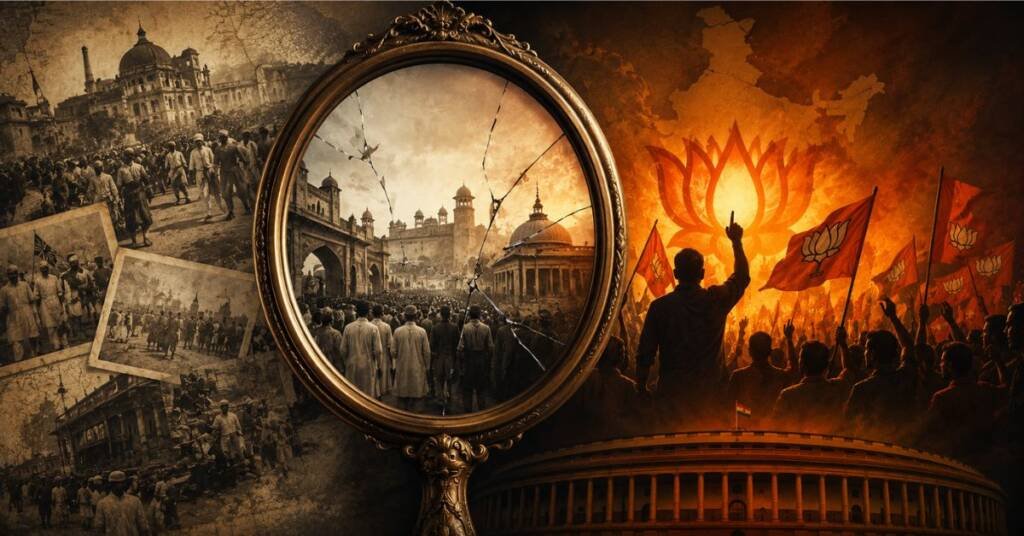
- This analytical commentary evaluates the historical narrative claiming that communal polarization or separatism in India was initiated by the Rashtriya Swayamsevak Sangh (RSS) or the Bharatiya Janata Party (BJP).
- Through a chronological analysis spanning from Sir Syed Ahmad Khan’s landmark 1888 speech to the 1947 Partition and post-independence policies, this text clarifies that the Two-Nation Theory, separate electorates, the Khilafat Movement, the Moplah genocide, and Direct Action Day stemmed from the British “Divide and Rule” policy, Muslim League radicalism, and Congress’s political appeasement,
- At that time when neither the BJP existed nor the RSS had any significant influence.
The Reality of RSS-BJP
I. Sowing the Seeds of the Two-Nation Theory: Sir Syed Ahmad Khan (1888)
The concept of two distinct nations based on religious identity in India was not created by any modern political party; rather, its formal public documentation occurred as early as the late 19th century.
- The Historic Meerut Speech: On March 14, 1888, addressing a massive public gathering in Meerut, Sir Syed Ahmad Khan, founder of Aligarh Muslim University, explicitly declared that Hindus and Muslims were two distinct nations. He argued that after the departure of the British, it would not be possible for both communities to sit on the same throne with equality.
- The Politics of Dominance: He asserted that the balance of power could only be achieved if one community dominated and subjugated the other. Historians regard this address as the first public document of the “Two-Nation Theory” in modern Indian history.
- Historical Truth: At this pivotal moment, neither the Rashtriya Swayamsevak Sangh (founded in 1925) existed, nor had the ideology of the Bharatiya Janata Party (founded in 1980) been conceived.
II. Institutional Validation and Organized Separatism (1905–1909)
The British Empire institutionalized religious division by utilizing administrative decisions and statutory legal provisions to shatter Indian national consciousness.
- The Partition of Bengal (1905): Under the pretext of administrative convenience, the British partitioned Bengal into Eastern (Muslim-majority) and Western (Hindu-majority) provinces to rupture the emerging Indian national unity along religious lines.
- The Shimla Delegation (1906): A delegation of Muslim leaders led by the Aga Khan met Lord Minto to demand separate political representation for Muslims.
- Formation of the Muslim League (1906): On December 30, 1906, the All India Muslim League was established in Dhaka. Its primary objective was to advocate solely for Muslim political interests and maintain loyalty toward the British Crown. This organization came into existence nearly two decades before the founding of the RSS.
- Morley-Minto Reforms (1909): The British codified “Separate Electorates” into law, permanently stamping an administrative and legal seal on the premise that Hindus and Muslims constituted two distinct political categories.
III. Congress Appeasement and the Violent Turn of Khilafat (1916–1921)
During the freedom movement, strategic miscalculations and the politicization of religious issues further empowered separatist forces.
- The Lucknow Pact (1916): The Congress reached an agreement with the Muslim League, formally accepting the demand for separate electorates. Historians view this as the first major historical blunder of political appeasement by the Congress, which paved the way for the ultimate partition.
- The Khilafat Movement (1919–1920): A purely extra-territorial religious issue—the restoration of the Ottoman Caliphate in Turkey—was linked to India’s national freedom struggle.
- The Moplah Genocide (1921): Following the failure of the Khilafat Movement, radical Muslim groups in Malabar, Kerala, unleashed targeted violence against local Hindus. This resulted in the massacre of over 10,000 Hindus and widespread forced religious conversions.
- Historical Reality: Neither the RSS nor the BJP existed during these far-reaching historical events.
IV. From the Allahabad Address to Direct Action Day (1930–1946)
The separatist movement that gathered momentum in the 1930s escalated over the next decade and a half into horrific violence and a formal demand for partition.
- The Allahabad Address (1930): The poet Muhammad Iqbal presented the first explicit ideological framework for a separate Muslim nation from the platform of the Muslim League.
- The Lahore Resolution (1940): The Muslim League officially passed the resolution demanding the creation of “Pakistan.” By this time, the Congress had been in existence for over 50 years with Mahatma Gandhi, Jawaharlal Nehru, and Vallabhbhai Patel as established leaders, whereas the RSS was merely a 15-year-old cadre-based organization with limited influence.
- Direct Action Day (August 16, 1946): Muhammad Ali Jinnah called for “Direct Action Day” to force the demand for Pakistan. This resulted in catastrophic communal violence in Calcutta, known as the “Great Calcutta Killings.” Countless innocent citizens were slaughtered, while Mahatma Gandhi’s declaration that “Pakistan will be built over my dead body” proved completely ineffective.
V. The 1947 Partition and Policy Discrimination Under Coalition Era Rules
From the 1947 Partition through the next seven decades of post-independence governance, state policies further perpetuated this pattern of appeasement.
- The 1947 Partition: When the partition of India on a religious basis was accepted, only three parties were present at the decision table—the British, the Congress, and the Muslim League. The RSS raised its voice against partition in favor of an undivided India (Akhand Bharat), but its stance was ignored by the established political leadership.
- 70 Years of Asymmetrical Policies: Examining the roughly 70-year rule of various coalition governments reveals systemic bias across plans, policies, and constitutional amendments. Driven by vote-bank politics, special concessions were extended to the Muslim minority while the rights and interests of the majority Hindu community were consistently overlooked.
- The Narrative of “Saffron Terror”: During Congress rule, a narrative of “Saffron Terror” was fabricated for political leverage. Although this construct failed to hold up in courts, prejudiced administrative actions resulted in severe persecution, distress, and trauma for numerous innocent Hindus over many years.
VI. 12 Years of Inclusive Governance: Non-Discriminatory Policy Balance
The BJP/RSS-inspired governance model over the past 12 years has fundamentally transformed this decades-old framework of appeasement.
- Implementation of ‘Sabka Saath, Sabka Vikas’: Flagship welfare schemes of the Central Government—including housing (PMAY), cooking gas (Ujjwala), financial inclusion (Jan Dhan), healthcare (Ayushman Bharat), and free foodgrain distribution—have been extended equally to every citizen without any religious discrimination.
- The Principle of Uniformity: Governance has transitioned from appeasement to justice and equity. Rather than granting special concessions to specific groups, merit, need, and fairness serve as the bedrock of public administration, neutralizing appeasement-driven polarization.
An Unbiased Historical Assessment
- Historical evidence demonstrates that the seeds of religious separatism in India were planted by the British “Divide and Rule” policy, fueled by the radical separatism of the Muslim League, and nurtured by post-independence appeasement policies.
- The rise of the RSS and the BJP is not the cause of this communal division, but a natural ideological and social response to these historical developments and decades of policy bias.
Satyamev Jayate (Truth Alone Triumphs).
🇮🇳 Jai Bharat, Vandematram 🇮🇳
Read our previous blogs 👉 Click here
Join us on Arattai 👉 Click here
👉Join Our Channels👈