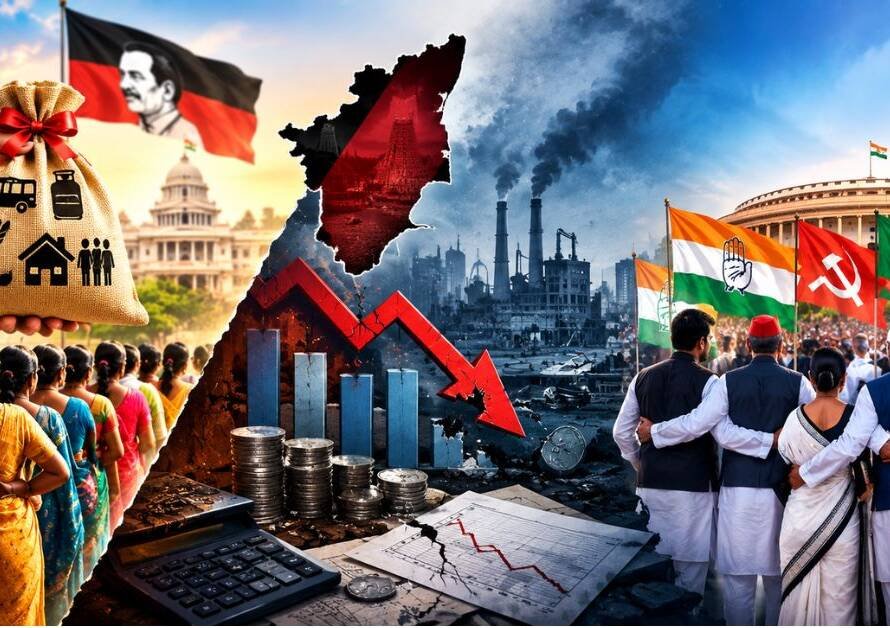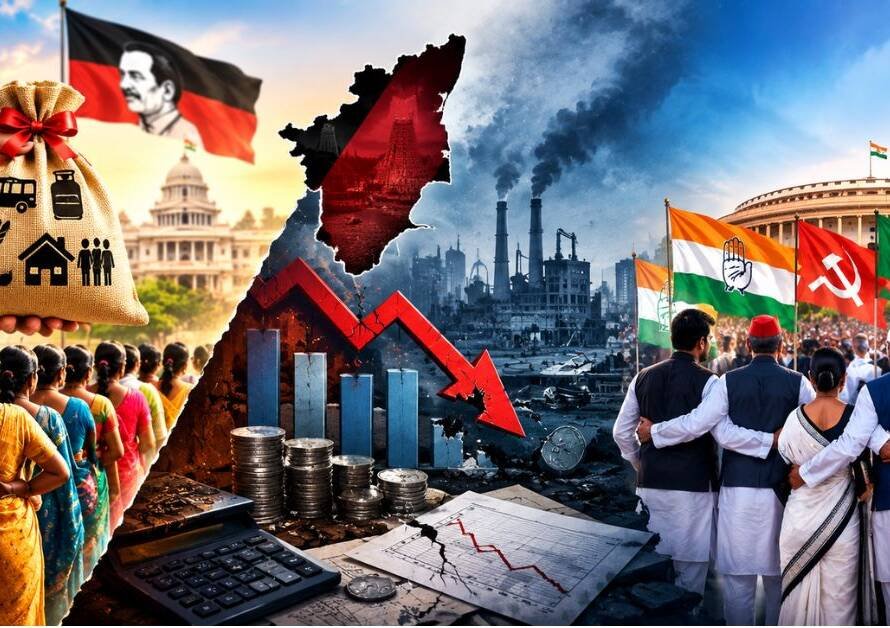
Summary
- India is undergoing a profound structural shift where traditional academic degrees are suffering an unprecedented Return on Investment (ROI) collapse.
- While millions of youth chase low-paying, stagnant white-collar desk jobs for social status, practical vocational trades and micro-entrepreneurial ventures are significantly out-earning formal graduates.
- This narrative analyzes this “Degree Deficit,” addresses the deep-seated cultural bias against manual and technical skills, and outlines how the convergence of skill-based education and accessible microcredit can transform India from a nation of endless job seekers into an economic powerhouse driven by self-reliant job creators.
Breaking the White-Collar Trap for a Superpower Trajectory
1. The Reality of the “Degree Collapse” and the Income Disparity
The foundational promise of the traditional Indian education system—that a university degree automatically guarantees financial upward mobility—is undergoing a systematic collapse. A direct evaluation of current market dynamics reveals an undeniable economic mismatch: the labor market is aggressively rewarding practical execution while severely penalizing rote academic credentials.
- The Vocational Earning Premium: Practical, skill-bound professionals operate in a highly dynamic, demand-driven ecosystem. Independent electricians command monthly revenues between ₹35,000 and ₹60,000, outperforming many corporate entry-level packages. Similarly, skilled plumbers and tile workers/masons consistently earn between ₹30,000 and ₹50,000 per month.
- The Logistics and Gig Economy Baseline: Driven by rapid digitization, execution-based roles in the gig and logistics sectors offer strong financial baselines. E-commerce delivery couriers for platforms like Amazon or Flipkart earn between ₹28,000 and ₹40,000 monthly, while hyper-local delivery riders for Swiggy or Zomato bring home ₹25,000 to ₹35,000 per month based on pure operational velocity.
- The Small Business Frontier: Independent neighborhood retail and small shop owners demonstrate the highest raw earning potential among non-corporate pathways, routinely generating net monthly cash flows ranging from ₹30,000 to ₹70,000 depending on localized market demand and inventory turnover.
- The Academic Wage Suppression: In stark contrast, standard university graduates holding BA, B.Com, or BSc degrees face highly compressed starting wages, typically restricted to a bracket of ₹10,000 to ₹18,000 per month. Post-graduate qualifications offer little relief, with MSc holders averaging between ₹15,000 and ₹22,000 monthly.
- The Technical and Management Cap: Even professional tracks are struggling under the weight of oversupply and low institutional quality. Non-tech engineers are frequently stuck with starting salaries of ₹12,000 to ₹20,000, while MBAs graduating from Tier-2 and Tier-3 institutions top out at ₹18,000 to ₹30,000 per month. Standard tech engineers, excluding the top 5% elite bracket, struggle within a modest baseline of ₹20,000 to ₹35,000.
2. The Diminishing Returns on Expensive Technical Education
The financial math behind pursuing expensive higher education in non-premium institutes has turned sharply negative. When calculated strictly as a business transaction, formal degrees have become high-cost, low-yield assets that place immense financial strain on middle-class families.
- The Capital Loss of Tuition Fees: Families routinely drain life savings or secure high-interest education loans amounting to lakhs of rupees to fund engineering or management degrees at Tier-2 and Tier-3 colleges. When the outcome is an entry-level salary of ₹15,000 to ₹25,000, the time required to achieve a basic break-even point spans decades, resulting in a net destruction of household wealth.
- The Opportunity Cost of Time: A typical technical degree requires four years of full-time campus enrollment, representing a massive period of zero productivity. During these same four years, a vocational apprentice entering a trade directly out of secondary school builds continuous market experience, establishes a local customer network, and accumulates active savings.
- The Structural Unemployment Buffer: Universities continue to operate as holding pens for millions of youth, delaying their entry into the workforce without providing functional, employable capabilities. Graduates leave the campus gates deeply in debt, yet possess few practical skills that a modern business is willing to pay a premium for.
- The Illusion of White-Collar Security: The historical safety net associated with corporate desk jobs has evaporated due to automation, corporate consolidation, and a massive oversupply of generic graduates. The entry-level white-collar market is fundamentally a buyer’s market, allowing corporate entities to keep starting wages suppressed at levels barely tracking inflation.
3. Shattering the Cultural Bias Against Vocational Trades
The single greatest bottleneck preventing India from fully leveraging its massive demographic dividend is not a lack of opportunity, but a deep-seated cultural obsession with white-collar desk jobs. For generations, social prestige has been tied exclusively to working in air-conditioned offices, leading to an economic landscape where lucrative technical trades are viewed with unfair social prejudice.
- The High Cost of Social Prestige: Millions of Indian youth actively choose to remain underemployed or endlessly chase low-paying data entry, administrative, or retail desk jobs paying ₹12,000 a month simply to maintain the social status of a “white-collar professional.” In doing so, they consciously reject highly profitable technical vocations that offer double or triple the earning capacity.
- The Autonomy of the Skilled Professional: Unlike corporate employees who are bound to rigid corporate appraisal cycles and top-down institutional mandates, independent skilled professionals function as autonomous business entities. Their income is determined entirely by their efficiency, domain mastery, and local market reputation, giving them a level of professional control that no corporate cubicle can provide.
- Redefining the Dignity of Labor: To sustain rapid economic advancement, Indian society must systematically overhaul how it views manual, technical, and vocational expertise. A master electrician, an advanced automotive technician, or an expert precision mason must be recognized as a highly specialized engineering professional rather than an uneducated laborer.
- Breaking the Cycle of Stagnant Growth: Generic white-collar roles feature highly compressed growth ceilings with minimal vertical mobility. Conversely, an individual operating in a high-demand skilled trade faces no artificial boundaries; their financial runway is limited only by their personal work capacity and operational ambition.
4. Bridging Skills and Microcredit to Drive Grassroots Innovation
Reversing the degree crisis requires an administrative ecosystem that actively converts systemic liabilities into entrepreneurial assets. By pairing localized, high-demand technical capabilities with flexible, democratized institutional funding, the youth can bypass traditional corporate gatekeepers entirely.
- The Shift to Competence-Based Education: Modern educational reforms are dismantling the artificial divide between academic theory and practical vocational intelligence. By weaving practical industry certifications, technology-driven skill labs, and hands-on apprenticeships directly into the core curriculum, education is transforming from a search for paper credentials into a pipeline for functional capability.
- Democratizing Institutional Capital: The traditional banking system long acted as a barrier for aspiring entrepreneurs without collateral. The wide availability of government-backed microcredit and streamlined micro-finance models has fundamentally altered this landscape. Aspiring business owners can now access seed capital on flexible, easy terms without facing bureaucratic red tape.
- Mitigating Entrepreneurial Risk: Accessible microcredit fundamentally shifts the risk calculations for young professionals. When seed funding is affordable and decoupled from predatory collateral requirements, launching a localized service startup or an urban micro-enterprise becomes a highly viable, calculated path rather than an unreachable financial gamble.
- Spurring Rural and Semi-Urban Industrialization: The combination of specialized skill development and flexible micro-lending is decentralizing wealth creation away from major tier-1 metropolitan hubs. It enables small-town youth to launch high-yield service hubs, automated workshops, and regional production facilities directly within their local communities.
5. From Job Seekers to Job Creators: Building a Superpower
The ultimate milestone for India’s economic evolution lies in transitioning the national mindset away from competing for a dwindling pool of entry-level vacancies toward building sustainable assets that employ others. Over the last 12 years, decisive structural overhauls have elevated the nation’s growth trajectory; maintaining this momentum requires a massive wave of grassroots entrepreneurship.
- The Mathematical Necessity of Enterprise Scale: An independent skilled professional earning ₹60,000 a month eventually hits a natural operational ceiling governed by their limited individual hours. To scale further, they must transition from a sole operator into an active employer, bringing on junior helpers, apprentices, and specialized technicians.
- Absorbing the Academic Surplus: By expanding their micro-enterprises, successful skilled contractors and small shop owners become primary engines of local employment. Paradoxically, these growing trade businesses frequently hire underemployed college graduates to manage operations, logistics, and digital marketing, creating a healthy cycle of absorption for the academic surplus.
- Building Real Wealth for the Nation: Corporate salaries are primarily consumption-driven, moving money from corporate treasuries directly into consumer spending. Grassroots entrepreneurship, however, creates net-new economic velocity. It converts raw community demand into local infrastructure, asset accumulation, and localized capital retention.
- Securing Global Sovereignty Through Self-Reliance: A nation composed primarily of corporate employees is highly vulnerable to global macroeconomic shocks, corporate layoffs, and international outsourcing trends. A nation anchored by millions of self-reliant, highly skilled micro-entrepreneurs possesses an indestructible economic foundation, providing the continuous momentum needed to secure India’s position as a global economic superpower.
🇮🇳 Jai Bharat, Vandematram 🇮🇳
Read our previous blogs 👉 Click here
Join us on Arattai 👉 Click here
👉Join Our Channels👈