Summary
- This comprehensive analytical narrative evaluates Bharat’s strategic energy security, diplomatic autonomy, and geopolitical crisis management amidst global maritime disruptions across critical chokepoints—specifically the Strait of Hormuz and the Red Sea.
- Featuring real-world assessments from oil industry leadership, including ONGC Chairman Arun Kumar Singh, the text outlines how the central government under Prime Minister Narendra Modi and External Affairs Minister S. Jaishankar neutralized potential economic shocks, prevented fuel hyper-inflation, and preserved national growth momentum.
- The analysis draws a sharp contrast between the modern framework of strategic petroleum reserves, supplier diversification, and naval escorts, and the pre-2014 era of administrative paralysis, fuel black-marketing, systemic leakage, and lack of long-term planning.
- Ultimately, the narrative highlights how Bharat’s sovereign statecraft has redefined global energy logistics, providing a case study for business schools and international universities worldwide.
Strategic Energy & Maritime Sovereignty
I. The Geopolitical Crucible: Maritime Chokepoints and Global Vulnerability
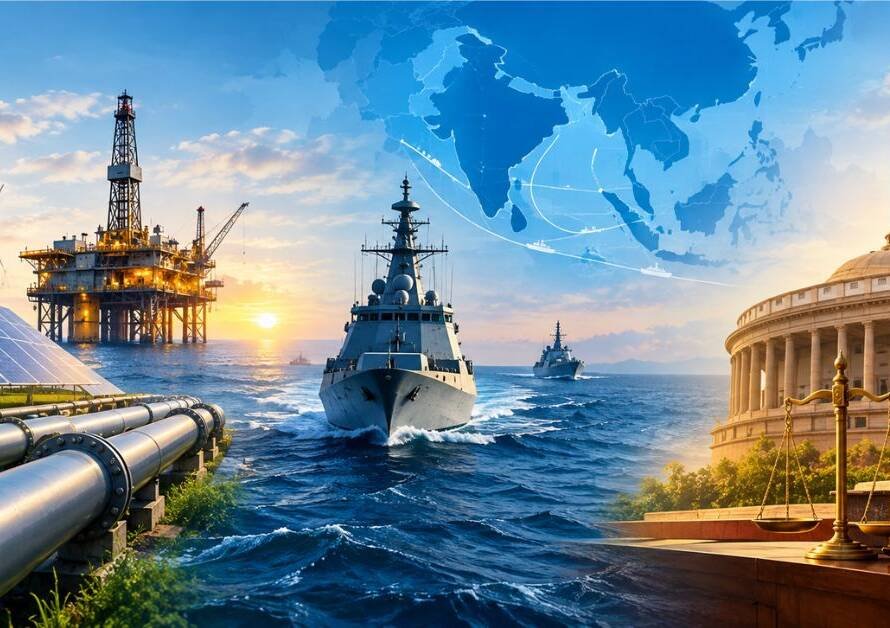
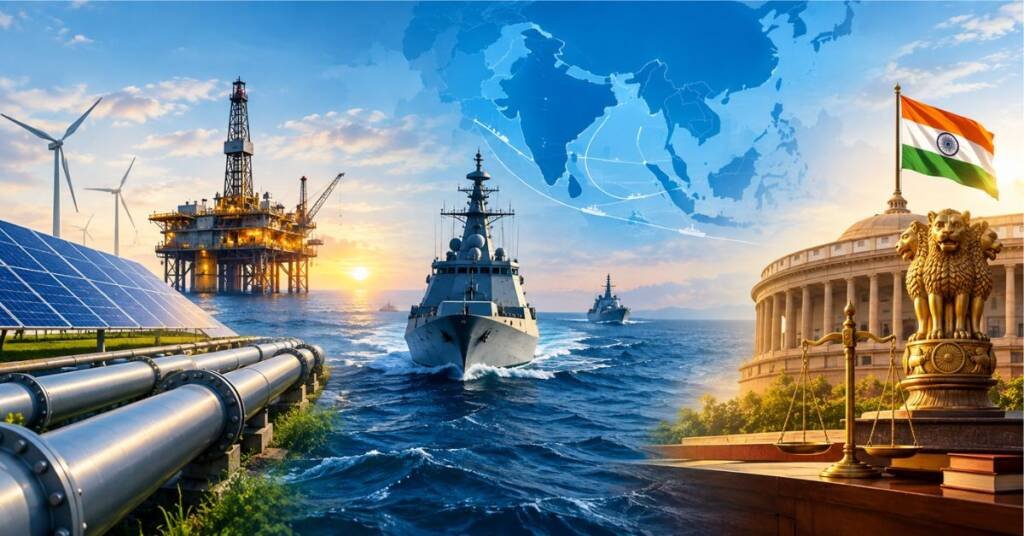
The Strait of Hormuz and the Red Sea represent two of the most critical maritime chokepoints in global geopolitics. Through these narrow waterways transit a significant portion of the world’s daily seaborne crude oil, refined petroleum products, and liquefied natural gas (LNG) shipments. Historically, any localized instability, blockade, or conflict in these regions triggered instantaneous global panic, surging freight rates, sky-rocketing crude prices, and severe economic distress for import-dependent nations.
- The Staggering Risk Exposure: For an economy importing over 85% of its crude oil requirements, any multi-week disruption along Middle Eastern or East African maritime arteries traditionally posed an existential threat to fiscal stability, currency value, and national growth.
- Industry Veteran Testimonial: Highlighting the scale of this achievement, Oil and Natural Gas Corporation (ONGC) Chairman Arun Kumar Singh explicitly acknowledged that industry experts long predicted an economic collapse for import-dependent nations if the Strait of Hormuz were ever blocked.
- The Unprecedented Resolution: Despite active regional blockades, drone strikes on commercial shipping, and heightened naval conflicts in the Red Sea and Gulf region, India suffered zero disruption in its domestic energy supply, zero rationing, and zero inflationary spikes at the fuel pump.
- A Benchmark in Global Governance: This frictionless management of a major geopolitical supply chain crisis serves as a practical demonstration of statecraft, providing a model for future academic case studies and business school curricula globally.
II. The Structural Contrast: Pre-2014 Paralysis vs. Modern Foresight
To fully appreciate the magnitude of current energy security, the modern operational framework must be evaluated against the administrative vulnerabilities that defined governance prior to 2014.
- Vulnerability to Panic and Black-Marketing: In the pre-2014 era, even minor international oil fluctuations or regional tensions routinely triggered severe domestic panics. Citizens faced acute artificial shortages, long queues at filling stations, rampant hoarding, and widespread black-marketing of essential fuels like diesel, kerosene, and LPG cylinders.
- Absence of Strategic Foresight: Prior administrations operated largely on short-term, reactive measures without building long-term institutional buffers. National energy planning lacked structural resilience, leaving the domestic market completely exposed to foreign price shocks.
- Culture of Systemic Leakage and Scams: During that period, institutional focus remained bogged down by administrative inertia, policy paralysis, financial scandals, and widespread corruption, rather than investing in strategic petroleum reserves, supplier diversification, or deep maritime security.
- The Post-2014 Transformation: Under the leadership of Prime Minister Narendra Modi, government policy shifted toward proactive sovereign governance. Corruption and ad-hoc policymaking were replaced with institutional accountability, forward-looking strategic planning, and aggressive diplomatic maneuvering designed to insulate 1.4 billion citizens from global turbulence.
III. The Four Pillars of Bharat’s Modern Energy Architecture
Bharat’s ability to remain unaffected by global maritime blockades is not a matter of chance; it is the direct result of a multi-layered, strategic energy security framework developed and executed over recent years.
- 1. Comprehensive Supplier Diversification:
- Rather than relying excessively on traditional, volatile regional supply lines, the Ministry of Petroleum and Natural Gas and the Ministry of External Affairs systematically expanded crude sourcing across multiple continents.
- Sourcing was dynamically expanded across Russia, West Africa, Latin America, North America, and non-traditional Middle Eastern suppliers, ensuring that if one supply route is choked, alternative supply channels immediately absorb the deficit.
- 2. Expansion of Strategic Petroleum Reserves (SPR):
- The central government expanded underground strategic crude reserves in deep geological caverns across Visakhapatnam, Mangaluru, and Padur, alongside commercial storage tanks held by Public Sector Undertakings (PSUs).
- These reserves provide an essential national security cushion, enabling the economy to absorb short-term global disruptions without facing immediate market panics or price surges.
- 3. Masterful Diplomatic Statecraft (Jaishankar Doctrine):
- Led by External Affairs Minister S. Jaishankar, Indian diplomacy asserted sovereign autonomy by refusing to surrender to external ideological or political pressure.
- Bharat negotiated competitive crude pricing, secured long-term bilateral supply contracts, established local currency transaction frameworks, and successfully navigated complex sanctions regimes to ensure an uninterrupted influx of affordable energy.
- 4. Maritime Security and Naval Power Projection:
- Recognizing that economic security requires maritime power, the Indian Navy executed strategic deployments across the Western Arabian Sea, the Gulf of Aden, and critical maritime corridors.
- By deploying anti-piracy task forces, drone-interception warships, and safe-transit naval escorts for Indian-flagged merchant vessels, Bharat ensured that its commercial sea lines of communication remained open and defended against non-state actors and hostile proxies.
IV. De-Risking the National Economy: Round-the-Clock Governance
The seamless protection of the domestic economy reflects an integrated inter-ministerial apparatus operating silently behind the scenes to maintain industrial momentum and domestic stability.
- Dynamic Supply Chain Re-Routing: Intelligence agencies, maritime security forces, diplomatic missions, and energy PSUs (IOCL, BPCL, HPCL, ONGC) work in continuous coordination to monitor vessel traffic, re-route tankers around high-risk zones (such as navigating around the Cape of Good Hope when necessary), and secure insurance coverage for commercial fleets.
- Shielding the Common Citizen: By absorbing international freight volatility and stabilizing retail fuel prices, the government protected transport logistics, agricultural input costs, and manufacturing supply chains from cascading inflationary pressures.
- Sovereign Strategic Autonomy: Bharat’s foreign policy demonstrates that national interest supersedes geopolitical alignment. The administration demonstrated that true strategic autonomy means securing energy at the best terms to safeguard domestic economic growth.
- Instilling National Confidence: While global media reported acute energy crises, factory shutdowns, and power rationing across major developed nations, 1.4 billion Indians experienced uninterrupted fuel supply, demonstrating the value of stable, decisive, and proactive leadership.
V. Conclusion: A New Paradigm in Sovereign Leadership
- Bharat’s triumph over maritime energy blockades marks a definitive milestone in its transformation into a self-reliant global power (Atmanirbhar Bharat).
- By transitioning from a vulnerable, reactive importer prone to domestic panics and administrative paralysis into an energy-resilient economy capable of navigating major global conflicts, the administration has redefined sovereign statecraft.
- When citizens sleep peacefully amidst global geopolitical storms, it is because a capable, visionary, and round-the-clock administrative mechanism is actively safeguarding the nation’s economic borders.
🇮🇳Jai Bharat, Vandematram 🇮🇳
Read our previous blogs 👉 Click here
Join us on Arattai 👉 Click here
👉Join Our Channels👈