Summary:
- This comprehensive analytical piece evaluates the critical distinction between democratic accountability and strategic social fragmentation within Hindu society.
- While questioning and criticizing any governing party—including the BJP—is a fundamental democratic right, allowing political discontent to cause electoral atomization carries severe, irreversible consequences for the collective security, demographic stability, and cultural continuity of the nation.
- By analyzing historical precedents ranging from the Direct Action Day massacres and Partition to the 1990 Kashmiri Hindu exodus, this essay demonstrates that political parties function as structural shields in modern statecraft.
- Their total collapse does not merely penalize politicians; it leaves the majority community directly exposed to institutional bias, street-level insecurity, and existential threats.
Beyond Political Frustration, Narrative Traps, and Electoral Risks
1. The Mechanics of the Narrative Trap: Distinguishing Discontent from Self-Sabotage
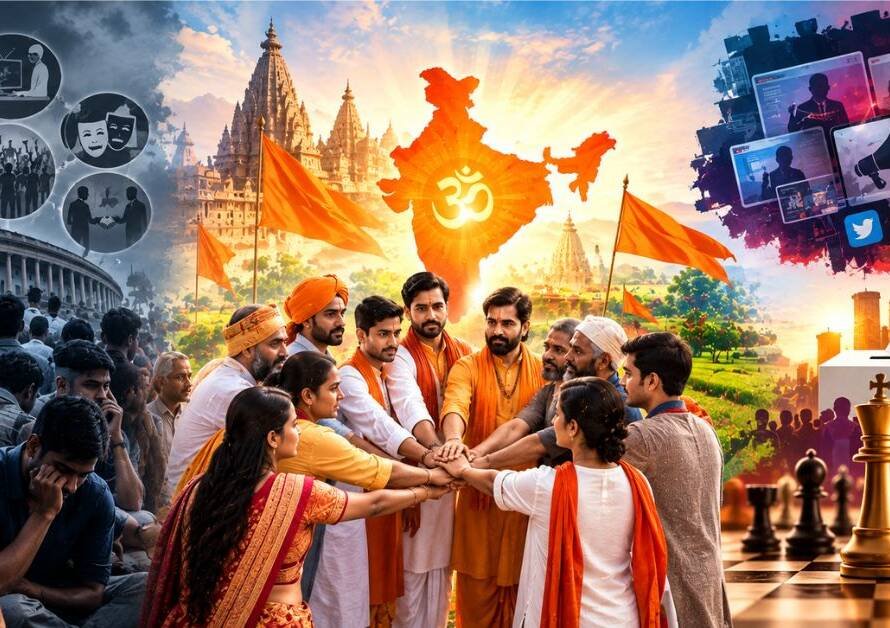
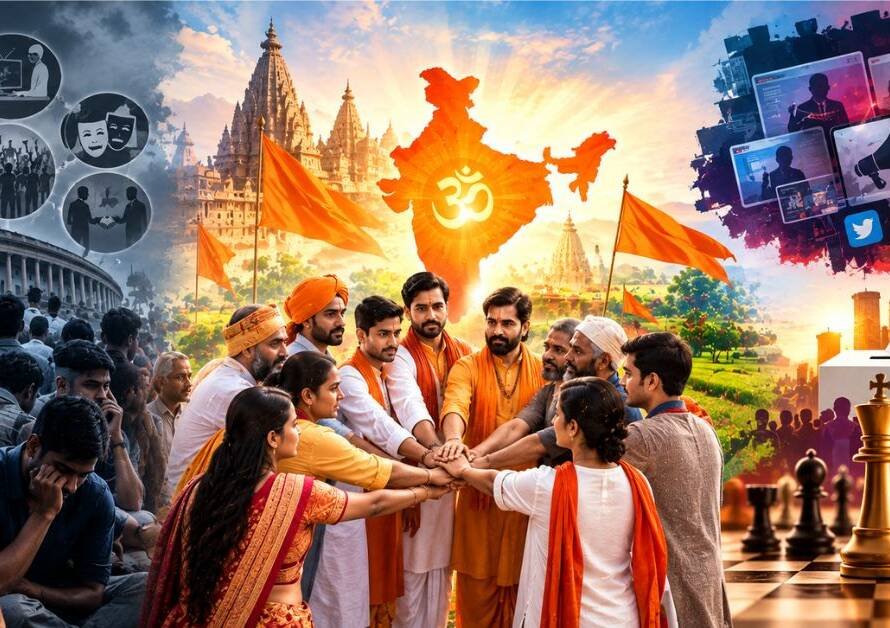
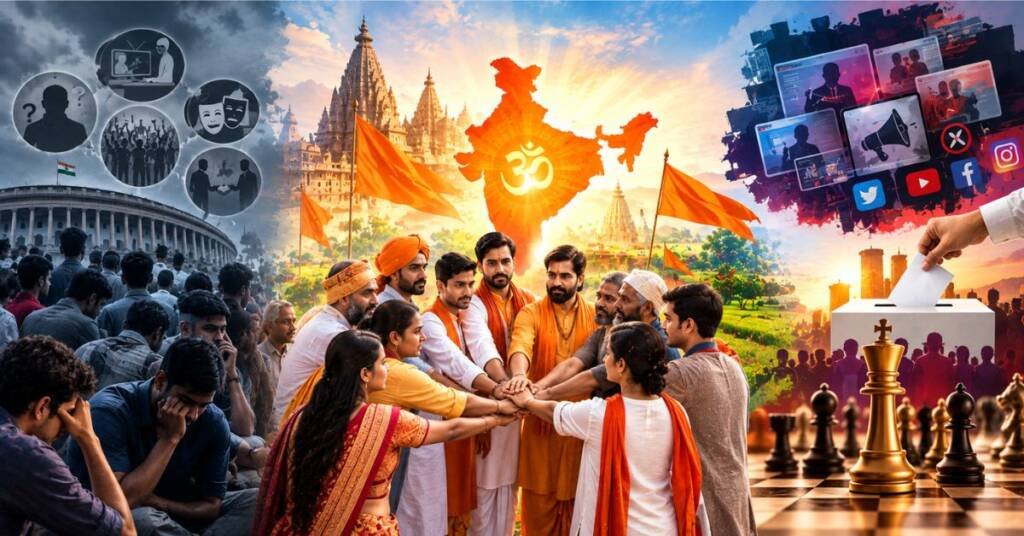
In a vibrant democracy, demanding performance, questioning governance, and expressing dissatisfaction with the ruling establishment is both natural and necessary for healthy statecraft. However, a subtle narrative strategy is currently at play across media and digital spaces—one that harnesses legitimate grievances to engineer total political abandonment and voter apathy.
- The Fallacy of Punitive Voting: The mindset that lowering a ruling party’s mandate—whether reducing its parliamentary strength from 303 seats down to 240, or pushing it down to zero—serves as a “lesson” to political elites rests on a flawed premise. Political leaders and party machinery easily survive electoral setbacks and adapt to opposition status, but society at large directly absorbs the resulting policy shifts, security vacuums, and institutional realignments.
- Weaponization of Perfectionism: A recurring psychological trap involves convincing the majority community to demand absolute perfection from a pro-native establishment while ignoring the systemic hostility of alternative political coalitions. Questions such as “Why wasn’t this law passed?” or “Why was that action delayed?” are frequently leveraged to induce paralysis and emotional resentment rather than constructive civic pressure.
- Asymmetry in Voting Behavior: Minority vote banks consistently vote with strategic block-cohesion to maximize their political leverage and secure community interests. In contrast, the majority community frequently fragments along caste lines, regional identities, and short-term economic grievances, thereby neutralizing its numerical advantage.
- The Normalization of Political Nihilism: Emotional rhetoric encouraging voters to collapse their own political shield out of spite ignores basic arithmetic. In a first-past-the-post electoral system, abstaining or splitting the consolidated vote directly hands power to coalitions dependent on appeasement politics.
2. Historical Realities: The Uncompromising Cost of Social Disunity
History provides undeniable evidence of what occurs when the majority community lacks an effective political or structural defense. When institutional protection dissolves, the burden of vulnerability falls directly upon citizens, residential neighborhoods, and local businesses.
- Direct Action Day (1946) & The Partition Violence (1947): The horrific communal violence in Kolkata and across partitioned regions demonstrated that when political power is hostile or indifferent, civil law collapses overnight. Hundreds of thousands of civilians paid the ultimate price for the lack of unified, proactive social and political defense mechanisms.
- The 1990 Kashmiri Hindu Exodus: The ethnic cleansing and forced displacement of over 300,000 Kashmiri Hindus from their ancestral homeland stands as a stark modern example. The exodus occurred not because the community lacked culture, education, or wealth, but because they lacked demographic density, political leverage, and state protection at a crucial historical juncture.
- 1984 Anti-Sikh Pogroms: The targeted violence against the Sikh community highlighted how state machinery, when turned hostile or passive under authoritarian political control, can fail to protect its own citizens in urban neighborhoods.
- Regional Security Vacuums: In various pockets of the country where demographic shifts have outpaced political representation, local law enforcement often becomes hesitant to act against aggressive lawlessness, leaving law-abiding citizens without immediate recourse.
3. The “Shield” Framework: Political Realities vs. Ideological Ideals
A political party is neither a religious deity nor an infallible entity; it remains subject to human errors, tactical compromises, and policy missteps. However, in modern statecraft, a dominant political party aligned with national security and cultural preservation acts as an indispensable institutional shield.
- Absorbing Systemic Shockwaves: The ruling establishment serves as a vital structural buffer against aggressive demographic engineering, institutionalized appeasement laws, and the unfettered expansion of bodies like the Waqf Board. If this shield breaks, administrative pressure does not stop at party headquarters—it directly impacts local communities.
- Law Enforcement & Border Security Control: The nature of local policing, border intelligence, illegal immigration management, and counter-terrorism is dictated directly by central and state executive power. A collapse in political willpower immediately reflects in weakened street-level security for vulnerable populations.
- Judicial and Administrative Continuity: Key appointments, policy frameworks, educational reforms, and national security postures require sustained political stability over decades to take deep root within the bureaucratic machinery.
- The Mirage of the “Neutral Alternative”: Assuming that an opposition coalition will respect neutral secularism is contradicted by decades of policy history—including the implementation of unequal religious laws (such as the HRCE Act controlling Hindu temples) and disproportionate allocation of state funds.
4. The Path to Strategic Maturity: Vigilance, Pressure, and Absolute Cohesion
Navigating this complex landscape requires Hindu society to transition from emotional volatility to cold, calculated strategic maturity in its civic engagements.
- Demand Accountability Without Abandonment: Apply intense civic, intellectual, and social pressure on ruling representatives to deliver on core promises. Use organizational networks, digital media, and public discourse to hold elected leaders accountable—but do so while preserving the macro-political shield.
- Transcend Caste and Regional Faultlines: Recognize that internal divisions—whether caste rivalries, regional parochialism, or linguistic debates—are actively exploited by political strategists seeking to fracture the consolidated Hindu vote. Unity must remain a non-negotiable prerequisite.
- Strategic Voting on Election Day: Treat voting not as an emotional endorsement of an individual candidate’s personal perfection, but as a clear-eyed strategic exercise in civilizational preservation and national security.
- Building Independent Social Resilience: Beyond electoral politics, society must invest in grassroots cultural education, legal awareness, economic self-reliance, and youth mentorship to ensure long-term community strength regardless of political cycles.
5. Conclusion: Preserving the Core for Future Generations
- The timeless principle of “Dharmo Rakshati Rakshitah” (Dharma protects those who protect it) demands active, intelligent civic responsibility rather than passive expectation.
- Governments will come and go, and political figures will change over time. However, allowing emotional frustration to dismantle the structural defenses of the nation risks turning every city into a vulnerable frontier.
- Criticize rigorously, demand performance fiercely, and hold leaders accountable—but remain consolidated when it matters most, because when a shield breaks, the blow lands directly on the society standing behind it.
🇮🇳Jai Bharat, Vandematram 🇮🇳
Read our previous blogs 👉 Click here
Join us on Arattai 👉 Click here
👉Join Our Channels👈