Summary
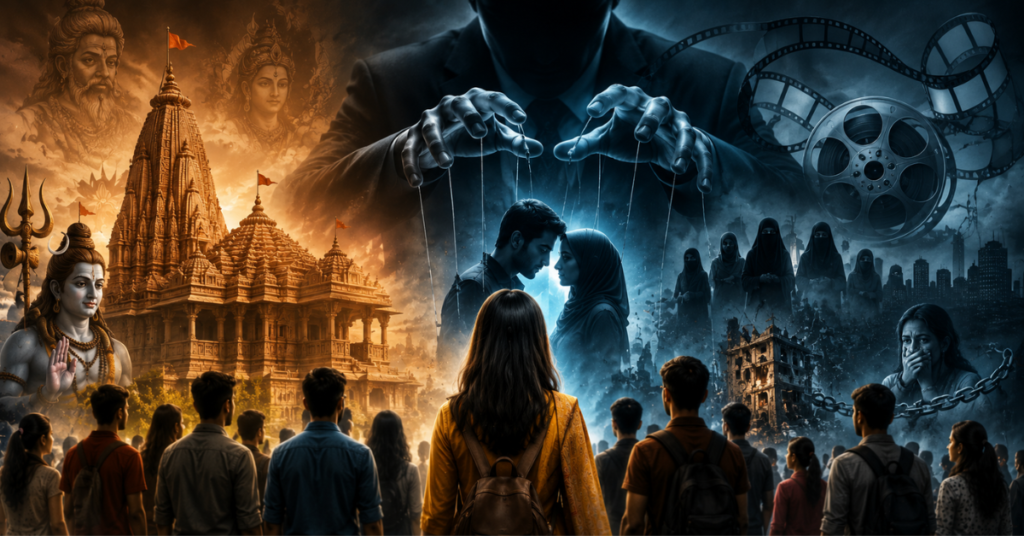
- This comprehensive political and sociological analysis presents a fact-based examination of decades-old narratives, screenwriting, and social messaging in Indian cinema (specifically Bollywood).
- The analysis exposes how mainstream cinema not only systematically associated the symbols, language, and characters of Sanatan Dharma with negativity but also laid the ideological foundation (the originating point) for sensitive social traps like ‘Love Jihad’.
- By portraying Hindu families and parents as orthodox, regressive, and anti-modern while depicting Muslim youth and their families as highly cultured, wealthy, modern, and sophisticated, films subtly brainwashed the subconscious minds of young Hindu women.
- Behind this polished and glamorized silver screen, grim ground realities—such as forced religious conversion, the subjugation of the burqa, polygamy, physical and mental torture, and even brutal murder in cases of non-compliance—were consistently covered up.
- This article urges society to recognize that cinema is not reality but a highly polished, artificial, and exaggerated narrative designed for commercial entertainment, calling on viewers to step out of this deceptive trap and wake up to these real-world challenges.
Cinema is Not Just Entertainment, It is a Battlefield of the Subconscious Mind
- In any vibrant society, cinema is never merely a source of entertainment; it is the most powerful medium shaping a community’s ideological fabric, values, and culture. The nature of the audio-visual medium is such that it strikes directly at the human subconscious mind.
- Unfortunately, if the history of Indian cinema—particularly Bollywood—is analyzed with an objective and critical eye, a highly damaging, one-sided narrative emerges over the decades.
- This is neither a matter of mere creative freedom nor a series of coincidences. It is a well-structured ideological apparatus designed to systematically criminalize, demean, and ridicule the religious identity, language, and sacred symbols of the majority Hindu society. When a society repeatedly witnesses its own faith portrayed in a negative light on screen, it gradually begins to alienate itself from its roots.
- The time has come to unmask the patterns behind this ideological, linguistic, and cultural colonialism.
1. The Cinematic Origin of ‘Love Jihad’: Deceptive Portrayals and Brainwashing
Bollywood did not stop at targeting religious symbols; it constructed a dangerous social and demographic narrative to influence the minds of young Hindu women—a phenomenon society today recognizes as ‘Love Jihad’. The following patterns were utilized on screen to condition these young minds:
- The False Facade of Modernity and Sophistication: For decades, films consistently portrayed Muslim male characters as exceptionally modern, smart, polite, sensitive, and progressive. Their families were depicted as highly cultured, liberal, and affluent, where women supposedly enjoyed immense freedom.
- Negative Depiction of Hindu Families: Conversely, Hindu parents and Hindu society were routinely shown as backward, orthodox, narrow-minded, and oppressive toward their daughters’ freedom. The Hindu parents of the protagonist were almost always cast in negative or antagonistic roles to breed resentment and alienation among young Hindu women toward their own families and culture.
- Concealing Grim Realities: In this glossy, manufactured cinematic world, the horrifying ground realities faced by thousands of victims were completely erased. Films never depicted the post-marriage trauma of forced conversion, the restrictions of the burqa, polygamy, systematic physical and mental abuse, or sexual exploitation. In reality, whenever victims attempt to assert their religious freedom or refuse to comply (non-compliance), they are often subjected to extreme physical torture, social isolation, and in many tragic cases, brutal murder.
2. Linguistic and Idiomatic Distortion: The Game of Slandering Sanatan Culture
Language is the backbone of any civilization. Bollywood reshaped the idioms, proverbs, and popular vocabulary of Hindi cinema to automatically link criminality and immorality with Hindu traditions.
- The Hinduization of Sin and Lust: Terms like “Gunaahon ka Devta” (God of Sins) or “Havas ka Pujari” (Priest of Lust) were deeply normalized in everyday vocabulary, as if sin and lust were exclusive domains of Hindu religious figures (such as Devta or Pujari). History is a testament to the historical atrocities and moral transgressions committed by religious zealots and invaders, yet terms like “Priest of Lust” were never countered with phrases like “Maulana of Lust” or “Peer of Sins” in mainstream discourse.
- Selective Proverbs: Slogans and idioms like “Muh mein Ram, bagal mein chhuri” (Ram on the tongue, a knife in the pocket) or “Ram naam japna, paraya maal apna” (Chanting Ram’s name while pocketing others’ wealth) became the standard labels for any fraudster. This is despite the glaring historical reality that mass plunder, land-grabbing, and the capture of women under the banner of theological slogans have been a long-standing historical phenomenon. Yet, these harsh realities were never allowed to shape popular idioms or cinematic discourse.
3. Depiction of the Villain: Tilak and Rudraksha vs. Religious Virtue
Through visual representation, films conditioned the audience to view any character sporting traditional Hindu symbols with suspicion.
- Criminalization of Sanatan Symbols: If one looks at films from the 1970s, 80s, and 90s, the primary villain—whether a rapist, corrupt landlord, smuggler, or black marketer—was almost always shown sporting a large tilak on his forehead, wearing heavy gold chains or rudraksha beads, and chanting “Ram-Ram” or “Shiv-Shiv” while committing heinous crimes.
- Glorification of Other Religious Characters: In stark contrast, characters named ‘Rahim Chacha’ or ‘Rahman Bhai’—even if involved in crime due to some tragic circumstance—were invariably depicted as compassionate, deeply honest, devout five-time namazis, and the epitome of morality. Similarly, Christian priests (Fathers) were presented as saviors of orphans and messengers of peace, while Hindu ascetics, sadhus, or priests (pandits) were consistently painted as greedy, cunning, or superstitious.
- One-Sided Miracles: Films frequently showed supernatural miracles associated with symbols like ‘Badge No. 786’ or sacred shrines (mazars) saving the protagonist’s life. Meanwhile, sacred Hindu symbols—such as the janeu (sacred thread), kalawa (holy wrist band), or trishul—were ridiculed as signs of backwardness and blind faith.
4. Ideological Bias in Screenwriting: Ridiculing Temples and Faith
Bollywood scripts operated on a rigid, highly predictable formula when it came to depicting crime scenes and character behavior.
- Temples as Centers of Crime: Why was every illegal deal, smuggling plot, or kidnapping conspiracy plotted in the inner sanctum or backyard of an ancient temple? Was a mosque or a church ever depicted as a hub for arms smuggling, drug trafficking, or organized crime?
- Monopoly on Spiritual Exploitation: According to these films, the only person capable of exploiting people through blind faith is a tilak-wearing Hindu priest or godman. Mainstream cinema systematically censored and hid the real-world social issues of forced conversions carried out under the guise of fake miracles by missionaries, or superstitions spread by clerics.
- Mocking Sacred Deities: Sri Yamaraj (the God of Justice) and Sri Chitragupta (the keeper of deeds) were routinely reduced to buffoons, caricature figures, and objects of cheap comedy. No filmmaker ever dared to show such mockery toward the sacred figures, prophets, or symbols of other religions.
5. The Linguistic Divide: The Narrative of Pure Hindi vs. Urdu
Cinema also created a subtle, deep division at the linguistic level, seeking to render the native language inferior.
- The Language of the Villain: In older films, whenever a character spoke highly pure, literary, and Sanskritized Hindi, he was almost always a cruel villain, an exploitative landlord, or a greedy accountant (munim). This conditioned audiences to associate pure Hindi with regressive, malicious, and untrustworthy behavior.
- The Language of the Hero: The hero, on the other hand, spoke Urdu-infused, English-mixed, or highly colloquial Hindustani, which was projected as a symbol of progressiveness, sophistication, and modernity. This selective use of language bred a sense of linguistic inferiority among the younger generation toward their own mother tongue.
Time to Recognize Reality as a Viewer
- As viewers, many have failed to realize that movies are not based on realities; they are highly polished, exaggerated, and fabricated stories created solely for commercial entertainment to extract your money and time.
- However, when these polished narratives are used to inject ideological poison into society, brainwash the youth, and destroy the lives of our daughters, maintaining silence becomes suicidal.
- If we genuinely wish to protect our culture, sovereignty, and national identity, we must become highly vigilant and critical of the cinematic content we consume. It is essential to reject and boycott films, web series, and actors who thrive by demeaning Sanatan symbols and manipulating social narratives.
- Only when the collective consciousness of the audience awakens to reject such agenda-driven content will we see a genuine transformation in the creative industry, allowing the true, glorious heritage of Indian culture to shine on screen
🇮🇳 Jai Bharat, Vandematram 🇮🇳
Read our previous blogs 👉 Click here
Join us on Arattai 👉 Click here
👉Join Our Channels👈