Summary
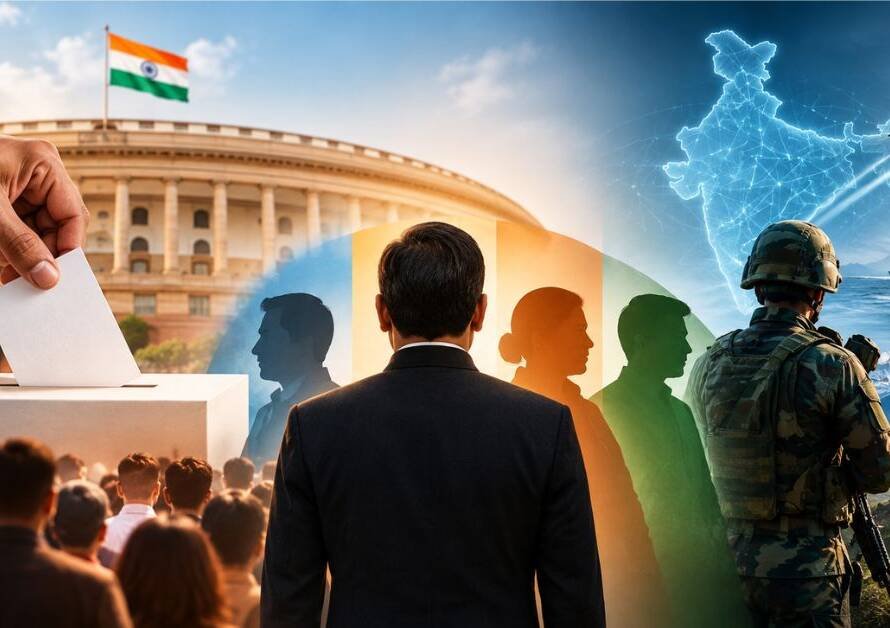
- This extensive political analysis evaluates the systemic vulnerabilities of India’s electoral framework and the historical trajectory of caste-and-minority-driven identity politics.
- It highlights how regional and dynastic factions successfully consolidated power for decades under the protection of a specialized, protective socio-political ecosystem.
- Furthermore, this article deeply analyzes the paradigm-shifting strategies instituted by the BJP under Prime Minister Narendra Modi—such as scaling nationwide vote shares beyond the critical 40% threshold, mobilizing women as an independent political class, and neutralizing divisive ‘caste censuses’ by invoking ‘caste pride.’
Finally, the piece exposes the current ideological gridlock and recurring strategic self-sabotage plaguing the opposition
From Caste Appeasement to Nationwide Social Engineering
I. The First-Past-The-Post (FPTP) System and the Inception of Political Laziness
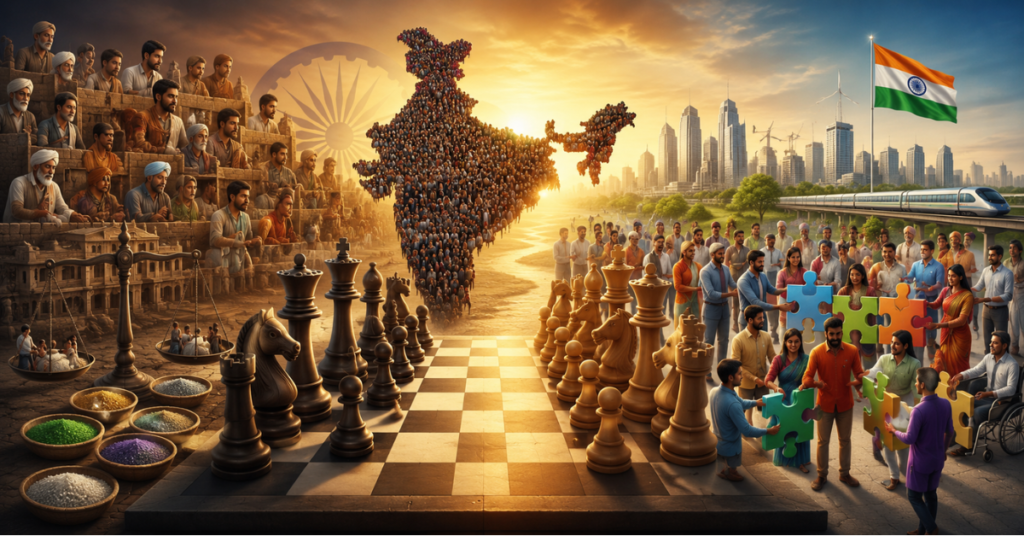
The foundational architecture of India’s electoral democracy dictates that a victorious candidate does not require an absolute majority (50% or more) of the total votes cast. Whosoever secures even a single vote more than the closest runner-up is declared the winner. Recognizing this constitutional nuance, opposition parties historically adopted a shortcut model of identity politics.
- The Game of Limited Mandates: Political factions realized they did not need to govern for 100% of society. By mathematically combining minority groups with a few specific caste blocks, they could construct a predictable 25% to 30% ‘core vote bank’—a threshold entirely sufficient to capture state power.
- The Rise of the Minority Veto: Under this structural model, cohesive minority voting blocs became the ultimate gatekeepers of power, frequently voting en bloc. Consequently, the aspirations, grievances, and cultural identities of the broader majority population were systemically marginalized.
- The Cultivation of Artificial Coalitions: This systemic political laziness birthed hollow, transactional caste-minority arithmetic, such as the MY (Muslim-Yadav), AJGAR (Ahir, Jat, Gujjar, Rajput), and MAJGAR equations. To this day, legacy regional outfits like the Samajwadi Party (SP) and Rashtriya Janata Dal (RJD) rely on these outdated playbooks to survive.
- The Hypocrisy of Divisive Alliances: Rhetoric like the ‘Jai Bhim–Jai Meem’ narrative represents the absolute peak of this cynical manipulation. It attempts to forge an unnatural, short-term electoral coalition between Dalits and minorities solely for immediate seat gains, completely hollowed of any genuine intent for long-term grassroots upliftment.
II. Mandal Politics and the Implicit Protection of ‘Elite Intelligentsia’
The ultimate paradox of Indian political history is that the very identity-driven, hyper-fragmented politics that fractured society into microscopic interest groups received its moral and intellectual cover from the self-styled ‘intelligentsia’ class.
- V.P. Singh’s Mandal Gambit: Former Prime Minister V.P. Singh institutionalized backward-class identity politics (the Mandal Commission) primarily as a tactical maneuver to neutralize the growing political influence of Chaudhary Devi Lal. This gambit pushed Indian society into a seemingly endless spiral of caste rivalries, the socio-economic costs of which the nation bears to this day.
- The Rise of Regional Satraps: The true beneficiaries of V.P. Singh’s tactical board game were regional leaders like Mulayam Singh Yadav and Lalu Prasad Yadav. Under the banner of backward-class empowerment, they constructed highly insular, family-run dynastic empires, exercising absolute hegemony over North Indian politics for nearly two decades.
- The Symbolic Inauthenticity of the New Wave: In subsequent years, modern actors like Arvind Kejriwal adopted a modified version of this playbook. Emerging from an anti-corruption crusade, his apparatus rapidly pivoted to traditional minority and specific caste alignments. The strategic backdrops of specific icons in offices and promotional posters are not expressions of genuine reverence, but calculated symbolism designed to court distinct caste and regional voter bases.
- The Shielding Power of the Lutyens Ecosystem: This entire network of caste mobilization was consistently legitimized under the attractive banner of ‘Social Justice’ by elite lawyers, left-wing academicians, and Delhi’s Lutyens journalists. This ecosystem effectively masked the reality that the fruits of this ‘justice’ were strictly confined to a handful of ruling political dynasties.
III. The BJP’s Vote Share Transformation: Shattering the 25% Glass Ceiling
The foundational difference between the BJP of the Vajpayee-Advani era and the contemporary Modi-led party lies in the absolute baseline of its national vote share. This transformation shifted the BJP from an entity reliant on complex coalitions to a singular, dominant political force.
- The Constraints of the Vajpayee-Advani Era: During that period, the BJP was primarily categorized as an urban, upper-caste centric organization, with its national vote share plateauing around 25% or lower. Consequently, even amidst massive public anger following the 2008 Mumbai terror attacks, L.K. Advani could not propel the BJP to victory in the 2009 general elections, allowing the Congress to retain power with just a 28% vote share.
- The Modi Phenomenon and the 40% Benchmark: Prime Minister Narendra Modi dismantled these structural boundaries completely. He scaled the party’s national vote share to 37–38%, pushing it well past 42–45% in core states like Uttar Pradesh and Madhya Pradesh. By doing so, he re-positioned the BJP as the definitive choice for the impoverished, the marginalized, and indigenous tribal communities.
- The Definitive Lessons of 2024: The 2024 Lok Sabha results in Uttar Pradesh demonstrated that even a 40% vote share at the state level no longer guarantees total victory. With the Samajwadi Party (43.52%) and the BJP (43.69%) finishing virtually neck-and-neck in popular vote, the BJP suffered notable seat losses. Because minority voting blocks consolidate heavily against the BJP, the party recognized that absolute electoral dominance demands the structural integration of every other societal segment.
IV. Hijacking Opposition Weapons: The BJP’s Advanced Social Engineering
When the opposition attempted to corner the ruling party by demanding a ‘Caste Census’—essentially trying to initiate a Mandal-2.0 wave—the BJP altered the rules of engagement entirely rather than playing on traditional identity territory.
- The West Bengal Paradigm Shift: This strategic evolution was clearly evident in recent electoral cycles in West Bengal. The BJP breached the Trinamool Congress’s (TMC) fortress by mobilizing a massive 46% vote share. It achieved this by focusing heavily on historically neglected sub-demographics, such as the Vanvasi (Tribal) and Matua communities, who had been systematically ignored by both the Left and the TMC.
- The Silent Vanguard—Women Voters: To systematically dilute traditional caste lines, the BJP has successfully cultivated ‘Women’ as a distinct, organized, and hyper-aware voting bloc. Schemes like Ujjwala, PM Awas Yojana, free grain security, and targeted cash transfers have insulated women from traditional, male-dominated household caste allegiances, aligning them directly with the Narendra Modi brand.
- Caste Counting vs. Caste Pride: While the opposition seeks to divide society by counting individual castes, the BJP is weaving these groups together by systematically elevating their historical, cultural, and regional pride.
- The Co-option of Cultural Nationalism: State-level celebrations honoring icons like Bhagwan Birsa Munda (Tribal Pride), Raja Suheldev (Pasi and Rajbhar Pride), Sant Shiromani Ravidas (Dalit Pride), the sacrifices of the Sikh Gurus, Maharana Pratap, and Chhatrapati Shivaji Maharaj are not mere history lessons. They send a powerful message to these communities that their cultural legacy is safe within a broader nationalist umbrella, rather than under opposition appeasement models.
V. The Opposition’s Ideological Gridlock and Strategic Self-Sabotage
The core crisis facing leaders like Rahul Gandhi, Akhilesh Yadav, Lalu Prasad, and Mamata Banerjee is that their strategic architecture remains firmly trapped in the political realities of the 1990s. They have failed to comprehend a rapidly evolving, aspirational India.
- Disconnect from Grassroots Realities: Instead of expanding their reach through rigorous grassroots organizing or alternative policy frameworks, the opposition relies primarily on short-term tactics. They focus on attacking Prime Minister Modi’s personal image, questioning the neutrality of the Election Commission, and relying on aggressive social media campaigns to win elections.
- Playing on the BJP’s Preferred Territory: The opposition consistently forces national conversations on issues where the BJP holds an undeniable ideological and strategic advantage.
- Counterproductive Rhetoric: On matters concerning Veer Savarkar, the Rashtriya Swayamsevak Sangh (RSS), and the Ram Mandir, political prudence would dictate either silence or a measured approach. Instead, the opposition’s frequent, aggressive rhetorical attacks on these institutions ultimately consolidate the majority vote bank, inadvertently benefiting the BJP.
- Outdated Secularism Narratives: The opposition remains tethered to an outdated playbook that seeks to brand the BJP as purely ‘communal’ or ‘anti-Dalit.’ This narrative loses its efficacy when everyday citizens from marginalized or backward communities experience the direct, leak-free delivery of central welfare infrastructure.
- Indian politics has evolved past the point where a simple coalition of one or two castes alongside a minority bloc can guarantee a path to national power.
- The BJP has successfully blunted the opposition’s caste-division strategies by cultivating cultural pride, while simultaneously neutralizing minority vetoes through mass polarization and the mobilization of women voters.
- Until the opposition pivots away from purely negative campaigns, complaints over Electronic Voting Machines (EVMs), and reliance on external, divisive narratives, it will continue to find itself outmatched on this modern, highly strategic political playing field.
🇮🇳 Jai Bharat, Vandematram 🇮🇳
Read our previous blogs 👉 Click here
Join us on Arattai 👉 Click here
👉Join Our Channels👈